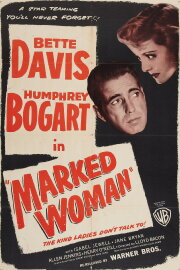
In this roman-a-clef for the infamous Lucky Luciano Trial, Mary Dwight and four roommates work as hostesses at the Club Intime, a "clip joint" that offers gambling, liquor, and female companionship to the "big spender" clientèle. When ruthless thug and pimp Johnny Vanning takes over all the clubs in town, the girls are forced to follow Vanning's rules and kick back on their "tips" in exchange for protection. Although she is not a hardened old hand like Gabby and Estella, Mar... (Full plot summary below)
Enjoy FREE movies and series with your Prime (USA) subscription or when you start a 30-day free trial!
| Movie Source | Available | Offers | Added | Views | Quality | Format | Rating | Link | Share |
|---|---|---|---|---|---|---|---|---|---|
 | UK only | 1 Month Free Trial | 20 Dec 2017 | 5637 | HD | Watch OnlineStream Instantly | 84% |  Report: Broken Link Report: Broken Link |   |
| USA only | 1 Month Free Trial | 25 Jul 2013 | 6724 | HD | Watch OnlineStream Instantly | 93% | Report: Broken Link | |
| IRELAND only | 1 Month Free Trial | 11 Aug 2017 | 5628 | HD | Watch OnlineStream Instantly | 94% | Report: Broken Link | |
 | UK only | 30 Day Free Trial | 07 Jun 2022 | 738 | HD | Watch OnlineStream Instantly | 96% | Report: Broken Link | |
![Its HD [Marked Woman]](/images/logos/icons/itshd.png) | WORLDWIDE | ? | 16 Mar 2016 | 3718 | HD | Watch OnlineStream Instantly | 96% | Report: Broken Link | |
 | UK only | 30 Day Free Trial | 24 Dec 2017 | 547 | HD | Watch OnlineStream Instantly | 58% | Report: Broken Link | |
 | UK only | Free Credit | 27 Sep 2013 | 139 | HD | Watch OnlineStream Instantly | 48% | Report: Broken Link | |
 | WORLDWIDE | ? | 07 Jun 2020 | 78 | HD | Watch OnlineStream Instantly | 25% | Report: Broken Link | |
 | WORLDWIDE | ? | 16 Jun 2014 | 18 | SD / TV | Watch OnlineStream Instantly | 23% | Report: Broken Link | |
 | WORLDWIDE | ? | 01 Jul 2025 | 222 | HD | Watch OnlineStream Instantly | 16% | Report: Broken Link | |
 | WORLDWIDE | ? | 09 Jan 2022 | 38 | SD / TV | Watch OnlineStream Instantly | 9% | Report: Broken Link | |
Links compiled using automated software. Availability of offers subject to change / might be region specific / out of date.
| Movie Source | Available | Offers | Added | Views | Quality | Format | Rating | Link | Share |
|---|---|---|---|---|---|---|---|---|---|
| UK only | 30 Day Free Trial | 26 Jan 2022 | 259 | SD / DVD | DVD RentalRent by Post | 61% |  Report: Broken Link Report: Broken Link | |
 | UK only | N/A | 26 Jan 2022 | 50 | SD / DVD | DVD RentalRent by Post | 31% | Report: Broken Link | |
 | USA only | 1 Month Free Trial | 26 Jan 2022 | 185 | SD / DVD | DVD RentalRent by Mail | 20% | Report: Broken Link | |
| USA only | 1 Month Free Trial | 26 Jan 2022 | 14224 | SD / DVD | DVD RentalRent by Mail | 84% | Report: Broken Link | |
| Movie Source | Available | Offers | Added | Views | Quality | Format | Rating | Link | Share |
|---|---|---|---|---|---|---|---|---|---|
| UK only | 30 Day Free Trial | 28 Jan 2013 | 323 | HD / BR | Blu Ray RentalRent by Post | 66% | Report: Broken Link | |
| UK only | N/A | 28 Jan 2013 | 110 | HD / BR | Blu Ray RentalRent by Post | 15% | Report: Broken Link | |
| USA only | 1 Month Free Trial | 26 Jan 2022 | 361 | HD / BR | Blu Ray RentalRent by Mail | 12% | Report: Broken Link | |
| USA only | 1 Month Free Trial | 28 Jan 2013 | 4674 | HD / BR | Blu Ray RentalRent by Mail | 99% | Report: Broken Link | |
In this roman-a-clef for the infamous Lucky Luciano Trial, Mary Dwight and four roommates work as hostesses at the Club Intime, a "clip joint" that offers gambling, liquor, and female companionship to the "big spender" clientèle. When ruthless thug and pimp Johnny Vanning takes over all the clubs in town, the girls are forced to follow Vanning's rules and kick back on their "tips" in exchange for protection. Although she is not a hardened old hand like Gabby and Estella, Mary knows enough to sidestep Vanning's amorous advances. Unfortunately the more naive Mary Lou is impressed by Vanning's oily veneer of materialism and accepts invitations to "entertain" at the gangster's private parties. Mary's naive younger sister Betty arrives from college just when Mary and her roommates are arrested as material witnesses in the murder of one of the casino's non-paying customers. Vanning's corrupt lawyer frees the others but pressures Mary to commit perjury in order to discredit crusading District Attorney David Graham. Disillusioned by her sister's lifestyle. Betty consents to accompany Emmy Lou to one of Vanning's private parties where the gangster ends up killing her for not submitting to the advances of one of the party's guests. Mary decides to tell the truth to the D.A., and is beaten to disfigurement by one of Vanning's hoods. Even so, Mary agrees to testify - and at her bedside, all the other hostesses decide to follow her example in the coming hearing.
Leave your thoughts about Marked Woman.
| Classic Film and TelevisionMichael E. GrostCrime melodrama benefits from the usual hard-hitting Warners approach, good cast, and a shrewd look at class and the collaboration of the educated and uneducated. |
| User ReviewJeannette WOne of my fav Bette Davis movies in which she plays a 'clip joint hostess' in gambling joints run by the mob. Bette plays Mary Dwight, girl who keeps one step ahead and knows all the angles until she gets into a jam that leads to tragic circumstances. The movie also stars Humphrey Bogart as a crusading D.A. and his real-life wife at the time, Mayo Methot as the over-the-hill hostess, Estelle. The movie is based on the life events of Lucky Luciano who was indicted because of testimonies of prostitutes. |
| User ReviewZoë PExcellent movie! I love Bette Davis, I wish people still made movies this good. |
| User ReviewTodd NThis is a pre-feminist feminist story. While Bogart is the male lead, Bette Davis is the star and hero as an escort for the mob whose sister is killed by them. The secondary leads are the other escorts. This is a story about standing up against fear, the establishment, and it's a story of courage and sisterhood. It's really great to see that progressive thinking isn't a new thing. |
| User ReviewJohn DBette Davis is a powerhouse in this amazing film. |
| User ReviewCaleb MEven Holly Golightly Only Got Fifty Bucks for the Powder Room It was kind of hard doing a certain kind of crime drama during the era of the Code. It isn't even just the whole thing about how you couldn't have the criminals as good guys and how Crime Does Not Pay. It was also the case, in the days of the Code, that certain crimes were forbidden material for Hollywood films. In the case of this particular story, a fictionalization of the downfall of Lucky Luciano, the problem is that Luciano was convicted of running a major prostitution ring. Thomas Dewey, best known for not defeating Harry Truman for President in 1948, made a fine hero, but the problem was that his witnesses were guilty of crimes you couldn't actually portray onscreen in 1937. This means that there's a lot of talking around, not to mention putting in crimes which you can talk about which are often inevitable consequences of any kind of organized crime. It also, however, means that the reason these "hostesses" are given hundred-dollar bills by random strangers is left a little vague. Bette Davis is Mary Dwight Strauber, though she just calls herself Mary Dwight. She works as a "hostess" in the nightclub of the notorious Johnny Vanning (Eduardo Ciannelli). Vanning runs what is called a "clip joint," a place where people are ludicrously overcharged for food and drink, often lured to it by hostesses promising what's not on the menu. One night, Ralph Krawford (Damian O'Flynn) writes a bad check to cover his debts. Mary takes pity on him, but it's too late. Johnny has his men kill Krawford. That gets Crusading Attorney David Graham (Humphrey Bogart) involved. He wants to prosecute Johnny, and he wants it bad. But Mary knows that there's no life out there for a "hostess" who turned in her employer, so she essentially throws her testimony. Only the whole thing means her sister, Betty (Jane Bryan), finds out what Mary does for a living, and what with one thing and another, Betty ends up at a party where she's hopelessly out of her depth, gets into a fight about what, exactly, she should be doing for that hundred-dollar bill, and takes a tumble down a flight of stairs. Mary is, in fact, the marked woman of the title. After her sister disappears, last seen at one of Johnny's parties, she goes to David Graham for help. Johnny, as you might figure, does not take this well. He doesn't dirty his hands himself; he doesn't ever dirty his hands himself. However, he has his men beat Mary half to death--and then cut an X into her face to show that she double-crossed Johnny Vanning and paid the penalty. It's pretty grim stuff, and Davis handles the part well. Better, indeed, than the studio wanted. This was before the days when the easiest way to an Oscar was to tone down the glamour. (Though the winners that year weren't far gone from that theory.) They wanted the bandages to be small and discreet, nothing which would detract from the beauty of their star. Bette Davis knew they were missing the point, and she insisted her doctor put the bandages on her that he would a woman who had suffered what Mary did--and then insisted that she be filmed wearing them. This was an unusual role for Bogart, of course--he played the good guy. Well enough; don't get me wrong. Bogart may have excelled at the heavy, but he didn't exactly always play villains. However, if you were to describe the plot of this to someone who knew old movies in general but not this one in particular, they would most likely assume that Bogart played Johnny Vanning. He and Bette Davis actually made several movies together, including of course his breakout role in [i]The Petrified Forest[/i], but they were mostly before he was a major star. It might also be surprising to people to learn that, therefore, he's really playing second fiddle at best. A later Bogart movie would probably involve the Crusading Attorney's being the main character, and he simply isn't here. Arguably, he is just a tool for Mary's use, by the end of things, and that's not what modern audiences expect of Bogart. One of the reasons the women accept the life they lead is that they know there aren't a whole lot of options out there for them. Mary has hidden her life from her sister. She is sending Betty to school, though she doesn't ever say so, because she wants Betty to be part of a better world than Mary ever will. It isn't even just the prospect of a rich husband--definitely never mentioned but almost certainly considered by Mary, if not Betty. It is also that education is its own power. If Mary finished high school, it's probably more than Emmy Lou (Isabel Jewell) did. If David Graham is Mary's tool, it is no less true that Mary and the others are his. What's more, he is the one who decides when the tool's use is over. He does consider a future for Mary, though he'd have to choose between her and politics, I think, but he does not consider one for the other women. Whatever fate they go to, they go to it alone. |
| User ReviewBob VA few friends and I are doing a Bette Davis retrospective, slowly working our way through all of Davis's films from the 1930s and 1940s. The biggest surprise so far is two relatively unknown films she did in 1937: "Marked Woman" and "Kid Galahad." Both are available from Netflix in pristine DVD pressings. They are an absolute delight and come highly recommended. They aren't great works of art, but they're two of the best traditional melodramas you'll ever see. The films have some similarity. In both, Davis plays a young woman from a lower-class background struggling to make a living in the criminal underground. "Marked Woman" is particularly daring, in that she plays a prostitute battling the mob kingpin for whom she works. It's a stark and tough work, conveying the sense that if one is born on the wrong side of the tracks, one is probably doomed to stay there the rest of one's life. The director was Lloyd Bacon, who also directed "42nd Street" a few years earlier. "Kid Galahad" is class-conscious but not quite so darkly. Davis plays sidekick to a crooked boxing promoter (Edward G. Robinson), and both are lower-class young people trying to survive as best they can. Robinson's character is presented forthrightly as the child of immigrants. There is one long scene where he talks to his mother in fluent Italian, and there aren't any subtitles. This was a joy to see in a mainstream Hollywood movie. I can't imagine how much it must have meant to Italian audiences of that era. Davis's character falls in love with the new boxer they are promoting, whom she dubs Kid Galahad. Twenty-three-year-old Wayne Morris positively melts the screen as the boxer. In one of the most touching and non-actorly performances I've ever seen, the largely untrained Morris plays the character from his heart. His physical beauty (Rudy Valentino good looks and an Olympian body) is matched by his homespun kindness. You can feel Bette Davis falling in love with Morris in every scene they have together. Michael Curtiz, who would in later years bring us "Casablanca" and "Mildred Pierce," among many other films, directed "Kid Galahad." Coincidentally, Humphrey Bogart has a supporting role in both "Marked Woman" and "Kid Galahad," as does Jane Bryan. If you haven't seen a movie from Hollywood's golden era in a while, these are two titles that will surely not disappoint. Note on Davis: Nineteen thirty-seven was the year Bette Davis hit her stride. She first caught attention in 1934 for her Oscar-nominated tour de force in "Of Human Bondage" opposite Leslie Howard. She followed that up by winning the first of her two Oscars in 1935 for "Dangerous." By 1937, she was soaring, becoming a major box-office attraction. In 1938, she won her second and final Oscar for "Jezebel." It's hard to believe that an actor of her stature would only win two Oscars (out of 11 total nominations). But then again, Meryl Streep has only won two (out of a total 16 nominations). |
| User ReviewMomin KThis reminded me a lot of On the Waterfront, the stories are very similar. I love On the Waterfront, but this movie was good too. Whats different about it is that it focuses more on the fact that women should stand up for themselves when men are pushing them around. It's really pretty feminist for the thirties. Plus it stars Davis and Bogart, so if you're a fan of either of them you wont want to miss this movie. |
| User ReviewDawni CA well written script played out wonderfully by an outstanding cast. Bette Davis continues her streak of strong characters and brilliant performances. |
| User ReviewNelly Ba good classic gangster-law court drama, inspired by Lucky Luciano's demise. |