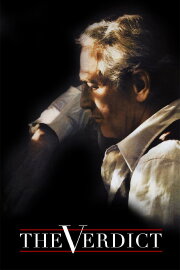
Frank Galvin was once a promising Boston lawyer with a bright future ahead. An incident early in his career in which he was trying to do the right thing led to him being fired from the prestigious law firm with which he was working, almost being disbarred, and his wife leaving him. Continually drowning his sorrows in booze, he is now an ambulance-chasing lawyer, preying on the weak and vulnerable, and bending the truth whenever necessary to make what few dollars he has, as he... (Full plot summary below)
Enjoy FREE movies and series with your Prime (USA) subscription or when you start a 30-day free trial!
| Movie Source | Available | Offers | Added | Views | Quality | Format | Rating | Link | Share |
|---|---|---|---|---|---|---|---|---|---|
 | UK only | 1 Month Free Trial | 05 Aug 2013 | 3787 | HD | Watch OnlineStream Instantly | 69% |  Report: Broken Link Report: Broken Link |   |
| USA only | 1 Month Free Trial | 03 Dec 2017 | 6050 | HD | Watch OnlineStream Instantly | 76% | Report: Broken Link | |
| IRELAND only | 1 Month Free Trial | 28 Jun 2023 | 5076 | HD | Watch OnlineStream Instantly | 93% | Report: Broken Link | |
 | UK only | 30 Day Free Trial | 17 Sep 2020 | 390 | HD | Watch OnlineStream Instantly | 90% | Report: Broken Link | |
![Its HD [The Verdict]](/images/logos/icons/itshd.png) | WORLDWIDE | ? | 18 Feb 2026 | 3238 | HD | Watch OnlineStream Instantly | 90% | Report: Broken Link | |
 | UK only | 30 Day Free Trial | 15 Aug 2013 | 210 | HD | Watch OnlineStream Instantly | 59% | Report: Broken Link | |
 | UK only | Free Credit | 02 Jun 2023 | 149 | HD | Watch OnlineStream Instantly | 43% | Report: Broken Link | |
 | WORLDWIDE | ? | 19 Sep 2022 | 123 | HD | Watch OnlineStream Instantly | 33% | Report: Broken Link | |
 | WORLDWIDE | ? | 16 Nov 2019 | 15 | SD / TV | Watch OnlineStream Instantly | 24% | Report: Broken Link | |
 | WORLDWIDE | ? | 30 Dec 2021 | 227 | HD | Watch OnlineStream Instantly | 34% | Report: Broken Link | |
 | WORLDWIDE | ? | 05 Feb 2020 | 16 | SD / TV | Watch OnlineStream Instantly | 16% | Report: Broken Link | |
Links compiled using automated software. Availability of offers subject to change / might be region specific / out of date.
| Movie Source | Available | Offers | Added | Views | Quality | Format | Rating | Link | Share |
|---|---|---|---|---|---|---|---|---|---|
| UK only | 30 Day Free Trial | 17 Feb 2025 | 2122 | SD / DVD | DVD RentalRent by Post | 91% |  Report: Broken Link Report: Broken Link | |
 | UK only | N/A | 17 Feb 2025 | 37 | SD / DVD | DVD RentalRent by Post | 51% | Report: Broken Link | |
 | USA only | 1 Month Free Trial | 17 Feb 2025 | 48 | SD / DVD | DVD RentalRent by Mail | 16% | Report: Broken Link | |
| USA only | 1 Month Free Trial | 17 Feb 2025 | 9344 | SD / DVD | DVD RentalRent by Mail | 87% | Report: Broken Link | |
| Movie Source | Available | Offers | Added | Views | Quality | Format | Rating | Link | Share |
|---|---|---|---|---|---|---|---|---|---|
| UK only | 30 Day Free Trial | 05 Dec 2016 | 251 | HD / BR | Blu Ray RentalRent by Post | 85% | Report: Broken Link | |
| UK only | N/A | 05 Dec 2016 | 91 | HD / BR | Blu Ray RentalRent by Post | 18% | Report: Broken Link | |
| USA only | 1 Month Free Trial | 17 Feb 2025 | 290 | HD / BR | Blu Ray RentalRent by Mail | 5% | Report: Broken Link | |
| USA only | 1 Month Free Trial | 05 Dec 2016 | 2549 | HD / BR | Blu Ray RentalRent by Mail | 83% | Report: Broken Link | |
Frank Galvin was once a promising Boston lawyer with a bright future ahead. An incident early in his career in which he was trying to do the right thing led to him being fired from the prestigious law firm with which he was working, almost being disbarred, and his wife leaving him. Continually drowning his sorrows in booze, he is now an ambulance-chasing lawyer, preying on the weak and vulnerable, and bending the truth whenever necessary to make what few dollars he has, as he has only had a few cases in the last few years, losing the last four. His only friend in the profession is his now retired ex-partner, Mickey Morrissey, who gets Frank a case, his fee solely a percentage of what his clients are awarded. The case should net Frank tens of thousands of dollars by settling out of court, that money which would at least get him back on his feet. It is a negligence suit brought on behalf of Deborah Ann Kaye by her sister and brother-in-law, Sally and Kevin Doneghy, against St. Catherine Labouré Hospital, operated by the Archdiocese of Boston, and Drs. Towler and Marks. Kaye was admitted to the hospital for what should have been a routine delivery, but something that happened while Kaye was on the operating room table led to her brain being deprived of oxygen, resulting in permanent brain damage, and Kaye now being in a totally vegetative state requiring hospitalization for the rest of her life. Frank eventually learns that the cause seems to be that Dr. Towler, the anesthesiologist and an expert in the field, used the incorrect anesthetic for the situation. However, all but one person that was in the operating room that day has provided depositions that nothing improper occurred in the operating room. The one holdout is the operating room head nurse, Maureen Rooney, who is not talking, period, to Frank or the other side. Upon seeing the state Kaye is in, Frank unilaterally decides to do what he believes is the right thing by declining the lucrative out-of-court settlement offered by the Archdiocese and take the case to court. In doing so, he hopes the truth that the hospital and the doctors truly were negligent comes to light. Feeling that this case may be a turning point in his life, Frank has a new spring in his step, enough that he attracts the attention of Laura Fischer, the two who begin a relationship. Despite having whatever the truth is on his side, that truth which he does not know, and having an expert witness of his own, Frank has an uphill battle in that the Archdiocese has retained the services of Ed Concannon, a high-priced lawyer who has a large team of associates whose task is to help Concannon and the Archdiocese win at any cost. Concannon's task seems even easier as Judge Hoyle, the presiding judge, is already biased against Frank for taking the case to court.
Leave your thoughts about The Verdict.
| Chicago Sun-TimesRoger EbertThe screenplay by David Mamet is a wonder of good dialogue, strongly seen characters and a structure that pays off in the big courtroom scene - as the genre requires. |
| FulvueDrive-in.comChuck O'LearyNewman gives a brilliant performance in this powerful David and Goliath tale of a sad man's quest for redemption in the face of despair. Newman, director Lumet and the film itself all should have won an Academy Award, but sadly didn't. |
| The New York TimesJanet MaslinA solidly old-fashioned courtroom drama such as The Verdict could have gotten by with a serious, measured performance from its leading man, or it could have worked well with a dazzling movie-star turn. The fact that Paul Newman delivers both makes a clever, suspenseful, entertaining movie even better. |
| The A.V. ClubJessse HassengerThough screenwriter David Mamet writes some chewy lines, director Sidney Lumet balances out any pulpiness with a somber mood, making sparing use of the musical score and creating a Boston awash in brown, beige, and gray. |
| The Associated PressBob ThomasIf you were presenting a case for Newman’s legacy of acting brilliance, this film would be exhibit A. |
| IGNScott ColluraWhat was boring and dull to our 12-year-old selves back when Dad was watching this film 25 years ago is now a thoroughly engrossing and satisfying film experience, and a reminder that what is old can be new again -- whether it's Newman's Galvin's outlook on life, an old courtroom drama premise, or a movie revisited after a quarter century lapse. |
| The New RepublicStanley KauffmannThis is realistic American film acting at its veristic/imaginative best. |
| Movie MetropolisJames PlathCount me among those who think the Best Actor Oscar that Paul Newman won for "The Color of Money" was a make-up call. The groundwork was laid right here in "The Verdict," and with the equally accomplished "Absence of Malice" a year earlier. |
| Kalamazoo GazetteJames SanfordO.K. courtroom drama, electrified by great Newman performance |
| Matt's Movie ReviewsMatthew PejkovicWhen a movie contains names as Paul Newman, David Mamet and Sidney Lumet, it is hard not to have high hopes. Yet The Verdict meets these aspirations, and in the process presents some of the best work by these three revered figures of American cinema. |