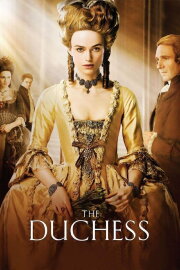
Georgiana Spencer became Duchess of Devonshire on her marriage to the Duke in 1774, at the height of the Georgian period, a period of fashion, decadence, and political change. Spirited and adored by the public at large she quickly found her marriage to be a disappointment, defined by her duty to produce a male heir and the Duke's philandering and callous indifference to her. She befriends Lady Bess but finds she is once again betrayed by her husband who wields his power with ... (Full plot summary below)
FREE with your Prime (USA) subscription or when you start a 30-day free trial!
| Movie Source | Available | Offers | Added | Views | Quality | Format | Rating | Link | Share |
|---|---|---|---|---|---|---|---|---|---|
 | UK only | 1 Month Free Trial | 27 Dec 2016 | 3340 | HD | Watch OnlineStream Instantly | 80% |  Report: Broken Link Report: Broken Link |   |
| USA only | 1 Month Free Trial | 23 Oct 2024 | 2131 | HD | Watch OnlineStream Instantly | 80% | Report: Broken Link | |
| IRELAND only | 1 Month Free Trial | 03 Sep 2013 | 1708 | HD | Watch OnlineStream Instantly | 88% | Report: Broken Link | |
 | UK only | 30 Day Free Trial | 22 Dec 2019 | 1041 | HD | Watch OnlineStream Instantly | 98% | Report: Broken Link | |
![Its HD [The Duchess]](/images/logos/icons/itshd.png) | WORLDWIDE | ? | 31 Jul 2013 | 3564 | HD | Watch OnlineStream Instantly | 92% | Report: Broken Link | |
 | UK only | 30 Day Free Trial | 26 Sep 2014 | 141 | HD | Watch OnlineStream Instantly | 37% | Report: Broken Link | |
 | UK only | Free Credit | 01 Jun 2019 | 145 | HD | Watch OnlineStream Instantly | 44% | Report: Broken Link | |
 | WORLDWIDE | ? | 29 Jun 2020 | 86 | HD | Watch OnlineStream Instantly | 16% | Report: Broken Link | |
 | WORLDWIDE | ? | 26 Jul 2024 | 26 | SD / TV | Watch OnlineStream Instantly | 26% | Report: Broken Link | |
 | WORLDWIDE | ? | 17 Apr 2017 | 244 | HD | Watch OnlineStream Instantly | 14% | Report: Broken Link | |
 | WORLDWIDE | ? | 10 Apr 2022 | 11 | SD / TV | Watch OnlineStream Instantly | 15% | Report: Broken Link | |
Links compiled using automated software. Availability of offers subject to change / might be region specific / out of date.
| Movie Source | Available | Offers | Added | Views | Quality | Format | Rating | Link | Share |
|---|---|---|---|---|---|---|---|---|---|
| UK only | 30 Day Free Trial | 25 Nov 2019 | 3182 | SD / DVD | DVD RentalRent by Post | 75% |  Report: Broken Link Report: Broken Link | |
 | UK only | N/A | 25 Nov 2019 | 37 | SD / DVD | DVD RentalRent by Post | 16% | Report: Broken Link | |
 | USA only | 1 Month Free Trial | 25 Nov 2019 | 188 | SD / DVD | DVD RentalRent by Mail | 13% | Report: Broken Link | |
| USA only | 1 Month Free Trial | 25 Nov 2019 | 2464 | SD / DVD | DVD RentalRent by Mail | 87% | Report: Broken Link | |
| Movie Source | Available | Offers | Added | Views | Quality | Format | Rating | Link | Share |
|---|---|---|---|---|---|---|---|---|---|
| UK only | 30 Day Free Trial | 04 Jul 2017 | 161 | HD / BR | Blu Ray RentalRent by Post | 82% | Report: Broken Link | |
| UK only | N/A | 04 Jul 2017 | 108 | HD / BR | Blu Ray RentalRent by Post | 26% | Report: Broken Link | |
| USA only | 1 Month Free Trial | 25 Nov 2019 | 336 | HD / BR | Blu Ray RentalRent by Mail | 8% | Report: Broken Link | |
| USA only | 1 Month Free Trial | 04 Jul 2017 | 7961 | HD / BR | Blu Ray RentalRent by Mail | 92% | Report: Broken Link | |
Georgiana Spencer became Duchess of Devonshire on her marriage to the Duke in 1774, at the height of the Georgian period, a period of fashion, decadence, and political change. Spirited and adored by the public at large she quickly found her marriage to be a disappointment, defined by her duty to produce a male heir and the Duke's philandering and callous indifference to her. She befriends Lady Bess but finds she is once again betrayed by her husband who wields his power with the three eventually living uncomfortably together. Against this background, and with the pressures of an unfaithful husband, strict social pressures and constant public scrutiny, Georgiana falls passionately in love with Charles Grey, a rising young Whig politician. However, despite his ongoing liaison with Lady Bess, the Duke refuses to allow her to continue the affair and threatens to take her children from her.
Leave your thoughts about The Duchess.
| Chicago Sun-TimesRoger EbertThis is not one of those delightful movies based on a Jane Austen novel. It is about hard realists, constrained in a stifling system and using whatever weapons they can command. |
| The A.V. ClubNoel MurrayThoroughly populist and middlebrow, full of all the high wigs, thick powder, perfect diction, and straightforward dialogue that define bodice-ripping prestige pictures about silently suffering souls. |
| TimeRichard SchickelThe players are uniformly good, but a special word must be said for Fiennes, whose portrayal of physical awkwardness and painful taciturnity never begs either for laughs or for sympathy. |
| Entertainment WeeklyLisa SchwarzbaumFiennes speaks with his body what the script cannot formulate about what it's like to be a man apart. The actor creates particulars of time, space, class, and personality with one crook of a finger, one twist of a wrist. I call that nobility of craft; he's the actors' prince. |
| Los Angeles TimesKenneth TuranEven surrounded by all this quality work, Ralph Fiennes, who plays William Cavendish, the fifth duke of Devonshire, the most powerful man in England next to the king, walks off with the picture. |
| New York Magazine (Vulture)David EdelsteinAn uncommonly well-crafted historical feminist tearjerker--both anti-patriarchal and a monument to motherhood. |
| Chicago ReaderJ.R. JonesThis is scandal-mongering fun that also lays bare the deforming power of the male aristocracy. |
| Rolling StonePeter TraversIt's Knightley who makes The Duchess a royal treat. |
| Charlotte ObserverLawrence ToppmanIf you're fond of wigs, you may be in heaven. If you're more interested in Whigs, you may wish the movie had dug deeper under the lovely powdered surface of Lady Georgiana Spencer. |
| USA TodayClaudia PuigPrincess Diana's antecedent, both genetically and figuratively, was a beautiful and glamorous duchess named Georgiana Spencer. Like her descendant, her charm and vivacity captivated England. |