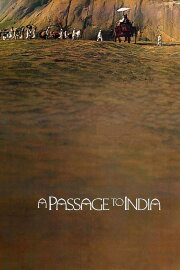
It's the early 1920s. Britons Adela Quested (Judy Davis) and her probable future mother-in-law Mrs. Moore (Peggy Ashcroft) have just arrived in Chandrapore in British India to visit Adela's unofficial betrothed, Ronny Heaslop (Nigel Havers), who works there as the city's magistrate. Adela and Mrs. Moore, who long for "an adventure" in experiencing all India has to offer, are dismayed to learn upon their arrival that the ruling British do not socialize, let alone associate, wi... (Full plot summary below)
Enjoy FREE movies and series with your Prime (USA) subscription or when you start a 30-day free trial!
| Movie Source | Available | Offers | Added | Views | Quality | Format | Rating | Link | Share |
|---|---|---|---|---|---|---|---|---|---|
 | UK only | 1 Month Free Trial | 05 Feb 2013 | 3069 | HD | Watch OnlineStream Instantly | 81% |  Report: Broken Link Report: Broken Link |   |
| USA only | 1 Month Free Trial | 06 Jul 2024 | 5800 | HD | Watch OnlineStream Instantly | 92% | Report: Broken Link | |
| IRELAND only | 1 Month Free Trial | 05 Feb 2017 | 2188 | HD | Watch OnlineStream Instantly | 96% | Report: Broken Link | |
 | UK only | 30 Day Free Trial | 11 Aug 2024 | 681 | HD | Watch OnlineStream Instantly | 78% | Report: Broken Link | |
![Its HD [A Passage to India]](/images/logos/icons/itshd.png) | WORLDWIDE | ? | 20 Jan 2014 | 3550 | HD | Watch OnlineStream Instantly | 86% | Report: Broken Link | |
 | UK only | 30 Day Free Trial | 25 Jun 2022 | 648 | HD | Watch OnlineStream Instantly | 35% | Report: Broken Link | |
 | UK only | Free Credit | 30 Apr 2013 | 130 | HD | Watch OnlineStream Instantly | 45% | Report: Broken Link | |
 | WORLDWIDE | ? | 01 Dec 2023 | 101 | HD | Watch OnlineStream Instantly | 28% | Report: Broken Link | |
 | WORLDWIDE | ? | 04 Jan 2025 | 19 | SD / TV | Watch OnlineStream Instantly | 16% | Report: Broken Link | |
 | WORLDWIDE | ? | 15 Jan 2022 | 169 | HD | Watch OnlineStream Instantly | 7% | Report: Broken Link | |
 | WORLDWIDE | ? | 20 Sep 2015 | 18 | SD / TV | Watch OnlineStream Instantly | 18% | Report: Broken Link | |
Links compiled using automated software. Availability of offers subject to change / might be region specific / out of date.
| Movie Source | Available | Offers | Added | Views | Quality | Format | Rating | Link | Share |
|---|---|---|---|---|---|---|---|---|---|
| UK only | 30 Day Free Trial | 18 Jul 2024 | 1775 | SD / DVD | DVD RentalRent by Post | 68% |  Report: Broken Link Report: Broken Link | |
 | UK only | N/A | 18 Jul 2024 | 110 | SD / DVD | DVD RentalRent by Post | 45% | Report: Broken Link | |
 | USA only | 1 Month Free Trial | 18 Jul 2024 | 167 | SD / DVD | DVD RentalRent by Mail | 19% | Report: Broken Link | |
| USA only | 1 Month Free Trial | 18 Jul 2024 | 12196 | SD / DVD | DVD RentalRent by Mail | 92% | Report: Broken Link | |
| Movie Source | Available | Offers | Added | Views | Quality | Format | Rating | Link | Share |
|---|---|---|---|---|---|---|---|---|---|
| UK only | 30 Day Free Trial | 28 Sep 2023 | 271 | HD / BR | Blu Ray RentalRent by Post | 90% | Report: Broken Link | |
| UK only | N/A | 28 Sep 2023 | 59 | HD / BR | Blu Ray RentalRent by Post | 40% | Report: Broken Link | |
| USA only | 1 Month Free Trial | 18 Jul 2024 | 789 | HD / BR | Blu Ray RentalRent by Mail | 18% | Report: Broken Link | |
| USA only | 1 Month Free Trial | 28 Sep 2023 | 10447 | HD / BR | Blu Ray RentalRent by Mail | 86% | Report: Broken Link | |
It's the early 1920s. Britons Adela Quested (Judy Davis) and her probable future mother-in-law Mrs. Moore (Peggy Ashcroft) have just arrived in Chandrapore in British India to visit Adela's unofficial betrothed, Ronny Heaslop (Nigel Havers), who works there as the city's magistrate. Adela and Mrs. Moore, who long for "an adventure" in experiencing all India has to offer, are dismayed to learn upon their arrival that the ruling British do not socialize, let alone associate, with the native population. Such people as the Turtons, Mr. Turton (Richard Wilson) being Ronny's superior, who openly thumb their noses at the idea in their belief that the Indians are an inferior people. They are further dismayed to see that Ronny adheres to that custom in not wanting to jeopardize his career. At the local white only club, Adela and Mrs. Moore find a like-minded Brit in the form of Richard Fielding (James Fox), the school master at government college, he who offers to organize a small, but truly inclusive, social gathering with some natives for them, unlike the large party the Turtons organize, where the natives are treated poorly, and are used more as window dressing for Adela and Mrs. Moore's benefit. In addition to Fielding's colleague, eccentric Brahmin scholar Professor Narayan Godbole (Sir Alec Guinness), Adela, and Mrs. Moore would like to invite Aziz Ahmed (Victor Banerjee), a young, widowed local physician with whom Mrs. Moore had a chance encounter. As Mrs. Moore is the first Brit who has ever treated him with kindness as she did at that encounter, Aziz is happy to attend. As Aziz wants to impress them by being what he thinks they want him to be, which is more western, he offers to organize an outing for this small collective to the Marabar Caves, which has some renown. The outing is despite Aziz never having been to the caves himself, and despite the expense to himself, that sum of money which he really can ill afford. Something that happens at the caves has the potential to bring the British-Indian bridge that has been forged within this small collective come crumbling down, that something which also threatens Aziz and Adela's lives in the process.
Leave your thoughts about A Passage to India.
| Chicago Sun-TimesRoger EbertForster's novel is one of the literary landmarks of this century, and now David Lean has made it into one of the greatest screen adaptations I have ever seen. |
| Video-Reviewmaster.comSteve CrumEpic, briliantly photographed, but slow David Lean drama. |
| The New York Review of BooksNoel AnnanThe spirit of the book has vanished and its strange music cannot be heard. The movie is lovely but earthbound. |
| Groucho ReviewsPeter CanaveseLean's visually appealing film frequently connects as a social satire and a mystical melodrama of transgressors looking for footholds in psychically threatening territory. |
| New York TimesVincent CanbyThe film is very much 'a full theatrical meal,' and one that conveys a lot of 'the multiplicity of life' one seldom sees on the screen these days. |
| Chicago ReaderDave KehrDavid Lean's studied, plodding, overanalytic direction manages to kill most of the meaning in E.M. Forster's haunting novel of cultural collision in colonial India. |
| Spirituality and PracticeFrederic and Mary Ann BrussatA literary riddle that every viewer is challenged to decipher in light of his or her own perception of human passion and prejudice. |
| Empire MagazineIan NathanThe film, for all Lean's innate elegance, is strangely remote and unmoving. It could easily have been a Merchant-Ivory film. |
| Apollo GuideBrian WebsterRegardless of what one thinks of David Lean and his old fashioned style, the results here - save perhaps for the casting of Alec Guinness as a Hindu professor - are exquisite. |
| User ReviewGary BThis was pure heaven for me tonight. H-e-a-v-e-n. |