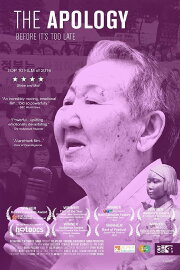
The Apology follows the personal journeys of three former "comfort women" who were among the 200,000 girls and young women kidnapped and forced into military sexual slavery by the Imperial Japanese Army during World War II. Some 70 years after their imprisonment in so-called "comfort stations", the three "grandmothers-Grandma Gil in South Korea, Grandma Cao in China, and Grandma Adela in the Philippines-face their twilight years in fading health. After decades of living in si... (Full plot summary below)
Enjoy FREE movies and series with your Prime (USA) subscription or when you start a 30-day free trial!
| Movie Source | Available | Offers | Added | Views | Quality | Format | Rating | Link | Share |
|---|---|---|---|---|---|---|---|---|---|
 | UK only | 1 Month Free Trial | 24 Feb 2023 | 3932 | HD | Watch OnlineStream Instantly | 66% |  Report: Broken Link Report: Broken Link |   |
| USA only | 1 Month Free Trial | 24 Mar 2022 | 6440 | HD | Watch OnlineStream Instantly | 71% | Report: Broken Link | |
| IRELAND only | 1 Month Free Trial | 26 Sep 2025 | 3578 | HD | Watch OnlineStream Instantly | 82% | Report: Broken Link | |
 | UK only | 30 Day Free Trial | 26 Aug 2018 | 677 | HD | Watch OnlineStream Instantly | 100% | Report: Broken Link | |
![Its HD [The Apology]](/images/logos/icons/itshd.png) | WORLDWIDE | ? | 08 Sep 2018 | 3251 | HD | Watch OnlineStream Instantly | 86% | Report: Broken Link | |
 | UK only | 30 Day Free Trial | 19 Feb 2018 | 673 | HD | Watch OnlineStream Instantly | 54% | Report: Broken Link | |
 | UK only | Free Credit | 17 Jun 2019 | 157 | HD | Watch OnlineStream Instantly | 35% | Report: Broken Link | |
 | WORLDWIDE | ? | 26 Jan 2020 | 185 | HD | Watch OnlineStream Instantly | 17% | Report: Broken Link | |
 | WORLDWIDE | ? | 16 Apr 2022 | 16 | SD / TV | Watch OnlineStream Instantly | 23% | Report: Broken Link | |
 | WORLDWIDE | ? | 20 Sep 2023 | 253 | HD | Watch OnlineStream Instantly | 31% | Report: Broken Link | |
 | WORLDWIDE | ? | 27 Feb 2015 | 10 | SD / TV | Watch OnlineStream Instantly | 6% | Report: Broken Link | |
Links compiled using automated software. Availability of offers subject to change / might be region specific / out of date.
| Movie Source | Available | Offers | Added | Views | Quality | Format | Rating | Link | Share |
|---|---|---|---|---|---|---|---|---|---|
| UK only | 30 Day Free Trial | 03 Jul 2016 | 2033 | SD / DVD | DVD RentalRent by Post | 75% |  Report: Broken Link Report: Broken Link | |
 | UK only | N/A | 03 Jul 2016 | 26 | SD / DVD | DVD RentalRent by Post | 32% | Report: Broken Link | |
 | USA only | 1 Month Free Trial | 03 Jul 2016 | 231 | SD / DVD | DVD RentalRent by Mail | 18% | Report: Broken Link | |
| USA only | 1 Month Free Trial | 03 Jul 2016 | 15557 | SD / DVD | DVD RentalRent by Mail | 80% | Report: Broken Link | |
| Movie Source | Available | Offers | Added | Views | Quality | Format | Rating | Link | Share |
|---|---|---|---|---|---|---|---|---|---|
| UK only | 30 Day Free Trial | 21 May 2019 | 229 | HD / BR | Blu Ray RentalRent by Post | 90% | Report: Broken Link | |
| UK only | N/A | 21 May 2019 | 31 | HD / BR | Blu Ray RentalRent by Post | 34% | Report: Broken Link | |
| USA only | 1 Month Free Trial | 03 Jul 2016 | 769 | HD / BR | Blu Ray RentalRent by Mail | 3% | Report: Broken Link | |
| USA only | 1 Month Free Trial | 21 May 2019 | 8278 | HD / BR | Blu Ray RentalRent by Mail | 89% | Report: Broken Link | |
The Apology follows the personal journeys of three former "comfort women" who were among the 200,000 girls and young women kidnapped and forced into military sexual slavery by the Imperial Japanese Army during World War II. Some 70 years after their imprisonment in so-called "comfort stations", the three "grandmothers-Grandma Gil in South Korea, Grandma Cao in China, and Grandma Adela in the Philippines-face their twilight years in fading health. After decades of living in silence and shame about their past, they know that time is running out to give a first-hand account of the truth and ensure that this horrific chapter of history is not forgotten. Whether they are seeking a formal apology from the Japanese government or summoning the courage to finally share their secret with loved ones, their resolve moves them forward as they seize this last chance to set future generations on a course for reconciliation, healing, and justice.
Leave your thoughts about The Apology.
| Globe and MailKate TaylorAs women age they become invisible to society; what is heartrendingly inspiring about The Apology is the grandmothers' steadfast refusal to disappear. |
| Spirituality and PracticeFrederic and Mary Ann BrussatA timely and important documentary about the courage of three elderly survivors of sexual slavery and their quest for justice. |
| National PostChris KnightHsiung clearly wanted to focus on several specific individuals, whose good humour and perseverance shine through in The Apology. It is one thing to talk about thousands of victims; quite another to look into the eyes of just three. |
| NOW TorontoSusan G. ColeFuelled by the deep personal relationships she developed with three women over five years, first-time director Tiffany Hsiung gives these courageous survivors their voice. |
| The Film StageTony HindsAlternately enraging and sorrowful, Hsiung's film sheds much needed light on a powerful and deeply important story of injustice. |
| San Francisco ChronicleG. Allen JohnsonThe stories told by these women are tough and unflinching. Yet "The Apology" is ultimately a film of strength and hope, not of nihilism. These are truly wonder women. |
| FF2 MediaNora Lee MandelExpands public's knowledge about WW2-era "comfort women" enslaved by Japanese Army...Emotional wallop surmounts unclear political negotiations and confusing organization. |
| Film InquiryTara MartinezHsiung's film is composed of a series of gut-wrenching scenes. As each of the women recalls her experience in striking detail, the audience is asked to relive the raw emotion with her. |
| Prairie Dog Magazine Jorge CastilloThe Apology does a superb job depicting these women's lives and how are they coping. It's not as effective from a journalistic perspective. |