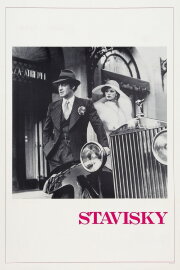
Irrestisible charm and talent help Serge Alexandre alias Stavisky, small-time swindler, to make friends with even the most influential members of the French industrial and political elite during the early '30s. But nothing lasts forever and when his great scam involving hundreds millions of francs gets exposed, the result is an unprecedented scandal that almost caused a civil war.... (Full plot summary below)
Enjoy FREE movies and series with your Prime (USA) subscription or when you start a 30-day free trial!
| Movie Source | Available | Offers | Added | Views | Quality | Format | Rating | Link | Share |
|---|---|---|---|---|---|---|---|---|---|
 | UK only | 1 Month Free Trial | 05 Jun 2026 | 5252 | HD | Watch OnlineStream Instantly | 73% |  Report: Broken Link Report: Broken Link |   |
| USA only | 1 Month Free Trial | 06 Mar 2026 | 5215 | HD | Watch OnlineStream Instantly | 94% | Report: Broken Link | |
| IRELAND only | 1 Month Free Trial | 21 Mar 2023 | 3176 | HD | Watch OnlineStream Instantly | 91% | Report: Broken Link | |
 | UK only | 30 Day Free Trial | 25 Nov 2014 | 1002 | HD | Watch OnlineStream Instantly | 93% | Report: Broken Link | |
![Its HD [Stavisky...]](/images/logos/icons/itshd.png) | WORLDWIDE | ? | 01 Nov 2024 | 3575 | HD | Watch OnlineStream Instantly | 95% | Report: Broken Link | |
 | UK only | 30 Day Free Trial | 11 Jun 2017 | 487 | HD | Watch OnlineStream Instantly | 41% | Report: Broken Link | |
 | UK only | Free Credit | 14 Nov 2025 | 125 | HD | Watch OnlineStream Instantly | 38% | Report: Broken Link | |
 | WORLDWIDE | ? | 29 Dec 2016 | 47 | HD | Watch OnlineStream Instantly | 20% | Report: Broken Link | |
 | WORLDWIDE | ? | 21 Mar 2013 | 18 | SD / TV | Watch OnlineStream Instantly | 24% | Report: Broken Link | |
 | WORLDWIDE | ? | 25 Jan 2017 | 295 | HD | Watch OnlineStream Instantly | 18% | Report: Broken Link | |
 | WORLDWIDE | ? | 21 Apr 2023 | 11 | SD / TV | Watch OnlineStream Instantly | 17% | Report: Broken Link | |
Links compiled using automated software. Availability of offers subject to change / might be region specific / out of date.
| Movie Source | Available | Offers | Added | Views | Quality | Format | Rating | Link | Share |
|---|---|---|---|---|---|---|---|---|---|
| UK only | 30 Day Free Trial | 22 Aug 2022 | 1089 | SD / DVD | DVD RentalRent by Post | 77% |  Report: Broken Link Report: Broken Link | |
 | UK only | N/A | 22 Aug 2022 | 71 | SD / DVD | DVD RentalRent by Post | 11% | Report: Broken Link | |
 | USA only | 1 Month Free Trial | 22 Aug 2022 | 212 | SD / DVD | DVD RentalRent by Mail | 13% | Report: Broken Link | |
| USA only | 1 Month Free Trial | 22 Aug 2022 | 7336 | SD / DVD | DVD RentalRent by Mail | 79% | Report: Broken Link | |
| Movie Source | Available | Offers | Added | Views | Quality | Format | Rating | Link | Share |
|---|---|---|---|---|---|---|---|---|---|
| UK only | 30 Day Free Trial | 29 Aug 2021 | 237 | HD / BR | Blu Ray RentalRent by Post | 86% | Report: Broken Link | |
| UK only | N/A | 29 Aug 2021 | 85 | HD / BR | Blu Ray RentalRent by Post | 15% | Report: Broken Link | |
| USA only | 1 Month Free Trial | 22 Aug 2022 | 765 | HD / BR | Blu Ray RentalRent by Mail | 6% | Report: Broken Link | |
| USA only | 1 Month Free Trial | 29 Aug 2021 | 2916 | HD / BR | Blu Ray RentalRent by Mail | 99% | Report: Broken Link | |
Irrestisible charm and talent help Serge Alexandre alias Stavisky, small-time swindler, to make friends with even the most influential members of the French industrial and political elite during the early '30s. But nothing lasts forever and when his great scam involving hundreds millions of francs gets exposed, the result is an unprecedented scandal that almost caused a civil war.
Leave your thoughts about Stavisky....
| Chicago Sun-TimesRoger EbertLike Charles Foster Kane, Alexandre Stavisky is a man of intriguing parts that make up any number of wholes. |
| New York TimesNora SayreA spell-casting mood piece that is also factually frustrating. |
| National ReviewArmond WhiteResnais and Semprún's themes are pleasure, happiness, riches, death, and the past -- as envisaged in the stylized recall of fancy-dressed individuals and the nation. |
| Easy Reader (California)Neely SwansonOne might even go so far as to say that this is an excellent example of style over substance. |
| Antagony & EcstasyTim BraytonQuite a pleasure it it is to unpack, and more of a pleasure when there's something genuinely worthwhile inside of it all. |
| Ozus' World Movie ReviewsDennis SchwartzIt's a stylishly glowing film, shimmering with both romantic images and haunting visions. |
| rec.arts.movies.reviewsDragan AntulovA failed film, but attractive and interesting enough to earn the attention of all lovers of non-conventional cinema. |
| User ReviewArt SUn bon petit film de ganster comme il ne s' en fait plus. Un bon Belmondo. |
| User ReviewJack GNot exactly emotionally engaging to the fullest, but I was always interested. This story of a conman is elevated by Resnais direction and the writing from the late Jorge Semprun. The narrative structure takes a couple minutes to get into, and I'm still not entirely sure what Trotsky (yes, the one and only) is doing in the plot entirely except as a backdrop of the period and how Stavisky, I think, ultimately ties in with him being deported from the country to get out of his already asylyumed state. But the two main characters here are Belmondo, super charming as always but here his bullshit-artiste type from Breathless is given more of a dose of reality and even psychological realism, and Stephen Sondheim's score, which comes in from time to time almost too insistently, like a melodramatic friend asking to amp up a walk down a hallway or a tracking shot (though, damn, don't those tracking shots get lovelier with Sondheim's strings and horns backing things up). We want to see where this guy will go and how far he can take his schemes because we know there is ruin lying ahead. I think there was a point about midway through where I was getting somewhat restless, as to the thought 'Resnais and Semprun and company have shown us this character, his very sleazy yet undoubtedly charming way of being around people, but where will it go now, what will the movie do to keep things interesting'. And in its own way it becomes more interesting than just being a series of 'how will he get out of this' as it is 'it's time for the downfall, let's hear what his associates, doctor, lawyer, the love he didn't really have - that was the one thing in the film that, while nice and had certain, brief sensual mood, was underdeveloped - had to say ala Citizen Kane. And another fascination comes with bringing the theater itself into it. Stavisky/Alex could have made just a wonderful actor, maybe a protege of Stanislavski, but he decided to take it into the real world as opposed to just the stage, where he could read lines next to other actors but not as confidently as in a fine suit and cigar giving our fake money. Maybe that explains, in a metaphorical part, the Trotsky thing, since Stavisky himself was from Russia too: the best way to subvert Capitalism, perhaps, is to just make a mockery of it, fuck the system and get away with millions and millions, always with a smile and courtesy. It's a moody, entertaining ride, the French-socio-historical-political flipside of something like The Sting, also from the same time. |
| User ReviewJeremiah LIt's not necessarily bad, but nothing happened that I found remotely interesting. |