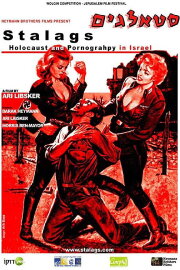
Stalags were pocket books whose plots revealed lusty female SS officers sexually abusing camp prisoners. During the 1960s, parallel to the trial held against Nazi war criminal Adolf Eichmann, sales of this pornographic literature broke all records in Israel and hundreds of thousands of copies were sold at kiosks. The popularity of the Stalags only declined after a much-reported trial, in which their authors were accused of distributing anti-Semitic pornography. This film exam... (Full plot summary below)
Enjoy FREE movies and series with your Prime (USA) subscription or when you start a 30-day free trial!
| Movie Source | Available | Offers | Added | Views | Quality | Format | Rating | Link | Share |
|---|---|---|---|---|---|---|---|---|---|
 | UK only | 1 Month Free Trial | 14 Jun 2019 | 5023 | HD | Watch OnlineStream Instantly | 81% |  Report: Broken Link Report: Broken Link |   |
| USA only | 1 Month Free Trial | 27 Nov 2019 | 6068 | HD | Watch OnlineStream Instantly | 89% | Report: Broken Link | |
| IRELAND only | 1 Month Free Trial | 01 Nov 2016 | 4126 | HD | Watch OnlineStream Instantly | 69% | Report: Broken Link | |
 | UK only | 30 Day Free Trial | 19 Sep 2017 | 1035 | HD | Watch OnlineStream Instantly | 82% | Report: Broken Link | |
![Its HD [Stalags]](/images/logos/icons/itshd.png) | WORLDWIDE | ? | 28 Jan 2022 | 3727 | HD | Watch OnlineStream Instantly | 90% | Report: Broken Link | |
 | UK only | 30 Day Free Trial | 12 Feb 2026 | 724 | HD | Watch OnlineStream Instantly | 44% | Report: Broken Link | |
 | UK only | Free Credit | 10 Jan 2016 | 175 | HD | Watch OnlineStream Instantly | 52% | Report: Broken Link | |
 | WORLDWIDE | ? | 17 Jul 2015 | 88 | HD | Watch OnlineStream Instantly | 22% | Report: Broken Link | |
 | WORLDWIDE | ? | 01 Jun 2025 | 13 | SD / TV | Watch OnlineStream Instantly | 23% | Report: Broken Link | |
 | WORLDWIDE | ? | 29 Feb 2016 | 100 | HD | Watch OnlineStream Instantly | 33% | Report: Broken Link | |
 | WORLDWIDE | ? | 21 Apr 2022 | 31 | SD / TV | Watch OnlineStream Instantly | 10% | Report: Broken Link | |
Links compiled using automated software. Availability of offers subject to change / might be region specific / out of date.
| Movie Source | Available | Offers | Added | Views | Quality | Format | Rating | Link | Share |
|---|---|---|---|---|---|---|---|---|---|
| UK only | 30 Day Free Trial | 11 Nov 2023 | 774 | SD / DVD | DVD RentalRent by Post | 85% |  Report: Broken Link Report: Broken Link | |
 | UK only | N/A | 11 Nov 2023 | 108 | SD / DVD | DVD RentalRent by Post | 62% | Report: Broken Link | |
 | USA only | 1 Month Free Trial | 11 Nov 2023 | 186 | SD / DVD | DVD RentalRent by Mail | 8% | Report: Broken Link | |
| USA only | 1 Month Free Trial | 11 Nov 2023 | 14379 | SD / DVD | DVD RentalRent by Mail | 96% | Report: Broken Link | |
| Movie Source | Available | Offers | Added | Views | Quality | Format | Rating | Link | Share |
|---|---|---|---|---|---|---|---|---|---|
| UK only | 30 Day Free Trial | 20 Dec 2018 | 290 | HD / BR | Blu Ray RentalRent by Post | 62% | Report: Broken Link | |
| UK only | N/A | 20 Dec 2018 | 110 | HD / BR | Blu Ray RentalRent by Post | 10% | Report: Broken Link | |
| USA only | 1 Month Free Trial | 11 Nov 2023 | 653 | HD / BR | Blu Ray RentalRent by Mail | 14% | Report: Broken Link | |
| USA only | 1 Month Free Trial | 20 Dec 2018 | 6493 | HD / BR | Blu Ray RentalRent by Mail | 86% | Report: Broken Link | |
Stalags were pocket books whose plots revealed lusty female SS officers sexually abusing camp prisoners. During the 1960s, parallel to the trial held against Nazi war criminal Adolf Eichmann, sales of this pornographic literature broke all records in Israel and hundreds of thousands of copies were sold at kiosks. The popularity of the Stalags only declined after a much-reported trial, in which their authors were accused of distributing anti-Semitic pornography. This film examines the notorious phenomenon, exposing the creators of this genre for the first time. It posits that the combination of pornography and the Holocaust also appears in canonic Holocaust litrature and continues to be a widespread part of the representation of the Holocaust in Israel today.
Leave your thoughts about Stalags.
| NewsBlazePrairie MillerEmpowerment fantasies of a decimated and injured race, a kind of post-traumatic Jewish mother syndrome, or a bit of both? The film mulls these strange notions of the politics of pornography, that would have likely sent Freud's mind into a tailspin. |
| New York PressFelicia Feaster[Director] Libsker rightfully questions how sex and sadism have become the distorting lens through which we think about the Holocaust. |
| New York TimesLaura KernStalags carries this line of inquiry forward, cramming an overwhelming amount of information and ideas into its 63 minutes -- not nearly enough time to explore satisfactorily all that it raises. |
| ReelTalk Movie ReviewsDonald J. Levit'Stalags' refuses to confront firmly the fine line at which individual or collective memory cannot distinguish myth from reality. |
| Filmcritic.comChris CabinNever less than enthusiastically fascinating |
| User ReviewLine FErotically-charged Israeli pulp with titles like "I was Colonel Schultz's Private Bitch" was some of the first widely-read narrative to deal with the Holocaust in Israel. Who knew? |
| User ReviewDalia DThis mediocre documentary seeks to shed light on the Israeli pulp fiction genre that emerged in the early 1960s, burned brightly for a few years, and quickly faded into collectors' oblivion. . . until now! These books were/are (supposedly) extremely controversial due to their plots, in which sex and dom/sub violence met against the backdrop of Nazi Germany. In these "perverted" (translation: silly) stories, American fighter pilots are beaten and raped by buxom female SS soldiers for the masturbatory delight of teen male readers who were turned on not only by the sex and violence, but by the illicit nature of reading about concentration camps (it was the era of the Eichmann trials, and until that point, there was an air of repressive mystery around the Holocaust for those born after it.) The documentary becomes tedious (even mildly annoying) when interviewees (particularly Holocaust survivors) criticize these books as evil filth, as though there is something evil (rather than human) in being aroused by the abuse so often concomitant with power relationships (Foucault would have a field day). Sexuality is a strange thing, and, in fact, the more these books are repressed and made out to be "bad," the hotter they become. More strangely, the women interviewed for this film insist that no female Jews served German soldiers as prostitutes in exchange for better treatment in camps (and/or their lives). They don't deny that there were accusations of such, but they do deny that those accusations had any grounding in reality. To propose that this never happened is naive, and to condemn a woman for making that choice is equally naive (I'm fairly certain that self-preservation is a stronger instinct than sexual and/or moral disgust). The film then takes a strange accusatory turn, explaining that some of the more prominent Stalag novels are being included (as historical documents, not literary ones) in Israeli public school curricula. This seems more than strange, if not just wildly inappropriate. While the books shouldn't be repressed, they also shouldn't be assigned (this from the girl who was made to read Monster: The Autobiography of an L.A. Gang Member as a high school sophomore). |