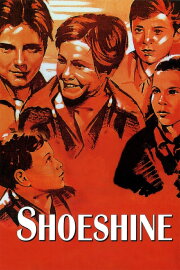
At a track near Rome, shoeshine boys are watching horses run. Two of them, the orphan Pasquale and his younger friend Giuseppe, are riding. The pair have been saving to buy their own horse. They meet Attilio, Giuse's much-older brother, and his shady friend at a boat on the Tiber. In return for a commission, the boys agree to deliver black-market goods to a fortuneteller. Once the woman has paid, Attilio's gang suddenly arrives, pretending to be cops, to shake the woman down.... (Full plot summary below)
Enjoy FREE movies and series with your Prime (USA) subscription or when you start a 30-day free trial!
| Movie Source | Available | Offers | Added | Views | Quality | Format | Rating | Link | Share |
|---|---|---|---|---|---|---|---|---|---|
 | UK only | 1 Month Free Trial | 08 Dec 2015 | 5583 | HD | Watch OnlineStream Instantly | 86% |  Report: Broken Link Report: Broken Link |   |
| USA only | 1 Month Free Trial | 04 May 2022 | 4794 | HD | Watch OnlineStream Instantly | 98% | Report: Broken Link | |
| IRELAND only | 1 Month Free Trial | 15 Jan 2015 | 3577 | HD | Watch OnlineStream Instantly | 94% | Report: Broken Link | |
 | UK only | 30 Day Free Trial | 11 Apr 2016 | 449 | HD | Watch OnlineStream Instantly | 87% | Report: Broken Link | |
![Its HD [Shoeshine]](/images/logos/icons/itshd.png) | WORLDWIDE | ? | 07 Jul 2022 | 3006 | HD | Watch OnlineStream Instantly | 93% | Report: Broken Link | |
 | UK only | 30 Day Free Trial | 03 Jan 2022 | 608 | HD | Watch OnlineStream Instantly | 44% | Report: Broken Link | |
 | UK only | Free Credit | 05 Jul 2014 | 160 | HD | Watch OnlineStream Instantly | 34% | Report: Broken Link | |
 | WORLDWIDE | ? | 08 Nov 2014 | 184 | HD | Watch OnlineStream Instantly | 17% | Report: Broken Link | |
 | WORLDWIDE | ? | 03 May 2014 | 19 | SD / TV | Watch OnlineStream Instantly | 10% | Report: Broken Link | |
 | WORLDWIDE | ? | 23 May 2018 | 144 | HD | Watch OnlineStream Instantly | 21% | Report: Broken Link | |
 | WORLDWIDE | ? | 22 Jun 2026 | 39 | SD / TV | Watch OnlineStream Instantly | 15% | Report: Broken Link | |
Links compiled using automated software. Availability of offers subject to change / might be region specific / out of date.
| Movie Source | Available | Offers | Added | Views | Quality | Format | Rating | Link | Share |
|---|---|---|---|---|---|---|---|---|---|
| UK only | 30 Day Free Trial | 29 Nov 2022 | 1278 | SD / DVD | DVD RentalRent by Post | 84% |  Report: Broken Link Report: Broken Link | |
 | UK only | N/A | 29 Nov 2022 | 59 | SD / DVD | DVD RentalRent by Post | 62% | Report: Broken Link | |
 | USA only | 1 Month Free Trial | 29 Nov 2022 | 39 | SD / DVD | DVD RentalRent by Mail | 12% | Report: Broken Link | |
| USA only | 1 Month Free Trial | 29 Nov 2022 | 16286 | SD / DVD | DVD RentalRent by Mail | 91% | Report: Broken Link | |
| Movie Source | Available | Offers | Added | Views | Quality | Format | Rating | Link | Share |
|---|---|---|---|---|---|---|---|---|---|
| UK only | 30 Day Free Trial | 14 Apr 2013 | 187 | HD / BR | Blu Ray RentalRent by Post | 86% | Report: Broken Link | |
| UK only | N/A | 14 Apr 2013 | 65 | HD / BR | Blu Ray RentalRent by Post | 20% | Report: Broken Link | |
| USA only | 1 Month Free Trial | 29 Nov 2022 | 749 | HD / BR | Blu Ray RentalRent by Mail | 6% | Report: Broken Link | |
| USA only | 1 Month Free Trial | 14 Apr 2013 | 8967 | HD / BR | Blu Ray RentalRent by Mail | 90% | Report: Broken Link | |
At a track near Rome, shoeshine boys are watching horses run. Two of them, the orphan Pasquale and his younger friend Giuseppe, are riding. The pair have been saving to buy their own horse. They meet Attilio, Giuse's much-older brother, and his shady friend at a boat on the Tiber. In return for a commission, the boys agree to deliver black-market goods to a fortuneteller. Once the woman has paid, Attilio's gang suddenly arrives, pretending to be cops, to shake the woman down. With a payoff from Attilio, the boys are able to make the final payment and stable their horse in Trastevere over the river. The fortuneteller identifies Pasqua and Giuse. Held at an overcrowded boys' prison, they are separated. Giuse falls under the influence of an older lad in his cell, Arcangeli. During interrogation, Pasqua is tricked into betraying Giuse's brother to the police. With their trial still in the future, the two friends are driven further apart.
Leave your thoughts about Shoeshine.
| TIME MagazineJames AgeeIt is filled, in every scene, with an awareness of the pitiful complexity of the causes of even simple evil. |
| EmanuelLevy.ComEmanuel LevyVittorio De Sica's second film was the first major success of the neorealistic movement and the first film to win the Best Foreign Language Oscar. |
| Old School ReviewsJohn A. NesbitShoeshine's tragedy evolves from the overall environment and system as much as it does from the individual choices the boys make. |
| User ReviewDaniel LCan't believe I'd never seen this before, but there it is. Not quite as good as Bicycle Thieves or Umberto D, but great nonetheless. |
| User ReviewAdam SAn important work in the larger development of neo-realism, with De Sica presenting the deplorable insides of a boy's prison as a sign of the rough post-war times. Both poetic and tragic, with scenes of great power and beauty, the further maturation of a master film-maker. |
| User ReviewNoel VVittorio de Sica's simple masterpiece (in my opine), about two boys and a horse, and not much else--but what a world of joy and heartbreak and tragedy those three elements include! |
| User ReviewChristopher BThe first - and rawest - of De Sica's trio of devastating neo-realist classics (with BICYCLE THIEVES and UMBERTO D.). Like the others it largely eschews didacticism regarding its very real social concerns by drawing you into its riveting story, acted out by an inspired - and largely amateur - cast. If your heart isn't broken by the time the word "Fine" is scrawled across the screen, you may want to check to see if you even have one. |
| User ReviewAdrian BTragic, disturbing and devastating portrait of how boys become outcasts in World War two scarred Italy. Great example of Italian neo-realist cinematic style. Feels like part of a trilogy with the other masterpieces Bicycle Thieves and Umberto D. , also by De Sica. An essential masterpiece. |
| User ReviewJuan David CCinema demonstrates that creativity and imagination can triumph over adversity; even in a country wounded by war. Vittorio De Sica was one of the greatest directors with the ability to capture innocence and resilience in motions pictures that depict the complete absence of human solidarity or the indifference of the global society towards suffering. |
| User ReviewIrvin CRegarded as one of the greatest films in the Italian neo-realist movement and with good reason: It's a great film. It's an absolutely heartbreaking sad tale of two boys during post-war Italy whose friendship and lives are changed forever and definitely not for the better. I would rank this alongside "Bicycle Thieves" as among De Sica's masterpieces. |