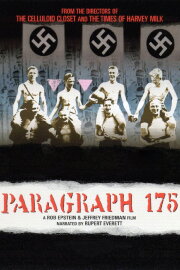
By the 1920's, Berlin had become known as a homosexual eden, where gay men and lesbians lived relatively open lives amidst an exciting subculture of artists and intellectuals. With the coming to power of the Nazis, all this changed. Between 1933 and 1945 100,000 men were arrested for homosexuality under Paragraph 175, the sodomy provision of the German penal code dating back to 1871. Some were imprisoned, others were sent to concentration camps. Of the latter, only about 4,00... (Full plot summary below)
Enjoy FREE movies and series with your Prime (USA) subscription or when you start a 30-day free trial!
| Movie Source | Available | Offers | Added | Views | Quality | Format | Rating | Link | Share |
|---|---|---|---|---|---|---|---|---|---|
 | UK only | 1 Month Free Trial | 10 May 2023 | 4284 | HD | Watch OnlineStream Instantly | 70% |  Report: Broken Link Report: Broken Link |   |
| USA only | 1 Month Free Trial | 26 Sep 2018 | 6760 | HD | Watch OnlineStream Instantly | 84% | Report: Broken Link | |
| IRELAND only | 1 Month Free Trial | 26 Oct 2020 | 2252 | HD | Watch OnlineStream Instantly | 95% | Report: Broken Link | |
 | UK only | 30 Day Free Trial | 17 Jun 2017 | 708 | HD | Watch OnlineStream Instantly | 90% | Report: Broken Link | |
![Its HD [Paragraph 175]](/images/logos/icons/itshd.png) | WORLDWIDE | ? | 11 Nov 2017 | 3244 | HD | Watch OnlineStream Instantly | 84% | Report: Broken Link | |
 | UK only | 30 Day Free Trial | 09 Aug 2016 | 553 | HD | Watch OnlineStream Instantly | 48% | Report: Broken Link | |
 | UK only | Free Credit | 12 Aug 2018 | 163 | HD | Watch OnlineStream Instantly | 44% | Report: Broken Link | |
 | WORLDWIDE | ? | 13 Apr 2025 | 109 | HD | Watch OnlineStream Instantly | 17% | Report: Broken Link | |
 | WORLDWIDE | ? | 04 May 2013 | 19 | SD / TV | Watch OnlineStream Instantly | 26% | Report: Broken Link | |
 | WORLDWIDE | ? | 14 Dec 2023 | 193 | HD | Watch OnlineStream Instantly | 33% | Report: Broken Link | |
 | WORLDWIDE | ? | 01 Aug 2023 | 14 | SD / TV | Watch OnlineStream Instantly | 15% | Report: Broken Link | |
Links compiled using automated software. Availability of offers subject to change / might be region specific / out of date.
| Movie Source | Available | Offers | Added | Views | Quality | Format | Rating | Link | Share |
|---|---|---|---|---|---|---|---|---|---|
| UK only | 30 Day Free Trial | 16 Jul 2018 | 1741 | SD / DVD | DVD RentalRent by Post | 79% |  Report: Broken Link Report: Broken Link | |
 | UK only | N/A | 16 Jul 2018 | 25 | SD / DVD | DVD RentalRent by Post | 47% | Report: Broken Link | |
 | USA only | 1 Month Free Trial | 16 Jul 2018 | 83 | SD / DVD | DVD RentalRent by Mail | 16% | Report: Broken Link | |
| USA only | 1 Month Free Trial | 16 Jul 2018 | 15610 | SD / DVD | DVD RentalRent by Mail | 98% | Report: Broken Link | |
| Movie Source | Available | Offers | Added | Views | Quality | Format | Rating | Link | Share |
|---|---|---|---|---|---|---|---|---|---|
| UK only | 30 Day Free Trial | 21 Jun 2021 | 180 | HD / BR | Blu Ray RentalRent by Post | 78% | Report: Broken Link | |
| UK only | N/A | 21 Jun 2021 | 43 | HD / BR | Blu Ray RentalRent by Post | 15% | Report: Broken Link | |
| USA only | 1 Month Free Trial | 16 Jul 2018 | 146 | HD / BR | Blu Ray RentalRent by Mail | 12% | Report: Broken Link | |
| USA only | 1 Month Free Trial | 21 Jun 2021 | 8133 | HD / BR | Blu Ray RentalRent by Mail | 94% | Report: Broken Link | |
By the 1920's, Berlin had become known as a homosexual eden, where gay men and lesbians lived relatively open lives amidst an exciting subculture of artists and intellectuals. With the coming to power of the Nazis, all this changed. Between 1933 and 1945 100,000 men were arrested for homosexuality under Paragraph 175, the sodomy provision of the German penal code dating back to 1871. Some were imprisoned, others were sent to concentration camps. Of the latter, only about 4,000 survived. Today, fewer than ten of these men are known to be living. Five of them have now come forward to tell their stories for the first time in this powerful new film. The Nazi persecution of homosexuals may be the last untold story of the Third Reich. Paragraph 175 fills a crucial gap in the historical record, and reveals the lasting consequences of this hidden chapter of 20th century history, as told through personal stories of men and women who lived through it: the half Jewish gay resistance fighter who spent the war helping refugees in Berlin; the Jewish lesbian who escaped to England with the help of a woman she had a crush on; the German Christian photographer who was arrested and imprisoned for homosexuality, then joined the army on his release because he "wanted to be with men"; the French Alsatian teenager who watched as his lover was tortured and murdered in the camps. These are stories of survivors -- sometimes bitter, but just as often filled with irony and humor; tortured by their memories, yet infused with a powerful will to endure. Their moving testimonies, rendered with evocative images of their lives and times, tell a haunting, compelling story of human resilience in the face of unspeakable cruelty. Intimate in its portrayals, sweeping in its implications, Paragraph 175 raises provocative questions about memory, history, and identity.
Leave your thoughts about Paragraph 175.
| Film Journal InternationalDavid NohEpstein and Friedman have clearly stumbled on priceless footage with these reminiscences. |
| San Francisco ChronicleMick LaSalleAn exquisite and powerful documentary -- one whose elegance only heightens its devastating impact. |
| Cinema em CenaPablo VillaçaImportante documentário que, embora burocrático em sua estrutura, traz depoimentos fortes e comoventes, revelando aspectos pouco divulgados sobre os horrores da Segunda Guerra. |
| PopMattersStephen TropianoAn extraordinary film that serves as important reminder. |
| L.A. WeeklyElla TaylorSpeaks so eloquently for itself, there's not much more for me to do than urge you to get over to the Nuart for the one week it's playing in Los Angeles. |
| Miami HeraldMarta BarberPerhaps the most disturbing fact in the film comes in the text at the end: Paragraph 175 remained on the books in both halves of postwar Germany until the late 1960s. |
| VarietyDennis HarveyThe definitive screen chronicle to date of homosexual persecution under the Third Reich. |
| Christian Science MonitorDavid SterrittVictimization of homosexuals during the Holocaust era has often been overlooked. Epstein and Friedman lucidly recount this woeful history, with help from Everett's articulate narration. |
| Ozus' World Movie ReviewsDennis SchwartzIlluminating, eloquent, harrowing and, at times, surprisingly humorous account of the untold story of the Nazi persecution of homosexuals of the Third Reich. |
| New York PostLou LumenickExplores the comparatively enlightened Berlin culture that had allowed homosexuality to flourish in intellectual and social circles before the Nazis forcibly changed the national mind-set. |