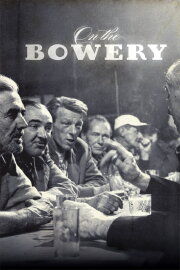
At the time of this film, the Bowery was a neighborhood in New York City populated largely by the down and out, and largely by transients. Those that can work generally can only find short term employment on a day to day basis, their daily earnings which primarily go into booze. Those that can't or won't work generally sponge off whoever they can, especially for that next drink. New to the neighborhood is Ray, who most recently had been working the rails in New Jersey. He is ... (Full plot summary below)
Enjoy FREE movies and series with your Prime (USA) subscription or when you start a 30-day free trial!
| Movie Source | Available | Offers | Added | Views | Quality | Format | Rating | Link | Share |
|---|---|---|---|---|---|---|---|---|---|
 | UK only | 1 Month Free Trial | 01 Feb 2018 | 4937 | HD | Watch OnlineStream Instantly | 60% |  Report: Broken Link Report: Broken Link |   |
| USA only | 1 Month Free Trial | 04 Oct 2020 | 4161 | HD | Watch OnlineStream Instantly | 85% | Report: Broken Link | |
| IRELAND only | 1 Month Free Trial | 31 Jan 2018 | 895 | HD | Watch OnlineStream Instantly | 65% | Report: Broken Link | |
 | UK only | 30 Day Free Trial | 29 Nov 2016 | 495 | HD | Watch OnlineStream Instantly | 79% | Report: Broken Link | |
![Its HD [On the Bowery]](/images/logos/icons/itshd.png) | WORLDWIDE | ? | 12 Sep 2016 | 3784 | HD | Watch OnlineStream Instantly | 92% | Report: Broken Link | |
 | UK only | 30 Day Free Trial | 07 Sep 2022 | 561 | HD | Watch OnlineStream Instantly | 58% | Report: Broken Link | |
 | UK only | Free Credit | 03 Jul 2023 | 149 | HD | Watch OnlineStream Instantly | 30% | Report: Broken Link | |
 | WORLDWIDE | ? | 12 May 2022 | 44 | HD | Watch OnlineStream Instantly | 11% | Report: Broken Link | |
 | WORLDWIDE | ? | 14 Mar 2018 | 25 | SD / TV | Watch OnlineStream Instantly | 12% | Report: Broken Link | |
 | WORLDWIDE | ? | 05 Mar 2016 | 178 | HD | Watch OnlineStream Instantly | 21% | Report: Broken Link | |
 | WORLDWIDE | ? | 17 Sep 2013 | 28 | SD / TV | Watch OnlineStream Instantly | 4% | Report: Broken Link | |
Links compiled using automated software. Availability of offers subject to change / might be region specific / out of date.
| Movie Source | Available | Offers | Added | Views | Quality | Format | Rating | Link | Share |
|---|---|---|---|---|---|---|---|---|---|
| UK only | 30 Day Free Trial | 05 Jan 2024 | 733 | SD / DVD | DVD RentalRent by Post | 83% |  Report: Broken Link Report: Broken Link | |
 | UK only | N/A | 05 Jan 2024 | 45 | SD / DVD | DVD RentalRent by Post | 27% | Report: Broken Link | |
 | USA only | 1 Month Free Trial | 05 Jan 2024 | 136 | SD / DVD | DVD RentalRent by Mail | 3% | Report: Broken Link | |
| USA only | 1 Month Free Trial | 05 Jan 2024 | 17040 | SD / DVD | DVD RentalRent by Mail | 99% | Report: Broken Link | |
| Movie Source | Available | Offers | Added | Views | Quality | Format | Rating | Link | Share |
|---|---|---|---|---|---|---|---|---|---|
| UK only | 30 Day Free Trial | 03 Jun 2023 | 238 | HD / BR | Blu Ray RentalRent by Post | 77% | Report: Broken Link | |
| UK only | N/A | 03 Jun 2023 | 91 | HD / BR | Blu Ray RentalRent by Post | 52% | Report: Broken Link | |
| USA only | 1 Month Free Trial | 05 Jan 2024 | 234 | HD / BR | Blu Ray RentalRent by Mail | 5% | Report: Broken Link | |
| USA only | 1 Month Free Trial | 03 Jun 2023 | 8545 | HD / BR | Blu Ray RentalRent by Mail | 84% | Report: Broken Link | |
At the time of this film, the Bowery was a neighborhood in New York City populated largely by the down and out, and largely by transients. Those that can work generally can only find short term employment on a day to day basis, their daily earnings which primarily go into booze. Those that can't or won't work generally sponge off whoever they can, especially for that next drink. New to the neighborhood is Ray, who most recently had been working the rails in New Jersey. He is one of those who can and still does work, but like the others spends what little money he has on booze, which means he usually sleeps on the streets in a drunken stupor. The only person he would probably consider a friend in the neighborhood is the elderly Gorman, who in turn takes advantage of his new friend at whatever opportunity. When he's sober, Ray understands that alcohol is ruining his life, and as such states that he will try to stop drinking. The questions become whether Ray has either the will or the support necessary to fulfill this goal, or whether he is destined to become another Gorman and the legions like Gorman in the Bowery.
Leave your thoughts about On the Bowery.
| Film-Forward.comNora Lee MandelFascinating for urban and film historians, but also a moving tribute to film's timeless power to illuminate social issues. See with new The Perfect Team:The Making of. |
| Slant MagazineBill WeberLionel Rogosin's semi-documentary is an unflinching document of skid-row denizens, and humanist cinema at its unsentimental best. |
| Time OutDavid FearThe Bowery's reign as ground zero for drinkers and drifters may be history, but more than a half century later, the film still hits you in the gut like a shot of two-bit hooch. |
| Wall Street JournalNicolas RapoldA fine-grained picture of stasis, both on the street and in the faces of lifers shuffling into gin mills and flophouses. |
| TikkunDavid SterrittThe result is harrowing and heartrending, and all the more so when you realize that the people on the screen died mostly miserable deaths, with only this little-known work of art to memorialize them. |
| Boston PhoenixPeter KeoughThis is a primal story of survival and trust set in what was one of the worst places in the world. |
| Boston GlobeWesley MorrisShot on 16mm in black-and-white with a Bolex camera, the results remain stunningly authentic. |
| Movie MetropolisChristopher LongA portrait of the ravages of alcoholism so vivid that I cannot off-hand think of any equivalent. |
| Reeling ReviewsLaura CliffordThe film is a fascinating bit of Americana, an indelible portrait of another time and place...stunning |
| Boston HeraldJames VerniereShot on Manhattan's virtually resurrected street of broken persons, the film is a snapshot of gin mills, flophouses and human wrecks, once known as "winos" for their addiction to cheap, fortified wine. |