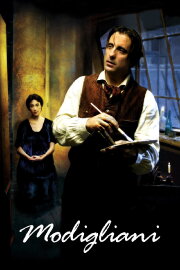
Set in Paris in 1919, this biopic centers on the life of late Italian artist Amedeo Modigliani, focusing on his last days and his rivalry with Pablo Picasso. The Jewish Modigliani has fallen in love with young, beautiful Catholic Jeanne. They have an illegitimate child, whom Jeanne's bigoted parents send to a faraway convent to be raised by nuns. The distraught Modigliani needs money to rescue and raise his child. The answer arrives in the shape of Paris' annual art competiti... (Full plot summary below)
Enjoy FREE movies and series with your Prime (USA) subscription or when you start a 30-day free trial!
| Movie Source | Available | Offers | Added | Views | Quality | Format | Rating | Link | Share |
|---|---|---|---|---|---|---|---|---|---|
 | UK only | 1 Month Free Trial | 21 Apr 2015 | 4763 | HD | Watch OnlineStream Instantly | 86% |  Report: Broken Link Report: Broken Link |   |
| USA only | 1 Month Free Trial | 09 Feb 2025 | 3381 | HD | Watch OnlineStream Instantly | 77% | Report: Broken Link | |
| IRELAND only | 1 Month Free Trial | 06 Jun 2020 | 4767 | HD | Watch OnlineStream Instantly | 83% | Report: Broken Link | |
 | UK only | 30 Day Free Trial | 14 Sep 2014 | 589 | HD | Watch OnlineStream Instantly | 90% | Report: Broken Link | |
![Its HD [Modigliani]](/images/logos/icons/itshd.png) | WORLDWIDE | ? | 30 Oct 2017 | 3576 | HD | Watch OnlineStream Instantly | 94% | Report: Broken Link | |
 | UK only | 30 Day Free Trial | 08 May 2021 | 328 | HD | Watch OnlineStream Instantly | 53% | Report: Broken Link | |
 | UK only | Free Credit | 28 Oct 2021 | 153 | HD | Watch OnlineStream Instantly | 39% | Report: Broken Link | |
 | WORLDWIDE | ? | 14 Feb 2026 | 189 | HD | Watch OnlineStream Instantly | 26% | Report: Broken Link | |
 | WORLDWIDE | ? | 07 Nov 2023 | 15 | SD / TV | Watch OnlineStream Instantly | 26% | Report: Broken Link | |
 | WORLDWIDE | ? | 07 Sep 2025 | 174 | HD | Watch OnlineStream Instantly | 27% | Report: Broken Link | |
 | WORLDWIDE | ? | 30 Mar 2018 | 29 | SD / TV | Watch OnlineStream Instantly | 14% | Report: Broken Link | |
Links compiled using automated software. Availability of offers subject to change / might be region specific / out of date.
| Movie Source | Available | Offers | Added | Views | Quality | Format | Rating | Link | Share |
|---|---|---|---|---|---|---|---|---|---|
| UK only | 30 Day Free Trial | 25 Oct 2017 | 2502 | SD / DVD | DVD RentalRent by Post | 78% |  Report: Broken Link Report: Broken Link | |
 | UK only | N/A | 25 Oct 2017 | 110 | SD / DVD | DVD RentalRent by Post | 56% | Report: Broken Link | |
 | USA only | 1 Month Free Trial | 25 Oct 2017 | 180 | SD / DVD | DVD RentalRent by Mail | 7% | Report: Broken Link | |
| USA only | 1 Month Free Trial | 25 Oct 2017 | 16769 | SD / DVD | DVD RentalRent by Mail | 93% | Report: Broken Link | |
| Movie Source | Available | Offers | Added | Views | Quality | Format | Rating | Link | Share |
|---|---|---|---|---|---|---|---|---|---|
| UK only | 30 Day Free Trial | 11 Oct 2016 | 172 | HD / BR | Blu Ray RentalRent by Post | 67% | Report: Broken Link | |
| UK only | N/A | 11 Oct 2016 | 65 | HD / BR | Blu Ray RentalRent by Post | 29% | Report: Broken Link | |
| USA only | 1 Month Free Trial | 25 Oct 2017 | 214 | HD / BR | Blu Ray RentalRent by Mail | 7% | Report: Broken Link | |
| USA only | 1 Month Free Trial | 11 Oct 2016 | 3884 | HD / BR | Blu Ray RentalRent by Mail | 81% | Report: Broken Link | |
Set in Paris in 1919, this biopic centers on the life of late Italian artist Amedeo Modigliani, focusing on his last days and his rivalry with Pablo Picasso. The Jewish Modigliani has fallen in love with young, beautiful Catholic Jeanne. They have an illegitimate child, whom Jeanne's bigoted parents send to a faraway convent to be raised by nuns. The distraught Modigliani needs money to rescue and raise his child. The answer arrives in the shape of Paris' annual art competition. Prize money and a guaranteed career await the winner. Neither Modigliani nor his dearest friend and rival Picasso has ever entered the competition, believing that it is beneath true artists like themselves. But push comes to shove with his child's welfare on the line, and Modigliani signs up for the competition in a drunken and drug-induced tirade. Picasso follows suit, and all of Paris is aflutter with excitement about who will win. With the balance of his relationship with Jeanne on the line, Modigliani tackles this work with the hopes of creating a masterpiece, and knows that all the artists of Paris are doing the same.
Leave your thoughts about Modigliani.
| Village VoiceR. Emmet SweeneySadly, instead of situating the l'amour fou in the artistic ferment of the period (1917-1920), Davis twists the period to fit the story. |
| Cinema SignalsJules BrennerA third of it is an episodically disordered string of scenes that coalesce into a narrative. The remaining two thirds is melodrama. |
| rec.arts.movies.reviewsMark R. LeeperThe material is just too familiar and we are given know reason to care if Modigliani lives or dies. |
| Los Angeles Daily NewsBob StraussDirector Mick Davis shows little if any imagination in presenting the troubled genius or the remarkable Montparnasse art scene of the World War I era, and that's the real bummer. |
| Boxoffice MagazineShlomo SchwartzbergZylberstein aside, the film rarely comes to life. |
| Miami HeraldMarta BarberDespite some nice shots of scenes converting into well-known art, Modigliani is plainly, badly directed. |
| Slant MagazineEd GonzalezIt ain't pretty but you have a choisa: See Modigliani or rent Derek Jarman's Caravaggio instead. |
| New York ObserverRex ReedA film of vitality, with imagery as haunting and romantic as it is intense. |
| Newark Star-LedgerLisa RoseModigliani is slow, shamefully cliched and disjointed as a cubist portrait. |
| Time OutRaven SnookInstead of trying to provide insight into this genius's debilitating madness, Davis prefers to wallow in incoherent and clichéd misery, punctuated by poetically oblique imagery. |