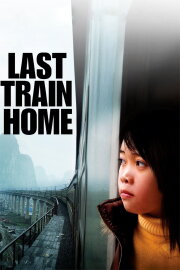
Husband and wife Changhua Zhang and Suqin Chen are among 130 million migrant Chinese workers, most, like them, who have left children behind in the village for elders to care of, and who only see their family once a year when they head home for the biggest holiday of the year, Lunar New Year. In 2006, they will have been away from their village for sixteen years, they starting this life when their only child at the time, daughter Qin Zhang, was one year old, she raised by Suq... (Full plot summary below)
Enjoy FREE movies and series with your Prime (USA) subscription or when you start a 30-day free trial!
| Movie Source | Available | Offers | Added | Views | Quality | Format | Rating | Link | Share |
|---|---|---|---|---|---|---|---|---|---|
 | UK only | 1 Month Free Trial | 08 Apr 2013 | 4643 | HD | Watch OnlineStream Instantly | 60% |  Report: Broken Link Report: Broken Link |   |
| USA only | 1 Month Free Trial | 27 May 2013 | 1798 | HD | Watch OnlineStream Instantly | 91% | Report: Broken Link | |
| IRELAND only | 1 Month Free Trial | 01 Aug 2021 | 2850 | HD | Watch OnlineStream Instantly | 95% | Report: Broken Link | |
 | UK only | 30 Day Free Trial | 11 Apr 2021 | 762 | HD | Watch OnlineStream Instantly | 97% | Report: Broken Link | |
![Its HD [Last Train Home]](/images/logos/icons/itshd.png) | WORLDWIDE | ? | 22 Sep 2022 | 3859 | HD | Watch OnlineStream Instantly | 92% | Report: Broken Link | |
 | UK only | 30 Day Free Trial | 09 Jan 2015 | 185 | HD | Watch OnlineStream Instantly | 63% | Report: Broken Link | |
 | UK only | Free Credit | 03 Apr 2022 | 156 | HD | Watch OnlineStream Instantly | 31% | Report: Broken Link | |
 | WORLDWIDE | ? | 16 Sep 2014 | 49 | HD | Watch OnlineStream Instantly | 20% | Report: Broken Link | |
 | WORLDWIDE | ? | 04 Feb 2017 | 26 | SD / TV | Watch OnlineStream Instantly | 13% | Report: Broken Link | |
 | WORLDWIDE | ? | 26 Feb 2025 | 204 | HD | Watch OnlineStream Instantly | 14% | Report: Broken Link | |
 | WORLDWIDE | ? | 29 Jul 2023 | 22 | SD / TV | Watch OnlineStream Instantly | 15% | Report: Broken Link | |
Links compiled using automated software. Availability of offers subject to change / might be region specific / out of date.
| Movie Source | Available | Offers | Added | Views | Quality | Format | Rating | Link | Share |
|---|---|---|---|---|---|---|---|---|---|
| UK only | 30 Day Free Trial | 17 Feb 2025 | 396 | SD / DVD | DVD RentalRent by Post | 88% |  Report: Broken Link Report: Broken Link | |
 | UK only | N/A | 17 Feb 2025 | 73 | SD / DVD | DVD RentalRent by Post | 16% | Report: Broken Link | |
 | USA only | 1 Month Free Trial | 17 Feb 2025 | 98 | SD / DVD | DVD RentalRent by Mail | 3% | Report: Broken Link | |
| USA only | 1 Month Free Trial | 17 Feb 2025 | 19458 | SD / DVD | DVD RentalRent by Mail | 79% | Report: Broken Link | |
| Movie Source | Available | Offers | Added | Views | Quality | Format | Rating | Link | Share |
|---|---|---|---|---|---|---|---|---|---|
| UK only | 30 Day Free Trial | 20 Jul 2019 | 182 | HD / BR | Blu Ray RentalRent by Post | 76% | Report: Broken Link | |
| UK only | N/A | 20 Jul 2019 | 92 | HD / BR | Blu Ray RentalRent by Post | 36% | Report: Broken Link | |
| USA only | 1 Month Free Trial | 17 Feb 2025 | 182 | HD / BR | Blu Ray RentalRent by Mail | 19% | Report: Broken Link | |
| USA only | 1 Month Free Trial | 20 Jul 2019 | 9241 | HD / BR | Blu Ray RentalRent by Mail | 91% | Report: Broken Link | |
Husband and wife Changhua Zhang and Suqin Chen are among 130 million migrant Chinese workers, most, like them, who have left children behind in the village for elders to care of, and who only see their family once a year when they head home for the biggest holiday of the year, Lunar New Year. In 2006, they will have been away from their village for sixteen years, they starting this life when their only child at the time, daughter Qin Zhang, was one year old, she raised by Suqin's parents, her father having since passed. Three years in their collective lives from 2006 to 2009 are told, largely centered on those annual trips home, and the parents' relationship with their two children, which also now includes adolescent son Yang Zhang, who they don't really know in only seeing them once a year. Changhua and Suqin's goal in choosing this life was to get the family out of poverty, they living to work - in a clothing sweat shop - sending money home so that Qin and Yang will stay in school for a better future, one that they themselves had no chance at in being confined to an agrarian existence. Qin, who over the course of those three years, will be at an age where she will make decisions for her own life, she seeing her parents' sacrifice not so much in that vein, but rather one that had a negative impact for her in not really having had parents and living what she considers a sad existence in the village, which is comprised primarily of school and farm work.
Leave your thoughts about Last Train Home.
| San Francisco ChronicleG. Allen JohnsonFan has visual panache - Last Train Home has some gorgeously composed shots - but he also has something that can't be taught: The patience and understanding to allow a family to tell their heartbreaking story in their own way. |
| Time OutDavid FearThe attention to visuals is above and beyond what most vérité is capable of; doing double duty as the film's cinematographer, Fan demonstrates a pitch-perfect photojournalistic eye. |
| Los Angeles TimesKenneth TuranThe Chinese economic miracle, however, came at a wrenching human cost, one that is beautifully explored in an exceptional documentary called Last Train Home. |
| Chicago Sun-TimesRoger EbertIt's one of those extraordinary films, like "Hoop Dreams," that tells a story the makers could not possibly have anticipated in advance. It works like stunning, grieving fiction. |
| Antagony & EcstasyTim BraytonAn extraordinary debut film... uncomfortably powerful and direct in its indictment of an entire way of living that the wealthier parts of the world take for granted. |
| Times-PicayuneMike ScottLast Train Home will tug at your heartstrings as it opens your eyes, but it also will make you feel incredibly lucky and more than a little spoiled. |
| Entertainment WeeklyLisa SchwarzbaumThis is essential viewing for understanding our world. |
| Village VoiceJ. HobermanEverything is edged with desperation. However arduous Last Train Home may have been to shoot, it was infinitely more arduous to live. |
| Boston GlobeTy BurrA miniature masterpiece of documentary observation. |
| ArtforumAmy TaubinRarely in a documentary does every shot matter as a bearer of emotion and information. Lixin Fan's nonfiction debut, Last Train Home (2009), is just such an exceptional movie. |