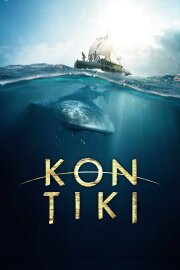
The Norwegian explorer Thor Heyerdahl crossed the Pacific Ocean in a balsawood raft in 1947, together with five men, to prove that South Americans back in pre-Columbian times could have crossed the ocean and settled on Polynesian islands. After financing the trips with loans and donations, they set off on an epic 101-day-long trip across 8000 kilometers, while the world was waiting for the result of the trip. The film tells about the origin of the idea, the preparations, and ... (Full plot summary below)
Enjoy FREE movies and series with your Prime (USA) subscription or when you start a 30-day free trial!
| Movie Source | Available | Offers | Added | Views | Quality | Format | Rating | Link | Share |
|---|---|---|---|---|---|---|---|---|---|
 | UK only | 1 Month Free Trial | 16 Sep 2015 | 4150 | HD | Watch OnlineStream Instantly | 77% |  Report: Broken Link Report: Broken Link |   |
| USA only | 1 Month Free Trial | 17 Jan 2013 | 4602 | HD | Watch OnlineStream Instantly | 77% | Report: Broken Link | |
| IRELAND only | 1 Month Free Trial | 31 Oct 2014 | 5267 | HD | Watch OnlineStream Instantly | 70% | Report: Broken Link | |
 | UK only | 30 Day Free Trial | 22 Apr 2020 | 910 | HD | Watch OnlineStream Instantly | 90% | Report: Broken Link | |
![Its HD [Kon-Tiki]](/images/logos/icons/itshd.png) | WORLDWIDE | ? | 22 Jul 2015 | 3610 | HD | Watch OnlineStream Instantly | 85% | Report: Broken Link | |
 | UK only | 30 Day Free Trial | 03 Nov 2018 | 176 | HD | Watch OnlineStream Instantly | 57% | Report: Broken Link | |
 | UK only | Free Credit | 05 Sep 2018 | 158 | HD | Watch OnlineStream Instantly | 46% | Report: Broken Link | |
 | WORLDWIDE | ? | 08 Sep 2013 | 128 | HD | Watch OnlineStream Instantly | 18% | Report: Broken Link | |
 | WORLDWIDE | ? | 10 Oct 2024 | 25 | SD / TV | Watch OnlineStream Instantly | 15% | Report: Broken Link | |
 | WORLDWIDE | ? | 17 May 2021 | 220 | HD | Watch OnlineStream Instantly | 18% | Report: Broken Link | |
 | WORLDWIDE | ? | 16 Aug 2022 | 35 | SD / TV | Watch OnlineStream Instantly | 12% | Report: Broken Link | |
Links compiled using automated software. Availability of offers subject to change / might be region specific / out of date.
| Movie Source | Available | Offers | Added | Views | Quality | Format | Rating | Link | Share |
|---|---|---|---|---|---|---|---|---|---|
| UK only | 30 Day Free Trial | 28 Apr 2023 | 203 | SD / DVD | DVD RentalRent by Post | 81% |  Report: Broken Link Report: Broken Link | |
 | UK only | N/A | 28 Apr 2023 | 112 | SD / DVD | DVD RentalRent by Post | 19% | Report: Broken Link | |
 | USA only | 1 Month Free Trial | 28 Apr 2023 | 215 | SD / DVD | DVD RentalRent by Mail | 20% | Report: Broken Link | |
| USA only | 1 Month Free Trial | 28 Apr 2023 | 19237 | SD / DVD | DVD RentalRent by Mail | 95% | Report: Broken Link | |
| Movie Source | Available | Offers | Added | Views | Quality | Format | Rating | Link | Share |
|---|---|---|---|---|---|---|---|---|---|
| UK only | 30 Day Free Trial | 15 Feb 2026 | 218 | HD / BR | Blu Ray RentalRent by Post | 80% | Report: Broken Link | |
| UK only | N/A | 15 Feb 2026 | 42 | HD / BR | Blu Ray RentalRent by Post | 25% | Report: Broken Link | |
| USA only | 1 Month Free Trial | 28 Apr 2023 | 724 | HD / BR | Blu Ray RentalRent by Mail | 2% | Report: Broken Link | |
| USA only | 1 Month Free Trial | 15 Feb 2026 | 9675 | HD / BR | Blu Ray RentalRent by Mail | 78% | Report: Broken Link | |
The Norwegian explorer Thor Heyerdahl crossed the Pacific Ocean in a balsawood raft in 1947, together with five men, to prove that South Americans back in pre-Columbian times could have crossed the ocean and settled on Polynesian islands. After financing the trips with loans and donations, they set off on an epic 101-day-long trip across 8000 kilometers, while the world was waiting for the result of the trip. The film tells about the origin of the idea, the preparations, and the events on the trip. The "Kon-Tiki" was named after the Inca sun god, Viracocha, and "Kon-Tiki" is an old name for this god. Heyerdahl filmed the expedition, which later became the Academy Award winning documentary in 1951, and he wrote a book about the expedition that was translated into 70 languages and sold more than 50 millions copies around the world. Heyerdahl believed that people from South America could have settled Polynesia in pre-Columbian times, although most anthropologists now believe they did not. Anyway he proved that it was possible by using only the materials and technologies available to those people at that time. The trip took 101 days over 4,300 miles across the Pacific Ocean before the "Kon-Tiki" crashed onto the dangerous reefs outside Raroia in the Tuamotu Islands on August 7, 1947. All crewmen survived, and the "Kon-Tiki" was taken back to Norway. She is now featured in the Kon-Tiki Museum.
Leave your thoughts about Kon-Tiki.
| AALBC.comKam WilliamsA fitting tribute to the enviable exploits of the legendary Thor Heyerdahl. |
| Screen-SpaceSimon FosterA handsomely-mounted human drama, epic in scope if not execution, Kon-Tiki is a worthy testament to the magnitude of the feat it portrays. |
| East Bay ExpressKelly VanceHas similar sea-going survival thrills as Life of Pi, but somehow means more. |
| New York TimesManohla DargisThere’s no denying the real Heyerdahl’s bravery, but if this movie is to be believed, his voyage was largely bereft of tension and interesting conversation. |
| EspinofMikel ZorrillaA mix between drama and adventure that occasionally works, but that in general is far from expressing in depth the greatness of the real story that adapts. [Full review in Spanish] |
| AV ClubSam AdamsKon-Tiki, Joachim Rønning and Espen Sandberg’s modern dramatization, while well-acted and smartly filmed, rarely musters any actual sense of excitement. |
| New York ObserverRex ReedAs an epic of awesome achievement, it never bores. |
| Time OutJoshua RothkopfDirectors Joachim Rønning and Espen Sandberg are unusually committed to maritime mechanics, and the excitement grows as steadily as the sailors’ beards. |
| OregonianMarc MohanFor most of its running time, it's a riveting rendition of a stranger-than-fiction tale. |
| We Got This CoveredSimon BrookfieldThis Scandinavian import is a lavishly constructed true-to-life epic that stands among the most thrilling and accessible films of this year's Academy Award nominations. |