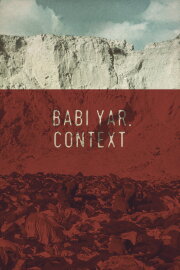
On September 29-30, 1941, Sonderkommando 4a of the Einsatzgruppe C, assisted by two battalions of the Police Regiment South and Ukrainian Auxiliary Police, and without any resistance from the local population, shot dead 33,771 Jews in the Babi Yar ravine northwest of Kyiv. The film reconstructs the historical context of this tragedy through archive footage documenting the German occupation of Ukraine and the subsequent decade. When memory turns into oblivion, when the past ov... (Full plot summary below)
Enjoy FREE movies and series with your Prime (USA) subscription or when you start a 30-day free trial!
On September 29-30, 1941, Sonderkommando 4a of the Einsatzgruppe C, assisted by two battalions of the Police Regiment South and Ukrainian Auxiliary Police, and without any resistance from the local population, shot dead 33,771 Jews in the Babi Yar ravine northwest of Kyiv. The film reconstructs the historical context of this tragedy through archive footage documenting the German occupation of Ukraine and the subsequent decade. When memory turns into oblivion, when the past overshadows the future, it is the voice of cinema that articulates the truth.
Leave your thoughts about Babi Yar. Context.
| The New York TimesA.O. ScottLoznitsa has assembled a wrenching and revelatory collage. |
| Screen DailyDemetrios MatheouLoznitsa creates a fascinating and quietly devastating chronicle of invasion, occupation and slaughter. As ever, the Ukrainian director doesn’t labour his film with voiceover or overt authorial steers. Yet this is close to home, and it’s impossible not to feel that he’s holding his country to account; for while this was a Nazi extermination, it came with a degree of collusion. |
| Slant MagazineClayton DillardSergei Loznitsa continues to mine the archives for what amount to living documents of a past that, as is all too clear, reverberate into the present with devastating force. |
| VarietyJay WeissbergBabi Yar. Context has power but falls short of the director’s greatest works, largely because his span here is considerably longer, and in consequence the focus suffers. |
| RogerEbert.comSimon AbramsThe dual nature of “Babi Yar. Context” as both an essay movie and a cut-up historic document might create an uneasy tension with viewers who would like to know more about whatever they’re looking at. If nothing else, Loznitsa succeeds at being upsetting. |