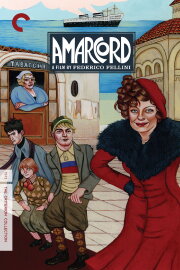
One year in a small northern Italian coastal town in the late 1930s is presented. The slightly off-kilter cast of characters are affected by time and location, the social mores dictated largely by Catholicism, and the national fervor surrounding Il Duce aka Benito Mussolini and Fascism. The stories loosely center on mid-teen Titta and his household, including his adolescent brother, his ever-supportive mother who is always defending him against his father, his freeloading mat... (Full plot summary below)
Enjoy FREE movies and series with your Prime (USA) subscription or when you start a 30-day free trial!
| Movie Source | Available | Offers | Added | Views | Quality | Format | Rating | Link | Share |
|---|---|---|---|---|---|---|---|---|---|
 | UK only | 1 Month Free Trial | 03 Apr 2014 | 3148 | HD | Watch OnlineStream Instantly | 66% |  Report: Broken Link Report: Broken Link |   |
| USA only | 1 Month Free Trial | 19 Jul 2014 | 6519 | HD | Watch OnlineStream Instantly | 81% | Report: Broken Link | |
| IRELAND only | 1 Month Free Trial | 28 Nov 2016 | 1684 | HD | Watch OnlineStream Instantly | 84% | Report: Broken Link | |
 | UK only | 30 Day Free Trial | 23 Jul 2021 | 843 | HD | Watch OnlineStream Instantly | 98% | Report: Broken Link | |
![Its HD [Amarcord]](/images/logos/icons/itshd.png) | WORLDWIDE | ? | 09 Sep 2021 | 3797 | HD | Watch OnlineStream Instantly | 86% | Report: Broken Link | |
 | UK only | 30 Day Free Trial | 30 Apr 2025 | 656 | HD | Watch OnlineStream Instantly | 36% | Report: Broken Link | |
 | UK only | Free Credit | 02 Mar 2017 | 133 | HD | Watch OnlineStream Instantly | 51% | Report: Broken Link | |
 | WORLDWIDE | ? | 27 Sep 2014 | 104 | HD | Watch OnlineStream Instantly | 38% | Report: Broken Link | |
 | WORLDWIDE | ? | 17 Dec 2025 | 20 | SD / TV | Watch OnlineStream Instantly | 15% | Report: Broken Link | |
 | WORLDWIDE | ? | 10 Dec 2015 | 113 | HD | Watch OnlineStream Instantly | 18% | Report: Broken Link | |
 | WORLDWIDE | ? | 16 Dec 2021 | 19 | SD / TV | Watch OnlineStream Instantly | 11% | Report: Broken Link | |
Links compiled using automated software. Availability of offers subject to change / might be region specific / out of date.
| Movie Source | Available | Offers | Added | Views | Quality | Format | Rating | Link | Share |
|---|---|---|---|---|---|---|---|---|---|
| UK only | 30 Day Free Trial | 26 Dec 2014 | 1265 | SD / DVD | DVD RentalRent by Post | 81% |  Report: Broken Link Report: Broken Link | |
 | UK only | N/A | 26 Dec 2014 | 85 | SD / DVD | DVD RentalRent by Post | 38% | Report: Broken Link | |
 | USA only | 1 Month Free Trial | 26 Dec 2014 | 55 | SD / DVD | DVD RentalRent by Mail | 17% | Report: Broken Link | |
| USA only | 1 Month Free Trial | 26 Dec 2014 | 14788 | SD / DVD | DVD RentalRent by Mail | 99% | Report: Broken Link | |
| Movie Source | Available | Offers | Added | Views | Quality | Format | Rating | Link | Share |
|---|---|---|---|---|---|---|---|---|---|
| UK only | 30 Day Free Trial | 14 Nov 2020 | 193 | HD / BR | Blu Ray RentalRent by Post | 71% | Report: Broken Link | |
| UK only | N/A | 14 Nov 2020 | 94 | HD / BR | Blu Ray RentalRent by Post | 17% | Report: Broken Link | |
| USA only | 1 Month Free Trial | 26 Dec 2014 | 214 | HD / BR | Blu Ray RentalRent by Mail | 12% | Report: Broken Link | |
| USA only | 1 Month Free Trial | 14 Nov 2020 | 5276 | HD / BR | Blu Ray RentalRent by Mail | 89% | Report: Broken Link | |
One year in a small northern Italian coastal town in the late 1930s is presented. The slightly off-kilter cast of characters are affected by time and location, the social mores dictated largely by Catholicism, and the national fervor surrounding Il Duce aka Benito Mussolini and Fascism. The stories loosely center on mid-teen Titta and his household, including his adolescent brother, his ever-supportive mother who is always defending him against his father, his freeloading maternal Uncle Lallo, and his paternal grandfather who slyly has eyes and hands for the household maid. Other townsfolk include: town beauty Gradisca, who can probably have any man she wants but generally has none as most think she out of their league; Volpina, the prostitute; Giudizio, the historian; a blind accordionist; and an extremely buxom tobacconist. The several vignettes presented include: the town bonfire in celebration of spring; life at Titta's school with his classmates and teachers; Titta's father Aurelio at his beachfront construction worksite and his and his workmates' encounter with Volpina; Titta's confessions to the priest about his burgeoning sexuality; Aurelio being questioned by authorities about his anti-Fascist leanings; a fantasy sequence at the luxurious Grand Hotel; a family outing with Aurelio's institutionalized brother Teo; many townsfolk embarking on a sail to witness a marine event passing by their town; an annual car race; Titta's fantasy encounter with the tobacconist after closing hours coming true; events surrounding the big snowfall that year, including a family tragedy; and an event centering on Gradisca and her future.
Leave your thoughts about Amarcord.
| Philadelphia WeeklySean BurnsWatching the movie feels like flipping through a cartoon sketchbook of Fellini's vivid remembrances and formative experiences. |
| Flick FilosopherMaryAnn Johanson[S]imply nonsensical to me. Fascists are idiots, Catholic priests are clowns -- I agree with this. So why don't I feel it? |
| Los Angeles TimesKevin ThomasHe [Director Fellini] leaves us with the hope that the human comedy just may be able to survive everything. |
| Cinema WriterJay AntaniA vulgar, crassly funny, tender, always affectionate nostalgia trip, Fellini style. |
| Chicago Sun-TimesRoger EbertA totally accessible film. It deals directly, hilariously, and sometimes poignantly with the good people of this small town. |
| New York TimesVincent CanbyWhen Mr. Fellini is working in peak condition, as he is in Amarcord, he somehow brings out the best in us. |
| Mountain Xpress (Asheville, NC)Ken HankeImages of such stunning beauty that you feel you're actually inside Fellini's mind, seeing the things he remembers -- in a highly colored fashion -- from childhood. |
| Combustible CelluloidJeffrey M. AndersonWhat's so surprising about this film is just how loose and effortlessly enjoyable it is, despite all its ideas and images. It's one of the director's very best. |
| Apollo GuideDerek SmithIn his own unique style, Federico Fellini has created a beautiful work of art that is as amusing as it is inspiring. |
| Filmcritic.comChristopher NullIt's the more fanciful and lighthearted first half of the film (obviously a big inspiration for some of Woody Allen's work) that works the best. |