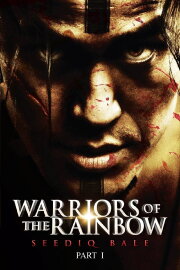
During the Japanese rule of Taiwan, the Seediq were forced to lose their own culture and give up their faith. Men were subject to harsh labor and kept from traditional hunting; whereas women had to serve the Japanese policemen and their families by doing the household work and giving up their traditional weaving work. Above all, they were forbidden to tattoo their faces. And these tattoos were seen as the Seediq's traditional belief to transform themselves into Seediq Bale ("... (Full plot summary below)
Enjoy FREE movies and series with your Prime (USA) subscription or when you start a 30-day free trial!
| Movie Source | Available | Offers | Added | Views | Quality | Format | Rating | Link | Share |
|---|---|---|---|---|---|---|---|---|---|
 | UK only | 1 Month Free Trial | 22 May 2023 | 4720 | HD | Watch OnlineStream Instantly | 73% |  Report: Broken Link Report: Broken Link |   |
| USA only | 1 Month Free Trial | 16 Jan 2013 | 4403 | HD | Watch OnlineStream Instantly | 75% | Report: Broken Link | |
| IRELAND only | 1 Month Free Trial | 03 May 2015 | 760 | HD | Watch OnlineStream Instantly | 76% | Report: Broken Link | |
 | UK only | 30 Day Free Trial | 08 Apr 2014 | 579 | HD | Watch OnlineStream Instantly | 100% | Report: Broken Link | |
![Its HD [Warriors of the Rainbow: Seediq Bale - Part 1: The Sun Flag]](/images/logos/icons/itshd.png) | WORLDWIDE | ? | 01 Apr 2015 | 3441 | HD | Watch OnlineStream Instantly | 93% | Report: Broken Link | |
 | UK only | 30 Day Free Trial | 16 Nov 2019 | 698 | HD | Watch OnlineStream Instantly | 44% | Report: Broken Link | |
 | UK only | Free Credit | 07 Jul 2015 | 142 | HD | Watch OnlineStream Instantly | 38% | Report: Broken Link | |
 | WORLDWIDE | ? | 26 Apr 2017 | 173 | HD | Watch OnlineStream Instantly | 36% | Report: Broken Link | |
 | WORLDWIDE | ? | 26 Jan 2023 | 21 | SD / TV | Watch OnlineStream Instantly | 16% | Report: Broken Link | |
 | WORLDWIDE | ? | 06 Apr 2021 | 230 | HD | Watch OnlineStream Instantly | 9% | Report: Broken Link | |
 | WORLDWIDE | ? | 26 Aug 2021 | 35 | SD / TV | Watch OnlineStream Instantly | 13% | Report: Broken Link | |
Links compiled using automated software. Availability of offers subject to change / might be region specific / out of date.
| Movie Source | Available | Offers | Added | Views | Quality | Format | Rating | Link | Share |
|---|---|---|---|---|---|---|---|---|---|
| UK only | 30 Day Free Trial | 16 Mar 2018 | 765 | SD / DVD | DVD RentalRent by Post | 73% |  Report: Broken Link Report: Broken Link | |
 | UK only | N/A | 16 Mar 2018 | 44 | SD / DVD | DVD RentalRent by Post | 21% | Report: Broken Link | |
 | USA only | 1 Month Free Trial | 16 Mar 2018 | 173 | SD / DVD | DVD RentalRent by Mail | 5% | Report: Broken Link | |
| USA only | 1 Month Free Trial | 16 Mar 2018 | 22443 | SD / DVD | DVD RentalRent by Mail | 98% | Report: Broken Link | |
| Movie Source | Available | Offers | Added | Views | Quality | Format | Rating | Link | Share |
|---|---|---|---|---|---|---|---|---|---|
| UK only | 30 Day Free Trial | 01 Apr 2019 | 270 | HD / BR | Blu Ray RentalRent by Post | 71% | Report: Broken Link | |
| UK only | N/A | 01 Apr 2019 | 81 | HD / BR | Blu Ray RentalRent by Post | 14% | Report: Broken Link | |
| USA only | 1 Month Free Trial | 16 Mar 2018 | 780 | HD / BR | Blu Ray RentalRent by Mail | 19% | Report: Broken Link | |
| USA only | 1 Month Free Trial | 01 Apr 2019 | 8004 | HD / BR | Blu Ray RentalRent by Mail | 92% | Report: Broken Link | |
Sorry, we can't find any suggestions at the moment.
During the Japanese rule of Taiwan, the Seediq were forced to lose their own culture and give up their faith. Men were subject to harsh labor and kept from traditional hunting; whereas women had to serve the Japanese policemen and their families by doing the household work and giving up their traditional weaving work. Above all, they were forbidden to tattoo their faces. And these tattoos were seen as the Seediq's traditional belief to transform themselves into Seediq Bale ("true humans"). Mona Rudao, the protagonist, witnessed the repression by the Japanese over a period of 30 years. Sometime between autumn and winter 1930, when the slave labor is at its harshest, a young Seediq couple are married and a joyful party is thrown. At the same time, a newly appointed Japanese policeman goes on his inspection tour to this tribe. Mona Rudao's first son, Tado Mona, offers wine to the policeman with gusto, but is in return beaten up because his hands were considered not clean enough. With anger, Tado Mona and his brother Baso Mona attack the policeman. And from that day onward, their tribe is living in the shadow of being the object of revenge by the Japanese. In a few days, a group of youth surround Mona Rudao. They strongly request him to lead the retaliation against the Japanese. Mona Rudao struggles for a long time between extending his fellow's lives and fighting back for dignity, until he sees these youngster's faces - clear without Seediq's tattoos - that he made up his mind. He tells the youngsters, "Japanese troops out-number the stones in Dakusui River, more intensive than the leaves in the forest, but my determination fighting them is ever stronger than Mt. Kire." "Children! On the tip of the Rainbow Bridge led to home of our ancestor's spirits, there is another beautiful hunting range. Our ancestors are all there! Remember, only brave spirits can enter this place, and we can never lose it. My fellows, let us hunt the heads of our enemies, and we wash our spirits with blood so that we walk the Rainbow Bridge to be always with our ancestors." The film Seediq Bale depicts the Wushe Incident, which occurred in central Taiwan during the Japanese rule. When the Seediq Bale, believing in the Rainbow, and the Japanese, believing in the Sun, met one another, they fought. The leader of Seediq Bale, Mona Rudao, led 300 warriors fighting against 3000 Japanese troopers. The only thing they forgot was whether it was the Rainbow or the Sun they believed in; they actually believed in the same sky.
Leave your thoughts about Warriors of the Rainbow: Seediq Bale - Part 1: The Sun Flag.
| Globe and MailAdam NaymanAt times, Warriors sacrifices dramatic nuance for scale, but even its most rousing passages are tempered by a sense of loss. Rather than simply enshrining its underdog heroes' efforts, it considers their cost. |
| Village VoiceNick SchagerIt's not clear what Warriors of the Rainbow: Seediq Bale values more - endless preaching about ancestral spirits or gruesome CG decapitations. |
| New York TimesStephen HoldenDespite the movie's considerable visual splendor, the pacing of Warriors of the Rainbow is clumsy, its battle scenes chaotic and its computer effects (especially of a fire that ravages the Seediq hunting forest) cheesy. |
| San Francisco ChronicleG. Allen JohnsonWarriors of the Rainbow is Taiwan's "Braveheart," with a nod to "The Last of the Mohicans." |
| ScreenAnarchyJ HurtadoAn emotionally engaging story that flows naturally into violence and action, rather than a flat story that uses plot points only as excuses to get into the action. |
| Examiner.comChris SawinThe Taiwanese epic doesn't shy away from anything even though the message is pretty hopeless. But all of the film's depth seems to have been stripped away. |
| CinemalogueTodd JorgensonThe film includes some stunning visuals, including a few terrific jungle battle scenes. |
| Film Journal InternationalDaniel EaganTaiwanese natives battle occupying Japanese forces in a doomed uprising. Exciting if exhausting account of a real-life incident. |
| Los Angeles TimesRobert AbeleWarriors is a bruising, relentless experience, one more tiring than inspiring. |
| User ReviewLei DU can't miss every single parts of this movie! |