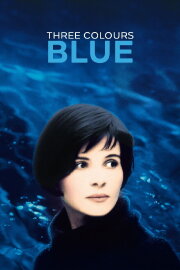
The first part of Kieslowski's trilogy on France's national motto: Liberty, Equality, and Fraternity. 'Blue' is the story of Julie who loses her husband, an acclaimed composer and her young daughter in a car accident. The film's theme of liberty is manifested in Julie's attempt to start life anew, free of personal commitments, belongings, grief or love. She intends to numb herself by withdrawing from the world and living completely independently, anonymously and in solitude i... (Full plot summary below)
Enjoy FREE movies and series with your Prime (USA) subscription or when you start a 30-day free trial!
| Movie Source | Available | Offers | Added | Views | Quality | Format | Rating | Link | Share |
|---|---|---|---|---|---|---|---|---|---|
 | UK only | 1 Month Free Trial | 02 Nov 2020 | 4779 | HD | Watch OnlineStream Instantly | 72% |  Report: Broken Link Report: Broken Link |   |
| USA only | 1 Month Free Trial | 23 Aug 2016 | 2269 | HD | Watch OnlineStream Instantly | 91% | Report: Broken Link | |
| IRELAND only | 1 Month Free Trial | 22 Nov 2021 | 4639 | HD | Watch OnlineStream Instantly | 81% | Report: Broken Link | |
 | UK only | 30 Day Free Trial | 18 Dec 2015 | 940 | HD | Watch OnlineStream Instantly | 97% | Report: Broken Link | |
![Its HD [Three Colors: Blue]](/images/logos/icons/itshd.png) | WORLDWIDE | ? | 27 Oct 2022 | 3232 | HD | Watch OnlineStream Instantly | 86% | Report: Broken Link | |
 | UK only | 30 Day Free Trial | 22 Feb 2026 | 861 | HD | Watch OnlineStream Instantly | 57% | Report: Broken Link | |
 | UK only | Free Credit | 31 Oct 2013 | 127 | HD | Watch OnlineStream Instantly | 41% | Report: Broken Link | |
 | WORLDWIDE | ? | 31 Aug 2024 | 37 | HD | Watch OnlineStream Instantly | 38% | Report: Broken Link | |
 | WORLDWIDE | ? | 08 Dec 2016 | 19 | SD / TV | Watch OnlineStream Instantly | 11% | Report: Broken Link | |
 | WORLDWIDE | ? | 28 May 2017 | 127 | HD | Watch OnlineStream Instantly | 12% | Report: Broken Link | |
 | WORLDWIDE | ? | 05 Apr 2021 | 21 | SD / TV | Watch OnlineStream Instantly | 7% | Report: Broken Link | |
Links compiled using automated software. Availability of offers subject to change / might be region specific / out of date.
| Movie Source | Available | Offers | Added | Views | Quality | Format | Rating | Link | Share |
|---|---|---|---|---|---|---|---|---|---|
| UK only | 30 Day Free Trial | 09 Mar 2017 | 1764 | SD / DVD | DVD RentalRent by Post | 69% |  Report: Broken Link Report: Broken Link | |
 | UK only | N/A | 09 Mar 2017 | 102 | SD / DVD | DVD RentalRent by Post | 23% | Report: Broken Link | |
 | USA only | 1 Month Free Trial | 09 Mar 2017 | 87 | SD / DVD | DVD RentalRent by Mail | 2% | Report: Broken Link | |
| USA only | 1 Month Free Trial | 09 Mar 2017 | 22133 | SD / DVD | DVD RentalRent by Mail | 90% | Report: Broken Link | |
| Movie Source | Available | Offers | Added | Views | Quality | Format | Rating | Link | Share |
|---|---|---|---|---|---|---|---|---|---|
| UK only | 30 Day Free Trial | 11 Nov 2017 | 312 | HD / BR | Blu Ray RentalRent by Post | 74% | Report: Broken Link | |
| UK only | N/A | 11 Nov 2017 | 90 | HD / BR | Blu Ray RentalRent by Post | 34% | Report: Broken Link | |
| USA only | 1 Month Free Trial | 09 Mar 2017 | 376 | HD / BR | Blu Ray RentalRent by Mail | 10% | Report: Broken Link | |
| USA only | 1 Month Free Trial | 11 Nov 2017 | 6664 | HD / BR | Blu Ray RentalRent by Mail | 87% | Report: Broken Link | |
The first part of Kieslowski's trilogy on France's national motto: Liberty, Equality, and Fraternity. 'Blue' is the story of Julie who loses her husband, an acclaimed composer and her young daughter in a car accident. The film's theme of liberty is manifested in Julie's attempt to start life anew, free of personal commitments, belongings, grief or love. She intends to numb herself by withdrawing from the world and living completely independently, anonymously and in solitude in the Parisian metropolis. Despite her intentions, people from her former and present life intrude with their own needs. However, the reality created by the people who need and care about her, a surprising discovery and the music around which the film revolves heal Julie and draws her back to the land of the living.
Leave your thoughts about Three Colors: Blue.
| CineVuePatrick GambleLike delving into a cold cave of human emotion, Three Colours: Blue is the jewel in the crown of Kieślowski’s trilogy – a fascinating examination of freedom, sorrow and identity, and perhaps one of the most necessary films of contemporary French cinema. |
| Los Angeles TimesKenneth TuranDaring in its willingness to risk looking maudlin by dealing with extremes, Blue doesn't hesitate to explore spiritual and psychological states that are beyond many films. |
| Washington PostHal HinsonFor Kieslowski, subtlety is a religion. He hints or implies -- anything to keep from laying his cards on the table. With "Blue," you never feel he's shown his whole hand; not even after the game is over. |
| The GuardianPeter BradshawThere is a wonderful reach and flair in Kieślowski’s film-making. |
| EmpireMarcus TrowerWhat lifts it out of the doldrums is Kieslowski's fascinating use of reflections, focusing techniques and camera angles to give the somewhat pedestrian material a profound and otherworldly East European feel. |
| Chicago Sun-TimesRoger EbertThink of how we read the thoughts of those closest to us, in moments when words will not do. We look at their faces, and although they do not make any effort to mirror emotions there, we can read them all the same, in the smallest signs. A movie that invites us to do the same thing can be very absorbing. |
| Austin ChronicleMarjorie BaumgartenBlue is a movie that engages the mind, challenges the senses, implores a resolution, and tells, with aesthetic grace and formal elegance, a good story and a political allegory. |
| ReelViewsJames BerardinelliAs rich in emotional impact as in style, this motion picture sets a high standard that we as viewers can only hope the other two chapters of the trilogy will match. |
| VarietyLisa NesselsonBold final sequence is a visual and aural crescendo calibrated to show that while each person is fundamentally alone, every life inevitably touches other lives. |
| The GuardianDerek MalcolmThe film is almost totally schematic and this weakens it. What strengthens it is the sheer emotional power of its making. |