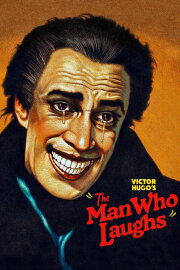
Forever disfigured by a wide and mirthless grin on his face, the orphaned son of a nobleman, Gwynplaine, rescues the blind baby-girl, Dea, in cold seventeenth-century England. Taken in by the paternal carnival philosopher, Ursus, the unloved boy grows into a kind and honest man who chooses, however, to hide his grotesque deformity behind a black cloak, utterly convinced that the beautiful Dea will never truly love him because of his horrible secret. Feeling unworthy of Dea's ... (Full plot summary below)
Enjoy FREE movies and series with your Prime (USA) subscription or when you start a 30-day free trial!
| Movie Source | Available | Offers | Added | Views | Quality | Format | Rating | Link | Share |
|---|---|---|---|---|---|---|---|---|---|
 | UK only | 1 Month Free Trial | 28 Feb 2020 | 3873 | HD | Watch OnlineStream Instantly | 69% |  Report: Broken Link Report: Broken Link |   |
| USA only | 1 Month Free Trial | 17 Jul 2023 | 1933 | HD | Watch OnlineStream Instantly | 80% | Report: Broken Link | |
| IRELAND only | 1 Month Free Trial | 14 Jun 2026 | 3900 | HD | Watch OnlineStream Instantly | 96% | Report: Broken Link | |
 | UK only | 30 Day Free Trial | 01 Jul 2025 | 753 | HD | Watch OnlineStream Instantly | 90% | Report: Broken Link | |
![Its HD [The Man Who Laughs]](/images/logos/icons/itshd.png) | WORLDWIDE | ? | 25 Nov 2015 | 3583 | HD | Watch OnlineStream Instantly | 90% | Report: Broken Link | |
 | UK only | 30 Day Free Trial | 13 Jul 2016 | 570 | HD | Watch OnlineStream Instantly | 38% | Report: Broken Link | |
 | UK only | Free Credit | 23 Jun 2020 | 136 | HD | Watch OnlineStream Instantly | 43% | Report: Broken Link | |
 | WORLDWIDE | ? | 09 Jun 2018 | 190 | HD | Watch OnlineStream Instantly | 17% | Report: Broken Link | |
 | WORLDWIDE | ? | 24 Apr 2014 | 16 | SD / TV | Watch OnlineStream Instantly | 23% | Report: Broken Link | |
 | WORLDWIDE | ? | 09 Dec 2019 | 103 | HD | Watch OnlineStream Instantly | 13% | Report: Broken Link | |
 | WORLDWIDE | ? | 10 Apr 2017 | 29 | SD / TV | Watch OnlineStream Instantly | 18% | Report: Broken Link | |
Links compiled using automated software. Availability of offers subject to change / might be region specific / out of date.
| Movie Source | Available | Offers | Added | Views | Quality | Format | Rating | Link | Share |
|---|---|---|---|---|---|---|---|---|---|
| UK only | 30 Day Free Trial | 27 Sep 2014 | 1715 | SD / DVD | DVD RentalRent by Post | 83% |  Report: Broken Link Report: Broken Link | |
 | UK only | N/A | 27 Sep 2014 | 36 | SD / DVD | DVD RentalRent by Post | 52% | Report: Broken Link | |
 | USA only | 1 Month Free Trial | 27 Sep 2014 | 135 | SD / DVD | DVD RentalRent by Mail | 19% | Report: Broken Link | |
| USA only | 1 Month Free Trial | 27 Sep 2014 | 16010 | SD / DVD | DVD RentalRent by Mail | 100% | Report: Broken Link | |
| Movie Source | Available | Offers | Added | Views | Quality | Format | Rating | Link | Share |
|---|---|---|---|---|---|---|---|---|---|
| UK only | 30 Day Free Trial | 30 Apr 2025 | 216 | HD / BR | Blu Ray RentalRent by Post | 80% | Report: Broken Link | |
| UK only | N/A | 30 Apr 2025 | 61 | HD / BR | Blu Ray RentalRent by Post | 17% | Report: Broken Link | |
| USA only | 1 Month Free Trial | 27 Sep 2014 | 589 | HD / BR | Blu Ray RentalRent by Mail | 6% | Report: Broken Link | |
| USA only | 1 Month Free Trial | 30 Apr 2025 | 8523 | HD / BR | Blu Ray RentalRent by Mail | 88% | Report: Broken Link | |
Forever disfigured by a wide and mirthless grin on his face, the orphaned son of a nobleman, Gwynplaine, rescues the blind baby-girl, Dea, in cold seventeenth-century England. Taken in by the paternal carnival philosopher, Ursus, the unloved boy grows into a kind and honest man who chooses, however, to hide his grotesque deformity behind a black cloak, utterly convinced that the beautiful Dea will never truly love him because of his horrible secret. Feeling unworthy of Dea's noble feelings, Gwynplaine will soon cross paths with the aristocratic temptress, Duchess Josiana, as a cruel and long-standing conspiracy in the palace of Queen Anne presents him with the burden of choice. Will poor Gwynplaine, the Man who Laughs, renounce everything in the name of love?
Leave your thoughts about The Man Who Laughs.
| Time OutBob BakerBaclanova is amusing as a decadent duchess, but it's Leni's pictorial genius -- aided here by what must have been an enormous budget -- that marks the film as one of the most exhilarating of late silent cinema. |
| Radio TimesRonald BerganThe superb German actor Conrad Veidt plays the pathetic protagonist, while Mary Philbin, whose most celebrated screen role was opposite another physically damaged hero in The Phantom of the Opera, is extremely touching as his beloved. |
| Chicago ReaderJ. R. JonesAs usual in Hugo, love is measured in sacrifice, yielding a sincere and extravagant sense of romance. |
| Commercial Appeal (Memphis, TN)John BeifussAn expressionistic masterpiece of spooky, fairy tale Poe-meets-Perrault imagery... |
| Filmcritic.comJake EukerPoised between the great German horror that preceded it and the great Universal horror that followed, it is, for genre fans, an inviting and necessary stop. |
| User ReviewJessi tPerhaps I'm a fair bit twisted, but I fail to see the horror in this. It's one of the most beautiful love stories I've ever seen, however, and Conrad Veidt is magnificient. |
| User ReviewStef II've never seen such astonishing acting in my whole life. It's amazing how Conrad Veidt can express effectivelly all sorts of emotions using only his eyes, due to his perpetual grin and silence of mute movies. |
| User ReviewJeremiah COne of the very best human dramas I have ever seen - Veidt's performance was nothing less than compelling and magnificent. |
| User ReviewDavid SYou'd have to be outright ignorant to not be able to appreciate this film exactly as is. The characters are beautifully human, the plot is original, and Viktor Hugo will not steer you wrong :-) |
| User ReviewZoran SGenius. Sublime. This film basically has everything: uber-grotesque horror, gypsies that deform kids, creepy clowns, seriously creepy clown smiles, romantic melodrama, and one of the great dogs of cinema (who is named "Homo.") You couldn't even make a film like this today: sound cinema killed the possibility and audiences (at least judging by the reviews here) have become too literal minded to accept its stylistic excesses and can only identify with characters on screen who express pre-packaged psychological tropes. I haven't had this much fun watching a movie in ages. |