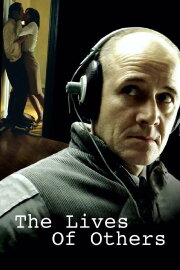
Gerd Wiesler is an officer with the Stasi, the East German secret police. The film begins in 1984 when Wiesler attends a play written by Georg Dreyman, who is considered by many to be the ultimate example of the loyal citizen. Wiesler has a gut feeling that Dreyman can't be as ideal as he seems, and believes surveillance is called for. The Minister of Culture agrees but only later does Wiesler learn that the Minister sees Dreyman as a rival and lusts after his partner Christa... (Full plot summary below)
Enjoy FREE movies and series with your Prime (USA) subscription or when you start a 30-day free trial!
| Movie Source | Available | Offers | Added | Views | Quality | Format | Rating | Link | Share |
|---|---|---|---|---|---|---|---|---|---|
 | UK only | 1 Month Free Trial | 28 Feb 2024 | 3079 | HD | Watch OnlineStream Instantly | 79% |  Report: Broken Link Report: Broken Link |   |
| USA only | 1 Month Free Trial | 28 Jun 2017 | 3724 | HD | Watch OnlineStream Instantly | 76% | Report: Broken Link | |
| IRELAND only | 1 Month Free Trial | 07 Jan 2022 | 3922 | HD | Watch OnlineStream Instantly | 88% | Report: Broken Link | |
 | UK only | 30 Day Free Trial | 17 Oct 2018 | 725 | HD | Watch OnlineStream Instantly | 87% | Report: Broken Link | |
![Its HD [The Lives of Others]](/images/logos/icons/itshd.png) | WORLDWIDE | ? | 05 Nov 2021 | 3436 | HD | Watch OnlineStream Instantly | 96% | Report: Broken Link | |
 | UK only | 30 Day Free Trial | 31 Aug 2019 | 787 | HD | Watch OnlineStream Instantly | 64% | Report: Broken Link | |
 | UK only | Free Credit | 10 Apr 2022 | 148 | HD | Watch OnlineStream Instantly | 43% | Report: Broken Link | |
 | WORLDWIDE | ? | 13 Nov 2020 | 42 | HD | Watch OnlineStream Instantly | 26% | Report: Broken Link | |
 | WORLDWIDE | ? | 27 Aug 2025 | 12 | SD / TV | Watch OnlineStream Instantly | 11% | Report: Broken Link | |
 | WORLDWIDE | ? | 05 Jan 2019 | 299 | HD | Watch OnlineStream Instantly | 27% | Report: Broken Link | |
 | WORLDWIDE | ? | 28 Jun 2021 | 22 | SD / TV | Watch OnlineStream Instantly | 5% | Report: Broken Link | |
Links compiled using automated software. Availability of offers subject to change / might be region specific / out of date.
| Movie Source | Available | Offers | Added | Views | Quality | Format | Rating | Link | Share |
|---|---|---|---|---|---|---|---|---|---|
| UK only | 30 Day Free Trial | 14 Jun 2015 | 2809 | SD / DVD | DVD RentalRent by Post | 75% |  Report: Broken Link Report: Broken Link | |
 | UK only | N/A | 14 Jun 2015 | 33 | SD / DVD | DVD RentalRent by Post | 31% | Report: Broken Link | |
 | USA only | 1 Month Free Trial | 14 Jun 2015 | 86 | SD / DVD | DVD RentalRent by Mail | 20% | Report: Broken Link | |
| USA only | 1 Month Free Trial | 14 Jun 2015 | 17772 | SD / DVD | DVD RentalRent by Mail | 87% | Report: Broken Link | |
| Movie Source | Available | Offers | Added | Views | Quality | Format | Rating | Link | Share |
|---|---|---|---|---|---|---|---|---|---|
| UK only | 30 Day Free Trial | 25 Apr 2023 | 298 | HD / BR | Blu Ray RentalRent by Post | 77% | Report: Broken Link | |
| UK only | N/A | 25 Apr 2023 | 81 | HD / BR | Blu Ray RentalRent by Post | 33% | Report: Broken Link | |
| USA only | 1 Month Free Trial | 14 Jun 2015 | 778 | HD / BR | Blu Ray RentalRent by Mail | 16% | Report: Broken Link | |
| USA only | 1 Month Free Trial | 25 Apr 2023 | 7318 | HD / BR | Blu Ray RentalRent by Mail | 80% | Report: Broken Link | |
Gerd Wiesler is an officer with the Stasi, the East German secret police. The film begins in 1984 when Wiesler attends a play written by Georg Dreyman, who is considered by many to be the ultimate example of the loyal citizen. Wiesler has a gut feeling that Dreyman can't be as ideal as he seems, and believes surveillance is called for. The Minister of Culture agrees but only later does Wiesler learn that the Minister sees Dreyman as a rival and lusts after his partner Christa-Maria. The more time he spends listening in on them, the more he comes to care about them. The once rigid Stasi officer begins to intervene in their lives, in a positive way, protecting them whenever possible. Eventually, Wiesler's activities catch up to him and while there is no proof of wrongdoing, he finds himself in menial jobs - until the unbelievable happens.
Leave your thoughts about The Lives of Others.
| The Tyee (British Columbia)Dorothy WoodendThe worst crime that this film has to offer is pure old simple dumbness, paper-thin characters, and a plot that leans heavily on artiness to give it the look of a more serious thinking story. |
| Film ThreatMatthew Sorrentovon Donnersmarck creates a milieu so realistic that the attention-worthy setting becomes just a backdrop, while an intricate tale, as suspenseful as it is humanistic, takes over. |
| Philadelphia InquirerCarrie RickeyLives is a best-foreign-film nominee competing in a year that at least three movies in this category are stronger than Oscar's best-picture contenders. |
| Cinema ScopeRichard PortonCinematic smugness has a fatal impact on the delineation of Wiesler's quietly heroic political calisthenics and The Lives of Others' supposedly uplifting denouement. |
| San Diego MetropolitanJean LowerisonAn absorbing look at the period and events that seem distressingly relevant today. |
| The New York Review of BooksTimothy Garton AshIt uses the syntax and conventions of Hollywood to convey to the widest possible audience some part of the truth about life under the Stasi, and the larger truths that experience revealed about human nature. |
| Portland OregonianShawn LevyIt's so full-blooded, smart, sexy, tense and absorbing, so cleverly written and shot and cut, so filled with superb acting and music, so perfect in its closing moment, that it surely ranks with the most impressive debuts in world cinema. |
| Washington PostDesson ThomsonTo watch "Lives" is not just to enjoy a fabulously constructed timepiece; it's to appreciate a deft cautionary tale. |
| San Francisco ChronicleMick LaSalleA great film, the best I've seen since Terrence Malick's "The New World," and far and away the richest and most brilliantly acted picture to be released this Oscar season. |
| SlateDana StevensIt's an intricate, ambiguous and deeply satisfying movie, a tautly plotted tale of state surveillance and personal betrayal that ultimately becomes an ode to the transformative power of art. |