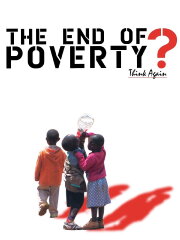
The End of Poverty? asks if the true causes of poverty today stem from a deliberate orchestration since colonial times which has evolved into our modern system whereby wealthy nations exploit the poor. People living and fighting against poverty answer condemning colonialism and its consequences; land grab, exploitation of natural resources, debt, free markets, demand for corporate profits and the evolution of an economic system in in which 25% of the world's population consum... (Full plot summary below)
Enjoy FREE movies and series with your Prime (USA) subscription or when you start a 30-day free trial!
| Movie Source | Available | Offers | Added | Views | Quality | Format | Rating | Link | Share |
|---|---|---|---|---|---|---|---|---|---|
 | UK only | 1 Month Free Trial | 22 May 2023 | 3571 | HD | Watch OnlineStream Instantly | 72% |  Report: Broken Link Report: Broken Link |   |
| USA only | 1 Month Free Trial | 06 Aug 2022 | 5837 | HD | Watch OnlineStream Instantly | 96% | Report: Broken Link | |
| IRELAND only | 1 Month Free Trial | 08 Jan 2015 | 3656 | HD | Watch OnlineStream Instantly | 79% | Report: Broken Link | |
 | UK only | 30 Day Free Trial | 11 Apr 2023 | 1014 | HD | Watch OnlineStream Instantly | 96% | Report: Broken Link | |
![Its HD [The End of Poverty?]](/images/logos/icons/itshd.png) | WORLDWIDE | ? | 04 Feb 2019 | 3137 | HD | Watch OnlineStream Instantly | 92% | Report: Broken Link | |
 | UK only | 30 Day Free Trial | 08 May 2013 | 807 | HD | Watch OnlineStream Instantly | 38% | Report: Broken Link | |
 | UK only | Free Credit | 20 Mar 2020 | 145 | HD | Watch OnlineStream Instantly | 45% | Report: Broken Link | |
 | WORLDWIDE | ? | 24 Feb 2026 | 197 | HD | Watch OnlineStream Instantly | 18% | Report: Broken Link | |
 | WORLDWIDE | ? | 26 Sep 2014 | 20 | SD / TV | Watch OnlineStream Instantly | 19% | Report: Broken Link | |
 | WORLDWIDE | ? | 13 May 2026 | 303 | HD | Watch OnlineStream Instantly | 16% | Report: Broken Link | |
 | WORLDWIDE | ? | 04 May 2025 | 26 | SD / TV | Watch OnlineStream Instantly | 9% | Report: Broken Link | |
Links compiled using automated software. Availability of offers subject to change / might be region specific / out of date.
| Movie Source | Available | Offers | Added | Views | Quality | Format | Rating | Link | Share |
|---|---|---|---|---|---|---|---|---|---|
| UK only | 30 Day Free Trial | 10 Feb 2020 | 2353 | SD / DVD | DVD RentalRent by Post | 63% |  Report: Broken Link Report: Broken Link | |
 | UK only | N/A | 10 Feb 2020 | 45 | SD / DVD | DVD RentalRent by Post | 37% | Report: Broken Link | |
 | USA only | 1 Month Free Trial | 10 Feb 2020 | 212 | SD / DVD | DVD RentalRent by Mail | 3% | Report: Broken Link | |
| USA only | 1 Month Free Trial | 10 Feb 2020 | 13913 | SD / DVD | DVD RentalRent by Mail | 80% | Report: Broken Link | |
| Movie Source | Available | Offers | Added | Views | Quality | Format | Rating | Link | Share |
|---|---|---|---|---|---|---|---|---|---|
| UK only | 30 Day Free Trial | 05 Apr 2015 | 244 | HD / BR | Blu Ray RentalRent by Post | 66% | Report: Broken Link | |
| UK only | N/A | 05 Apr 2015 | 41 | HD / BR | Blu Ray RentalRent by Post | 13% | Report: Broken Link | |
| USA only | 1 Month Free Trial | 10 Feb 2020 | 329 | HD / BR | Blu Ray RentalRent by Mail | 8% | Report: Broken Link | |
| USA only | 1 Month Free Trial | 05 Apr 2015 | 7833 | HD / BR | Blu Ray RentalRent by Mail | 81% | Report: Broken Link | |
The End of Poverty? asks if the true causes of poverty today stem from a deliberate orchestration since colonial times which has evolved into our modern system whereby wealthy nations exploit the poor. People living and fighting against poverty answer condemning colonialism and its consequences; land grab, exploitation of natural resources, debt, free markets, demand for corporate profits and the evolution of an economic system in in which 25% of the world's population consumes 85% of its wealth. Featuring Nobel Prize winner Amartya Sen and Joseph Stiglitz, authors/activist Susan George, Eric Toussaint, Bolivian Vice President Alvaro Garcia Linera and more.
Leave your thoughts about The End of Poverty?.
| Village VoiceAndrew SchenkerFor all his film's sober analysis, Diaz never loses sight of the human cost of global capitalism. |
| Film ThreatPhil HallThe film plays "blame Whitey" by insisting that all economic problems currently facing the people in Latin America, Africa and Asia were created by Western interference. |
| About.comJennifer MerinIt's startling to realize that locales supplying most resources we consider most valuable are Earth's most poverty-stricken spots. The film makes a compelling argument that our economic system is the equivalent of human doom. |
| PopMattersChris Barsanti...uncharacteristically revolutionary among today's issue documentaries, and all the more refreshing for its bluntness. |
| Arkansas Democrat-GazettePhilip MartinA confrontational documentary by neo-Marxist director Phillippe Diaz that explores the inconvenient truth that the gears of capitalism are greased by the exploitation of the weak. |
| Arizona RepublicKerry LengelEven if you're convinced by the many well-spoken interviewees, the film's conclusion is almost as depressing as the historical indictment that precedes it. |
| CompuserveHarvey S. KartenThough sorely in need of Michael Moore's humor, this leftist documentary successfully skewers the idea that poverty is strictly the fault of the poor nations. |
| NYC Movie GuruAvi OfferA timely and provocative documentary, but it's rather dull, poorly synthesized and fails to keep you engaged with an overload of information and a disorganized variety of interviews. |
| Monsters and CriticsRon WilkinsonThe most articulate film to date describing the modern means and methods of the free market enslavement of undeveloped countries. |
| Christian Science MonitorPeter RainerBecause Diaz constructs his movie like a classroom tutorial, we expect something more from him than an appeal to end privatization. |