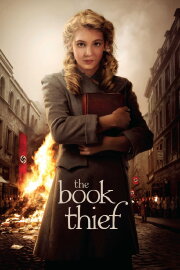
In 1938, the young girl Liesel Meminger is traveling by train with her mother and her younger brother when he dies. Her mother buries the boy in a cemetery by the tracks and Liesel picks up a book, "The Gravediggers Handbook", which was left on the grave of her brother and brings it with her. Liesel is delivered to a foster family in a small town and later she learns that her mother left her because she is a communist. Her stepmother, Rosa Hubermann, is a rude but caring woma... (Full plot summary below)
Enjoy FREE movies and series with your Prime (USA) subscription or when you start a 30-day free trial!
| Movie Source | Available | Offers | Added | Views | Quality | Format | Rating | Link | Share |
|---|---|---|---|---|---|---|---|---|---|
 | UK only | 1 Month Free Trial | 22 Oct 2023 | 4973 | HD | Watch OnlineStream Instantly | 85% |  Report: Broken Link Report: Broken Link |   |
| USA only | 1 Month Free Trial | 27 May 2020 | 4417 | HD | Watch OnlineStream Instantly | 90% | Report: Broken Link | |
| IRELAND only | 1 Month Free Trial | 01 Dec 2022 | 5463 | HD | Watch OnlineStream Instantly | 70% | Report: Broken Link | |
 | UK only | 30 Day Free Trial | 12 Aug 2020 | 929 | HD | Watch OnlineStream Instantly | 87% | Report: Broken Link | |
![Its HD [The Book Thief]](/images/logos/icons/itshd.png) | WORLDWIDE | ? | 07 Mar 2024 | 3332 | HD | Watch OnlineStream Instantly | 84% | Report: Broken Link | |
 | UK only | 30 Day Free Trial | 08 Aug 2019 | 842 | HD | Watch OnlineStream Instantly | 51% | Report: Broken Link | |
 | UK only | Free Credit | 20 Dec 2024 | 175 | HD | Watch OnlineStream Instantly | 45% | Report: Broken Link | |
 | WORLDWIDE | ? | 10 May 2016 | 144 | HD | Watch OnlineStream Instantly | 17% | Report: Broken Link | |
 | WORLDWIDE | ? | 29 May 2019 | 23 | SD / TV | Watch OnlineStream Instantly | 20% | Report: Broken Link | |
 | WORLDWIDE | ? | 03 Dec 2019 | 237 | HD | Watch OnlineStream Instantly | 12% | Report: Broken Link | |
 | WORLDWIDE | ? | 23 May 2013 | 24 | SD / TV | Watch OnlineStream Instantly | 7% | Report: Broken Link | |
Links compiled using automated software. Availability of offers subject to change / might be region specific / out of date.
| Movie Source | Available | Offers | Added | Views | Quality | Format | Rating | Link | Share |
|---|---|---|---|---|---|---|---|---|---|
| UK only | 30 Day Free Trial | 20 Oct 2024 | 765 | SD / DVD | DVD RentalRent by Post | 62% |  Report: Broken Link Report: Broken Link | |
 | UK only | N/A | 20 Oct 2024 | 28 | SD / DVD | DVD RentalRent by Post | 59% | Report: Broken Link | |
 | USA only | 1 Month Free Trial | 20 Oct 2024 | 135 | SD / DVD | DVD RentalRent by Mail | 18% | Report: Broken Link | |
| USA only | 1 Month Free Trial | 20 Oct 2024 | 4426 | SD / DVD | DVD RentalRent by Mail | 84% | Report: Broken Link | |
| Movie Source | Available | Offers | Added | Views | Quality | Format | Rating | Link | Share |
|---|---|---|---|---|---|---|---|---|---|
| UK only | 30 Day Free Trial | 01 Mar 2019 | 229 | HD / BR | Blu Ray RentalRent by Post | 68% | Report: Broken Link | |
| UK only | N/A | 01 Mar 2019 | 37 | HD / BR | Blu Ray RentalRent by Post | 34% | Report: Broken Link | |
| USA only | 1 Month Free Trial | 20 Oct 2024 | 485 | HD / BR | Blu Ray RentalRent by Mail | 8% | Report: Broken Link | |
| USA only | 1 Month Free Trial | 01 Mar 2019 | 3802 | HD / BR | Blu Ray RentalRent by Mail | 81% | Report: Broken Link | |
In 1938, the young girl Liesel Meminger is traveling by train with her mother and her younger brother when he dies. Her mother buries the boy in a cemetery by the tracks and Liesel picks up a book, "The Gravediggers Handbook", which was left on the grave of her brother and brings it with her. Liesel is delivered to a foster family in a small town and later she learns that her mother left her because she is a communist. Her stepmother, Rosa Hubermann, is a rude but caring woman and her stepfather, Hans Hubermann, is a simple kind-hearted man. Liesel befriends her next door neighbor, the boy Rudy Steiner, and they go together to the school. When Hans discovers that Liesel cannot read, he teaches her using her book and Liesel becomes an obsessed reader. During a Nazi speech where the locals are forced to burn books in a bonfire, Liesel recovers one book for her and the Mayor's wife Ilsa Hermann witnesses her action. Meanwhile Hans hides the Jewish Max Vandenburg, who is the son of a deceased friend that saved his life in the war, in the basement of his house and Liesel becomes his friend. One day, Rosa asks Liesel to deliver laundry to the Mayor and Ilsa invites Liesel to go to her library and tells that she can visit her to read whenever she wants. But in times of war there are many threats and the lives of Liesel, her family and friends will never be the same.
Leave your thoughts about The Book Thief.
| Flixist.comMatthew RazakAt the end of the film, Death comments that he sees humanity's beauty and ugliness and always wonders how the same thing can be both. Well, The Book Thief isn't both. It's just ugly. |
| Chicago Sun-TimesRichard RoeperThis is one of the best movies of the year, featuring one of the most perfect endings of any movie in recent memory. |
| ReviewExpress.comDiana SaengerIncredibly Inspiring - a best of the year |
| St. Paul Pioneer PressChris HewittIf a movie is going to tell yet another story about life during World War II, it better be a lot more special than this one. |
| Kaplan vs. KaplanJeanne KaplanIt is a stirring, heart-wrenching look at the atrocities of war and "Death", as witnessed by a fiercely determined young girl. |
| Reeling ReviewsLaura Clifford...a worthy cast hamstrung by poor directorial choices... |
| Paste MagazineMatt ShiverdeckerWith its muted cinematography and a fairly slow-paced story, The Book Thief isn't the flashiest of potential awards contenders this year, but it's one of the most genuine. |
| Entertainment WeeklyAdam MarkovitzIt would make for a pretty ghastly pageant if not for smart, understated turns by Watson and Geoffrey Rush as the charmingly Teutonic couple who rescue both Liesel and a stranded Jew (Ben Schnezter) — not to mention the movie itself — with honorable matter-of-factness. |
| AV ClubBen Kenigsberg"Life Is Beautiful" may or may not have set a benchmark for tackiness in Holocaust cinema, but The Book Thief offers a hypothetical way in which the former might have been worse: At least it wasn’t narrated by Death. |
| Associated PressJessica HerndonThe film shines a bright light on Nelisse, a fresh young talent whose expressive eyes say everything. |