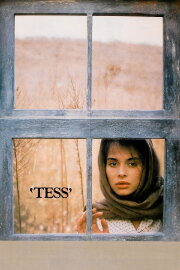
Wessex County, England during the Victorian era. Christian values dominate what are social mores. These mores and her interactions with two men play a large part in what happens in the young life of peasant girl, the shy, innocent, proper yet proud Tess Durbeyfield. The first of these men is Alec d'Urberville. After learning from a local historian that they are really descendants of the aristocratic d'Urberville family which has died out due to lack of male heirs, Tess' paren... (Full plot summary below)
Enjoy FREE movies and series with your Prime (USA) subscription or when you start a 30-day free trial!
| Movie Source | Available | Offers | Added | Views | Quality | Format | Rating | Link | Share |
|---|---|---|---|---|---|---|---|---|---|
 | UK only | 1 Month Free Trial | 24 Feb 2021 | 4484 | HD | Watch OnlineStream Instantly | 77% |  Report: Broken Link Report: Broken Link |   |
| USA only | 1 Month Free Trial | 17 Oct 2015 | 2985 | HD | Watch OnlineStream Instantly | 74% | Report: Broken Link | |
| IRELAND only | 1 Month Free Trial | 28 Oct 2014 | 3055 | HD | Watch OnlineStream Instantly | 90% | Report: Broken Link | |
 | UK only | 30 Day Free Trial | 14 Jan 2023 | 492 | HD | Watch OnlineStream Instantly | 86% | Report: Broken Link | |
![Its HD [Tess]](/images/logos/icons/itshd.png) | WORLDWIDE | ? | 22 Oct 2019 | 3616 | HD | Watch OnlineStream Instantly | 92% | Report: Broken Link | |
 | UK only | 30 Day Free Trial | 17 Sep 2022 | 485 | HD | Watch OnlineStream Instantly | 35% | Report: Broken Link | |
 | UK only | Free Credit | 11 Jan 2019 | 142 | HD | Watch OnlineStream Instantly | 30% | Report: Broken Link | |
 | WORLDWIDE | ? | 08 Jan 2018 | 85 | HD | Watch OnlineStream Instantly | 20% | Report: Broken Link | |
 | WORLDWIDE | ? | 12 Oct 2018 | 21 | SD / TV | Watch OnlineStream Instantly | 13% | Report: Broken Link | |
 | WORLDWIDE | ? | 02 Jan 2024 | 283 | HD | Watch OnlineStream Instantly | 23% | Report: Broken Link | |
 | WORLDWIDE | ? | 01 Sep 2017 | 4 | SD / TV | Watch OnlineStream Instantly | 18% | Report: Broken Link | |
Links compiled using automated software. Availability of offers subject to change / might be region specific / out of date.
| Movie Source | Available | Offers | Added | Views | Quality | Format | Rating | Link | Share |
|---|---|---|---|---|---|---|---|---|---|
| UK only | 30 Day Free Trial | 05 Mar 2018 | 1094 | SD / DVD | DVD RentalRent by Post | 78% |  Report: Broken Link Report: Broken Link | |
 | UK only | N/A | 05 Mar 2018 | 87 | SD / DVD | DVD RentalRent by Post | 27% | Report: Broken Link | |
 | USA only | 1 Month Free Trial | 05 Mar 2018 | 132 | SD / DVD | DVD RentalRent by Mail | 2% | Report: Broken Link | |
| USA only | 1 Month Free Trial | 05 Mar 2018 | 3985 | SD / DVD | DVD RentalRent by Mail | 89% | Report: Broken Link | |
| Movie Source | Available | Offers | Added | Views | Quality | Format | Rating | Link | Share |
|---|---|---|---|---|---|---|---|---|---|
| UK only | 30 Day Free Trial | 16 Jun 2015 | 293 | HD / BR | Blu Ray RentalRent by Post | 92% | Report: Broken Link | |
| UK only | N/A | 16 Jun 2015 | 80 | HD / BR | Blu Ray RentalRent by Post | 47% | Report: Broken Link | |
| USA only | 1 Month Free Trial | 05 Mar 2018 | 722 | HD / BR | Blu Ray RentalRent by Mail | 20% | Report: Broken Link | |
| USA only | 1 Month Free Trial | 16 Jun 2015 | 2524 | HD / BR | Blu Ray RentalRent by Mail | 98% | Report: Broken Link | |
Wessex County, England during the Victorian era. Christian values dominate what are social mores. These mores and her interactions with two men play a large part in what happens in the young life of peasant girl, the shy, innocent, proper yet proud Tess Durbeyfield. The first of these men is Alec d'Urberville. After learning from a local historian that they are really descendants of the aristocratic d'Urberville family which has died out due to lack of male heirs, Tess' parents send her to a nearby mansion where they know some d'Urbervilles actually reside. This move is in order for the family to gain some benefit from their heritage. Upon her arrival at the mansion, Tess quickly learns that the family of Tess' "cousin" Alec are not true d'Urbervilles, but rather an opportunistic lot who bought the family name in order to improve their own standing in life. Tess is pulled between what she was sent to accomplish for her family against her general disdain for Alec, who will give her anything she wants in return for sexual favors. The second of these men is Angel Clare, the son of a parson and an apprentice farmer. Angel and Tess fall in love with each other. Tess has to decide if she will divulge to Angel her past relationship with Alec, which if she does may jeopardize their own relationship. But if she doesn't, Tess also has to figure out if the secret will haunt her and thus jeopardize their relationship in other ways.
Leave your thoughts about Tess.
| Filmcritic.comChristopher NullPolanski is entitled to one monstrously overlong period piece, and in Tess he acquits himself satisfactorily, though the film isn't nearly the equal of its counterparts |
| VarietyVariety StaffTess is a sensitive, intelligent screen treatment of a literary masterwork. |
| ColeSmithey.comCole Smithey(PODCAST) The greatest filmic literary adaptation any filmmaker has produced. |
| The DissolveKeith PhippsThe film, like its source, is filled with pessimistic fatalism, but it spares no pity for the instruments of fate [...] What, if anything, this meant to Polanski remains unknowable. |
| Creative LoafingMatt BrunsonRoman Polanski is one of those men who, despite his icky treatment of women in real life, manages to create strong and compelling female characters for the screen. |
| The SpectatorPeter AckroydWe are driven back to Hardy at the end and Tess is proof, if proof is needed, of the power of that individual imagination which can survive changes of form. |
| Movie MetropolisChristopher LongThis is Kinski's show and she flat out steals it. |
| New YorkerPauline Kael[Polanski's film] is textured and smooth and even, with lateral compositions subtly flowing into each other; the sequences are beautifully structured, and the craftsmanship is hypnotic. But the picture is tame. |
| New York TimesJanet MaslinWithout Mr. Polanski's name in the credits, this lush and scenic Tess could even be mistaken for the work of David Lean. |
| User ReviewAlice .Wonderful adaptation (well, according to Wikipedia, anyway, it seems to almost completely match Thomas Hardy's book) of "Tess of the d'Urbervilles". I loved the story, it was heartbreaking but I can't really dock it stars for that. Not all movies are meant to mindlessly entertain. It had themes of feminism, classicism, traditional living vs. modernism, Paganism vs. Catholicism, rape vs. seduction, etc. It's deep. It's beautifully filmed (won an Oscar for Cinematography), Polanski, despite his reputation, is a brilliant filmmaker, I love everything he does, which is why I rented it. Nastassja Kinski, mostly unknown at the time, is brilliant in her role (guess talent runs in the family - fortunately not the madness of her father, Klaus!). I enjoyed watching all the special features, it's really neat how they filmed this, so much hard work that wouldn't need to be done today, taking new effects and CGI into consideration. It's long, but it's an epic, and I can't imagine cutting it. Reading all about the book (or the book) teaches you so much that you wouldn't possibly pick up without it, especially the Pagan themes. Loved it, highly recommend it. |