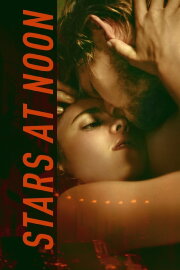
Set during the Sandinista Revolution in Nicaragua in 1984, it tells the story of the encounter between a mysterious British businessman and an American journalist committed to following the developments of the revolution. The two, driven by a strong connection, will be the protagonists of a love story, remaining prey to a "dangerous labyrinth of lies and conspiracies", trying to escape the country.... (Full plot summary below)
Enjoy FREE movies and series with your Prime (USA) subscription or when you start a 30-day free trial!
Set during the Sandinista Revolution in Nicaragua in 1984, it tells the story of the encounter between a mysterious British businessman and an American journalist committed to following the developments of the revolution. The two, driven by a strong connection, will be the protagonists of a love story, remaining prey to a "dangerous labyrinth of lies and conspiracies", trying to escape the country.
Leave your thoughts about Stars at Noon.
| RogerEbert.comMatt Zoller SeitzThe movie adaptation is typically described in articles and on streaming platforms as an "erotic thriller" or simply "a thriller." But as is so often the case with Denis' films, that's a misleading way to characterize, or even think about, what's actually onscreen, which is more of a vibe than a story, and all the more fascinating because of that choice. |
| Original-CinLiam LaceyBilled misleadingly as a “romantic thriller,” the film is neither romantic nor especially thrilling. The characters are enigmatic to the point of superficiality, the relationships largely transactional, and the action toggles between languid and frazzled over two-and-a-quarter-hours. But with some reflective distance, away from the snap judgment of festivals, Stars at Noon proves a pretty interesting film, if a sometimes confusing one. |
| IndieWireDavid EhrlichDenis, Andrew Litvack, and Léa Mysius’ dialogue is only strengthened by its occasional awkwardness, as it subsumes Trish and Daniel into the same disordered humidity that swamps the film around them. The frequent sex scenes become a dialogue of their own — the lovers feeling each other out in search of something they can actually trust. |
| TheWrapBen CrollWhen chewing through some oddly phrased text, Qualley’s non-verbal tics offer twice the information with half the winces, making “Stars at Noon” sometimes feel like two films in one. There’s the paranoid thriller and the dreamlike dirge; a steamy drama and its feminist reappraisal; the work of a master with the promise of new kinks to iron out and maybe greater heights to which to soar. |
| The TelegraphRobbie CollinStars at Noon is at its best when it has Trish and Daniel suspended in horny limbo, with Denis building an atmosphere of sultry languor that makes the film feel as if it’s constantly stretching and circling, like a sleepy cat. |
| VarietyGuy LodgeTrish is the plum part here, and a sensational Qualley — cycling through a ragged thrift-store wardrobe, with a lavish halo of dark curls that can’t help but recall her mother, Andie MacDowell — grabs it with both callused hands. |
| BBCNicholas BarberPartly because the characters look so healthily pretty, and partly because the mood is so woozy, The Stars at Noon feels more like a stylish pastiche of a Graham Greene novel than the story of real people battling their way out of a difficult, potentially deadly situation. It's beautifully made, but to enjoy it you have to relax, and let it wash over you. |
| Slant MagazineKeith UhlichIn Claire Denis’s film, sex is the great equalizer, or at least the act that allows people to defer taking a firm moral or ethical stance. |
| The Film StageDavid KatzHer latest work is not one that feels fully achieved and realized, suggesting an absolutely confident mastery of her primary source material, but it’s still deeply watchable, laden with sex and intimacy in a way that doesn’t apologize for itself, and provides an alternate gloss on her key themes of power, bodies, and postcolonial afterlives. |
| Austin ChronicleJosh KupeckiThe rainswept city streets overflowing with graffiti and half-torn leaflets are poignant tableaux of melancholy, the jazz-infused soundtrack by Denis’ house band, Tindersticks, unifying each moment. But as evocative and intoxicating as these elements are, they never quite fit into a cohesive whole, as Trish and Daniel tryst their way to the Costa Rican border. |