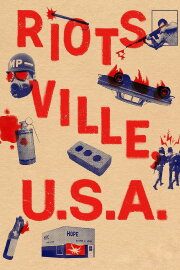
Welcome to Riotsville, a fictional town built by the US military. Using all archival footage, the film explores the militarization of the police and creates a counter-narrative to the nation's reaction to the uprisings of the late '60s.... (Full plot summary below)
Enjoy FREE movies and series with your Prime (USA) subscription or when you start a 30-day free trial!
Welcome to Riotsville, a fictional town built by the US military. Using all archival footage, the film explores the militarization of the police and creates a counter-narrative to the nation's reaction to the uprisings of the late '60s.
Leave your thoughts about Riotsville, USA.
| Austin ChronicleSarah JaneRiotsville, USA is a definitely worth your time and attention. |
| VoxAlissa WilkinsonThe film shows the birth of the militarization of police in America. |
| Film ThreatRay LoboRiotsville, U.S.A. brilliantly uses the aesthetic of its archival footage to not only place us in a historical era but also to inform, to critique state power. |
| TheWrapRonda Racha PenriceIn bold contrast to the flashier, more emotionally-charged documentaries of late, Riotsville, USA takes an approach more reminiscent of the PBS of old, or even C-SPAN, in the trust it places in the footage to tell the story. |
| ObserverOliver JonesAn equally dreamlike and urgent act of radical archiving, Sierra Pettengill’s Riotsville, USA traces the origin of America’s militarized dismantling of social justice movements to a specific time and place. |
| RogerEbert.comOdie HendersonRiotsville, U.S.A. is certainly not an objective documentary. It’s angry and it dares the viewer to argue back. The freeform nature of it may seem faulty, but I felt it served the purpose of forcing me to interrogate what I was being shown. |
| The Hollywood ReporterLovia GyarkyeAll elements of this arresting documentary work together to push an urgent thesis: What we are attuned to hearing, to seeing and to thinking about the U.S. and what the country can and cannot afford to do is by design. It’s better to realize that now before it’s too late. |
| The New York TimesGlenn KennyThis is not an objective film. It is a polemic, a work of activism, a challenge to the viewer. |
| The Film StageShayna WarnerGuided by stark intertitles and a poetic narration written by scholar Tobi Haslett, the film takes a micro and macro view of the ‘60s as a flashpoint for blatant disregard of American––especially impoverished Black American––social needs. |
| The GuardianPeter BradshawA shiver of disquiet runs right through it. |