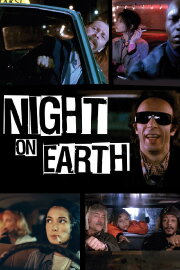
A collection of five stories involving cab drivers in five different cities. Los Angeles - A talent agent for the movies discovers her cab driver would be perfect to cast, but the cabbie is reluctant to give up her solid cab driver's career. New York - An immigrant cab driver is continually lost in a city and culture he doesn't understand. Paris - A blind girl takes a ride with a cab driver from the Ivory Coast and they talk about life and blindness. Rome - A gregarious cabbi... (Full plot summary below)
Enjoy FREE movies and series with your Prime (USA) subscription or when you start a 30-day free trial!
| Movie Source | Available | Offers | Added | Views | Quality | Format | Rating | Link | Share |
|---|---|---|---|---|---|---|---|---|---|
 | UK only | 1 Month Free Trial | 21 Nov 2025 | 5687 | HD | Watch OnlineStream Instantly | 71% |  Report: Broken Link Report: Broken Link |   |
| USA only | 1 Month Free Trial | 14 Oct 2021 | 6279 | HD | Watch OnlineStream Instantly | 84% | Report: Broken Link | |
| IRELAND only | 1 Month Free Trial | 08 Mar 2013 | 1446 | HD | Watch OnlineStream Instantly | 80% | Report: Broken Link | |
 | UK only | 30 Day Free Trial | 21 Jan 2014 | 344 | HD | Watch OnlineStream Instantly | 92% | Report: Broken Link | |
![Its HD [Night on Earth]](/images/logos/icons/itshd.png) | WORLDWIDE | ? | 29 May 2019 | 3109 | HD | Watch OnlineStream Instantly | 93% | Report: Broken Link | |
 | UK only | 30 Day Free Trial | 30 Nov 2013 | 602 | HD | Watch OnlineStream Instantly | 35% | Report: Broken Link | |
 | UK only | Free Credit | 01 Nov 2016 | 134 | HD | Watch OnlineStream Instantly | 42% | Report: Broken Link | |
 | WORLDWIDE | ? | 02 Jan 2019 | 61 | HD | Watch OnlineStream Instantly | 14% | Report: Broken Link | |
 | WORLDWIDE | ? | 17 Oct 2022 | 22 | SD / TV | Watch OnlineStream Instantly | 11% | Report: Broken Link | |
 | WORLDWIDE | ? | 25 Jan 2016 | 131 | HD | Watch OnlineStream Instantly | 6% | Report: Broken Link | |
 | WORLDWIDE | ? | 01 Apr 2024 | 9 | SD / TV | Watch OnlineStream Instantly | 10% | Report: Broken Link | |
Links compiled using automated software. Availability of offers subject to change / might be region specific / out of date.
| Movie Source | Available | Offers | Added | Views | Quality | Format | Rating | Link | Share |
|---|---|---|---|---|---|---|---|---|---|
| UK only | 30 Day Free Trial | 27 Mar 2013 | 205 | SD / DVD | DVD RentalRent by Post | 69% |  Report: Broken Link Report: Broken Link | |
 | UK only | N/A | 27 Mar 2013 | 68 | SD / DVD | DVD RentalRent by Post | 10% | Report: Broken Link | |
 | USA only | 1 Month Free Trial | 27 Mar 2013 | 238 | SD / DVD | DVD RentalRent by Mail | 15% | Report: Broken Link | |
| USA only | 1 Month Free Trial | 27 Mar 2013 | 11983 | SD / DVD | DVD RentalRent by Mail | 95% | Report: Broken Link | |
| Movie Source | Available | Offers | Added | Views | Quality | Format | Rating | Link | Share |
|---|---|---|---|---|---|---|---|---|---|
| UK only | 30 Day Free Trial | 06 Mar 2023 | 344 | HD / BR | Blu Ray RentalRent by Post | 76% | Report: Broken Link | |
| UK only | N/A | 06 Mar 2023 | 21 | HD / BR | Blu Ray RentalRent by Post | 32% | Report: Broken Link | |
| USA only | 1 Month Free Trial | 27 Mar 2013 | 85 | HD / BR | Blu Ray RentalRent by Mail | 14% | Report: Broken Link | |
| USA only | 1 Month Free Trial | 06 Mar 2023 | 2485 | HD / BR | Blu Ray RentalRent by Mail | 96% | Report: Broken Link | |
A collection of five stories involving cab drivers in five different cities. Los Angeles - A talent agent for the movies discovers her cab driver would be perfect to cast, but the cabbie is reluctant to give up her solid cab driver's career. New York - An immigrant cab driver is continually lost in a city and culture he doesn't understand. Paris - A blind girl takes a ride with a cab driver from the Ivory Coast and they talk about life and blindness. Rome - A gregarious cabbie picks up an ailing man and virtually talks him to death. Helsinki - an industrial worker gets laid off and he and his compatriots discuss the bleakness and unfairness of love and life and death.
Leave your thoughts about Night on Earth.
| Rolling StonePeter TraversJarmusch is a true visionary; he knows his films can't bring order to the ravishing chaos around him, but he can't resist the fun of trying. In this compassionate comedy of missed connections, he makes us see the ordinary in fresh and pertinent ways. But the flickers of humanity in those taxis are soon dulled by barriers of time, sex, race, language and money. They are flickers in a vast emotional void. |
| Slant MagazineDerek SmithJarmusch playfully blurs the line between driver/passenger, servant/customer, and native/immigrant, presenting these divisions as virtually meaningless social constructs which merely breed unnecessary contempt. |
| Chicago TribuneDave KehrIn Night on Earth, Jarmusch is painting with colors he has never used before. The transformation is thrilling. |
| The A.V. ClubKeith PhippsAlmost unavoidably uneven, it gets off to a rough start in a segment that relies too heavily on Winona Ryder's charms as a pixieish grease monkey. But it improves as it goes, and in segment after segment, Jarmusch's characters strive, almost heroically, to make human connections, even ones that won't last beyond the moment when they pay their fares. |
| Time Out LondonGeoff AndrewAs ever with Jarmusch, as the five sequential stories proceed toward their unexpectedly poignant conclusion, there's a touch of the experimental at play; but it's also a film of great warmth. Character prevails throughout, and with the exception of a miscast Ryder, the performances are terrific. Though it may take a while to get Jarmusch's gist, hang in there; by the time Tom Waits growls his lovely closing waltz over the credits, Jarmusch has shown us moments most film-makers don't even notice. |
| Deseret News (Salt Lake City)Chris HicksJarmusch's movies aren't for everyone - but for the sophisticated audience he pursues there are sometimes great rewards. |
| Entertainment WeeklyOwen GleibermanJim Jarmusch’s Night on Earth is an agreeably flaky comedy built around a surefire hook. Each of the film’s five segments consists of a single extended taxicab ride through a different city; the idea is that each excursion is taking place at exactly the same time. The movie is like a hipster’s ramshackle version of traveling around the world and never leaving the Hilton. |
| San Francisco ChronicleMick LaSalleJarmusch is a poet of the night. Much of Night on Earth creates the same kind of lonely, elegaic, romantic mood as Mystery Train, his film about wanderers in nighttime Memphis. Tom Waits' music helps to establish this mood of cities that have been emptied of the waking. It's as if the minds of these night people are affected by all of the dreams and nightmares that surround them. |
| The New York TimesVincent CanbyWith this, his fourth commercially released feature, Mr. Jarmusch again demonstrates his mastery of comedy of the oblique. He seems to see his characters through a telescope, while attending to their talk with some kind of long-range listening device. Everything that is seen and heard is vivid and particular, but decidedly foreign. Meanings are elusive. Themes can be supplied by others. He's also becoming an increasingly fine director of actors. |
| Los Angeles TimesPeter RainerJim Jarmusch gives us five different, self-contained episodes in five taxis in five cities on one night. The episodic structure breaks up Jarmusch's usual funky minimalism: It makes it less of a drag. Episodic movies usually don't work; we seem to settle into a story just when it ends and we're thrust into the next one. But Jarmusch's film may be a special case. Unbroken, his vague, meandering scenarios have sometimes dawdled into oblivion. But here, as in his last film, Mystery Train, the anomie is at least given some variation. |