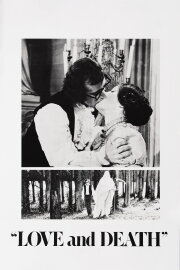
In Russia, Boris Grushenko is in love with his pseudo-intellectual cousin Sonja, who loves him since he too is a pseudo-intellectual, but she is not in love with him. Instead she is in love with his brother Ivan. But as Ivan doesn't seem to return her affections, she is determined to marry someone - anyone - except Boris. If that person isn't the perfect husband, then she has to find a suitable lover in addition. Boris' pursuit of Sonja has to take a back seat in his life whe... (Full plot summary below)
Enjoy FREE movies and series with your Prime (USA) subscription or when you start a 30-day free trial!
| Movie Source | Available | Offers | Added | Views | Quality | Format | Rating | Link | Share |
|---|---|---|---|---|---|---|---|---|---|
 | UK only | 1 Month Free Trial | 28 Oct 2013 | 5141 | HD | Watch OnlineStream Instantly | 86% |  Report: Broken Link Report: Broken Link |   |
| USA only | 1 Month Free Trial | 25 Mar 2024 | 3514 | HD | Watch OnlineStream Instantly | 98% | Report: Broken Link | |
| IRELAND only | 1 Month Free Trial | 11 Dec 2013 | 5865 | HD | Watch OnlineStream Instantly | 69% | Report: Broken Link | |
 | UK only | 30 Day Free Trial | 30 Aug 2017 | 906 | HD | Watch OnlineStream Instantly | 83% | Report: Broken Link | |
![Its HD [Love and Death]](/images/logos/icons/itshd.png) | WORLDWIDE | ? | 20 Apr 2019 | 3232 | HD | Watch OnlineStream Instantly | 88% | Report: Broken Link | |
 | UK only | 30 Day Free Trial | 06 Dec 2019 | 338 | HD | Watch OnlineStream Instantly | 55% | Report: Broken Link | |
 | UK only | Free Credit | 03 Jun 2013 | 132 | HD | Watch OnlineStream Instantly | 39% | Report: Broken Link | |
 | WORLDWIDE | ? | 22 Apr 2025 | 56 | HD | Watch OnlineStream Instantly | 35% | Report: Broken Link | |
 | WORLDWIDE | ? | 23 Dec 2023 | 21 | SD / TV | Watch OnlineStream Instantly | 17% | Report: Broken Link | |
 | WORLDWIDE | ? | 11 Oct 2019 | 226 | HD | Watch OnlineStream Instantly | 22% | Report: Broken Link | |
 | WORLDWIDE | ? | 05 Aug 2020 | 25 | SD / TV | Watch OnlineStream Instantly | 13% | Report: Broken Link | |
Links compiled using automated software. Availability of offers subject to change / might be region specific / out of date.
| Movie Source | Available | Offers | Added | Views | Quality | Format | Rating | Link | Share |
|---|---|---|---|---|---|---|---|---|---|
| UK only | 30 Day Free Trial | 26 Apr 2020 | 1261 | SD / DVD | DVD RentalRent by Post | 60% |  Report: Broken Link Report: Broken Link | |
 | UK only | N/A | 26 Apr 2020 | 50 | SD / DVD | DVD RentalRent by Post | 62% | Report: Broken Link | |
 | USA only | 1 Month Free Trial | 26 Apr 2020 | 199 | SD / DVD | DVD RentalRent by Mail | 19% | Report: Broken Link | |
| USA only | 1 Month Free Trial | 26 Apr 2020 | 5713 | SD / DVD | DVD RentalRent by Mail | 87% | Report: Broken Link | |
| Movie Source | Available | Offers | Added | Views | Quality | Format | Rating | Link | Share |
|---|---|---|---|---|---|---|---|---|---|
| UK only | 30 Day Free Trial | 22 Aug 2018 | 253 | HD / BR | Blu Ray RentalRent by Post | 61% | Report: Broken Link | |
| UK only | N/A | 22 Aug 2018 | 92 | HD / BR | Blu Ray RentalRent by Post | 12% | Report: Broken Link | |
| USA only | 1 Month Free Trial | 26 Apr 2020 | 598 | HD / BR | Blu Ray RentalRent by Mail | 12% | Report: Broken Link | |
| USA only | 1 Month Free Trial | 22 Aug 2018 | 8363 | HD / BR | Blu Ray RentalRent by Mail | 83% | Report: Broken Link | |
In Russia, Boris Grushenko is in love with his pseudo-intellectual cousin Sonja, who loves him since he too is a pseudo-intellectual, but she is not in love with him. Instead she is in love with his brother Ivan. But as Ivan doesn't seem to return her affections, she is determined to marry someone - anyone - except Boris. If that person isn't the perfect husband, then she has to find a suitable lover in addition. Boris' pursuit of Sonja has to take a back seat in his life when he, a pacifist and coward, is forced to join the Russian Army to battle Napoleon's forces which have just invaded Austria. Despite Sonja not being in the picture while he's away at war, Boris' thoughts do not stray totally from women. Although they take these two divergent paths in their lives, those paths cross once again as they, together, both try to find the perfect spouse and lover, and try to assassinate Napoleon.
Leave your thoughts about Love and Death.
| Spirituality and PracticeFrederic and Mary Ann BrussatStomps all over the games we play to pretend we're important |
| Mountain Xpress (Asheville, NC)Ken HankeAbsurd from start to finish, it may just be Allen's funniest film. |
| EmpireIan NathanThis magnificent, often anarchic pastiche of Russian literature’s portentous habits with a side order in Bergmanesque death wallowing actually finds Allen at his silliest. Which also means it is extraordinarily clever silliness, with designs deliberately stolen from Chaplin, Keaton and the Marx Brothers. It is film that explores comedy’s infinite variety via the medium of the existential philosophy of those big Russian sagas slumped in history like sulking teenagers. |
| The New York TimesJanet MaslinBesides being one of Woody's most consistently witty films, Love and Death marks a couple of other advances for Mr. Allen as a film maker and for Miss Keaton as a wickedly funny comedienne. |
| Chicago Sun-TimesRoger EbertThere are shadings of comic meaning that could have gotten lost if all we had were the words, and there are whole scenes that play off facial expressions. It's a good movie to watch just for that reason, because it's been done with such care, love and lunacy. |
| Creative LoafingMatt BrunsonThe picture is packed front to back with many more cheery bon mots -- to say nothing of rollicking slapstick sequences, spoofy film homages and other modes of merriment guaranteed to keep viewers in perpetual guffaw. |
| EmanuelLevy.ComEmanuel LevyThus early Woody Allen film is quite a funny, often even poignant satire of Russian literature and Russian mores. |
| CinePassionFernando F. CroceWoody Allen meets Dostoyevsky, and the two compare misanthropic views |
| User ReviewEyal DSo apparently this is Woody Allen's favorite film, of the ones he's made. I can see that, especially if Woody Allen is a little more snobbish than I thought. |
| User ReviewTina SLove and Death is a novel idea, because of all the spoofs---Airplane!, The Naked Gun, Blazing Saddles, Young Frankenstein, these horrible new ones like Meet the Spartans and Superhero Movie---Love and Death parodies things none of those other filmmakers would think to. The main thread of the plot is framed like a Russian novel with direct hints at Dostoevsky and Tolstoy, complete with imposed philosophical debates, and freely sprinkled across the film are direct send-ups of Ingmar Bergman films, namely Persona and Smiles of a Summer Night. Woody Allen, in what he has claimed to be his favorite of the few films he's made with which he's been satisfied, plays his normal nebbishy caricature which fits quite well into the context of his references, a scholar who is forced to enlist in the Russian Army, desperate and disappointed hearing the news that his cousin, played with a hilarious callousness by Diane Keaton, is to wed a herring merchant. In one of the film's funnier moments, Woody captures a group of enemy soldiers by accident, but to no avail, as the French reach Moscow immediately afterward. He returns and marries the recently widowed Keaton who really does not want to marry Boris, but promises him she will when she thinks he is about to be killed in a duel. She coaxes him into helping her plot to kill Napoleon. I wanted to see this film so badly, being an enormous fan of Woody Allen's work as he is amongst the very top trio of my favorite film directors. I was disappointed, though, to find this to be the most hit-or-miss of all of his comedies. It is not quite as funny as one would expect it to inevitably be, though there are some hilarious bits, usually amongst Woody's character's family and Keaton's total aloofness during tragedy. It's still nevertheless warm and entertaining, as are every single one of Woody's films. |