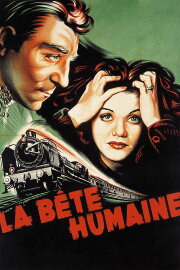
Jacques Lantier is a train engineer who is prone to violent seizures, a condition he attributes to his forefathers' habit of excessive drinking. Roubaud is a train conductor on the same railroad that Lantier works on, married to the much younger Séverine. When Roubaud catches wind of his wife's affair with her godfather, the wealthy M. Grandmorin, he kills him during a train journey in a fit of jealousy. He makes sure that Séverine is also present, making her an accomplice ... (Full plot summary below)
Enjoy FREE movies and series with your Prime (USA) subscription or when you start a 30-day free trial!
| Movie Source | Available | Offers | Added | Views | Quality | Format | Rating | Link | Share |
|---|---|---|---|---|---|---|---|---|---|
 | UK only | 1 Month Free Trial | 21 Jul 2018 | 3009 | HD | Watch OnlineStream Instantly | 60% |  Report: Broken Link Report: Broken Link |   |
| USA only | 1 Month Free Trial | 22 Jan 2013 | 1559 | HD | Watch OnlineStream Instantly | 96% | Report: Broken Link | |
| IRELAND only | 1 Month Free Trial | 30 Sep 2014 | 1058 | HD | Watch OnlineStream Instantly | 83% | Report: Broken Link | |
 | UK only | 30 Day Free Trial | 03 Dec 2017 | 411 | HD | Watch OnlineStream Instantly | 85% | Report: Broken Link | |
![Its HD [La Bête Humaine]](/images/logos/icons/itshd.png) | WORLDWIDE | ? | 16 Jul 2018 | 3795 | HD | Watch OnlineStream Instantly | 86% | Report: Broken Link | |
 | UK only | 30 Day Free Trial | 03 Apr 2023 | 730 | HD | Watch OnlineStream Instantly | 55% | Report: Broken Link | |
 | UK only | Free Credit | 28 Dec 2018 | 132 | HD | Watch OnlineStream Instantly | 41% | Report: Broken Link | |
 | WORLDWIDE | ? | 09 Aug 2014 | 63 | HD | Watch OnlineStream Instantly | 14% | Report: Broken Link | |
 | WORLDWIDE | ? | 23 Jun 2019 | 18 | SD / TV | Watch OnlineStream Instantly | 17% | Report: Broken Link | |
 | WORLDWIDE | ? | 27 Jul 2020 | 156 | HD | Watch OnlineStream Instantly | 6% | Report: Broken Link | |
 | WORLDWIDE | ? | 07 Dec 2019 | 21 | SD / TV | Watch OnlineStream Instantly | 17% | Report: Broken Link | |
Links compiled using automated software. Availability of offers subject to change / might be region specific / out of date.
| Movie Source | Available | Offers | Added | Views | Quality | Format | Rating | Link | Share |
|---|---|---|---|---|---|---|---|---|---|
| UK only | 30 Day Free Trial | 01 Jan 2018 | 3325 | SD / DVD | DVD RentalRent by Post | 75% |  Report: Broken Link Report: Broken Link | |
 | UK only | N/A | 01 Jan 2018 | 105 | SD / DVD | DVD RentalRent by Post | 16% | Report: Broken Link | |
 | USA only | 1 Month Free Trial | 01 Jan 2018 | 198 | SD / DVD | DVD RentalRent by Mail | 9% | Report: Broken Link | |
| USA only | 1 Month Free Trial | 01 Jan 2018 | 15000 | SD / DVD | DVD RentalRent by Mail | 88% | Report: Broken Link | |
| Movie Source | Available | Offers | Added | Views | Quality | Format | Rating | Link | Share |
|---|---|---|---|---|---|---|---|---|---|
| UK only | 30 Day Free Trial | 24 Dec 2013 | 184 | HD / BR | Blu Ray RentalRent by Post | 63% | Report: Broken Link | |
| UK only | N/A | 24 Dec 2013 | 102 | HD / BR | Blu Ray RentalRent by Post | 40% | Report: Broken Link | |
| USA only | 1 Month Free Trial | 01 Jan 2018 | 796 | HD / BR | Blu Ray RentalRent by Mail | 20% | Report: Broken Link | |
| USA only | 1 Month Free Trial | 24 Dec 2013 | 5331 | HD / BR | Blu Ray RentalRent by Mail | 87% | Report: Broken Link | |
Jacques Lantier is a train engineer who is prone to violent seizures, a condition he attributes to his forefathers' habit of excessive drinking. Roubaud is a train conductor on the same railroad that Lantier works on, married to the much younger Séverine. When Roubaud catches wind of his wife's affair with her godfather, the wealthy M. Grandmorin, he kills him during a train journey in a fit of jealousy. He makes sure that Séverine is also present, making her an accomplice to murder. Lantier, despite having witnessed them quite clearly in the train corridor, hides the fact during the investigation as he is attracted to Séverine. They both begin an affair, all the while Roubaud becomes increasingly withdrawn and starts to gamble. Séverine urges Lantier to kill her husband so that they would be free but she is unaware of Lantier's unfortunate condition.
Leave your thoughts about La Bête Humaine.
| Chicago ReaderDave KehrJean Renoir's generous sensibility seems at odds with the sterile determinism of the Zola novel on which this 1938 film was based. |
| New YorkerPauline KaelThe film has marvellous atmosphere and a fine cast, but the material, which involves brutal, uncontrollable passion seen in a social framework, turns oppressive, and at times Gabin is a lump. |
| Groucho ReviewsPeter Canavese[Renoir's] expertise behind the camera--and his driving curiosity for human constructs and human nature...elevate La bete humaine to an unforgettable filmic experience. |
| DVDJournal.comMark BourneLa bête humaine may show Renoir at his darkest, but as always Renoir in his observantly caustic mode can't bring himself to not splash highlighting colors onto his preeminently human canvas. |
| User ReviewAl MJean Renoir's adaptation of Emile Zola's La Bete Humaine (or "The Human Beast," as it is translated in the subtitles) is a naturalistic tour-de-force that explores the nature of love, the power of obsession, and inability to escape one's past. Unlike many naturalistic works, La Bete Humaine is not simply a bleak, depressing examination of characters as they destroy themselves; instead, it is a taunt thriller that follows the lives of several individuals related by the business of train-travel who become involved in murder, adultery, and a variety of other intrigues. Renoir powerfully brings locomotive travel into the film, and the train steadily becomes a character itself that ties together the various lives that we watch unravel onscreen. Indeed, as with any good naturalistic work, La Bete Humaine examines how our environment and upbringing determine our fates. And, indeed, the characters barrel full-speed towards their fates like the unstoppable juggernaut of the steam-engine. In effect, their lives, like the train, are own tracks as the proceed inevitably towards one fated, tragic outcome. As always, Renoir's direction is breathtaking and brilliant, and he manages to truly bring Zola's story to life in this powerful exploration of human identity and the damned relationships we forge with one another. |
| User Reviewpaul BJean Renoir's adaptation of Emile Zola's La Bete Humaine (or "The Human Beast," as it is translated in the subtitles) is a naturalistic tour-de-force that explores the nature of love, the power of obsession, and inability to escape one's past. Unlike many naturalistic works, La Bete Humaine is not simply a bleak, depressing examination of characters as they destroy themselves; instead, it is a taunt thriller that follows the lives of several individuals related by the business of train-travel who become involved in murder, adultery, and a variety of other intrigues. Renoir powerfully brings locomotive travel into the film, and the train steadily becomes a character itself that ties together the various lives that we watch unravel onscreen. Indeed, as with any good naturalistic work, La Bete Humaine examines how our environment and upbringing determine our fates. And, indeed, the characters barrel full-speed towards their fates like the unstoppable juggernaut of the steam-engine. In effect, their lives, like the train, are own tracks as the proceed inevitably towards one fated, tragic outcome. As always, Renoir's direction is breathtaking and brilliant, and he manages to truly bring Zola's story to life in this powerful exploration of human identity and the damned relationships we forge with one another. |
| User ReviewDavid HSaw the Fritz Lang Remake before allthough it still was a Impression to me the Style is really amazing and the Direction, Camera Work and the Actors brilliant the Music ist Bombastic |
| User ReviewLuciana OThe exquisite performances by the love triangle and also by the protagonists friend make this film noir such an enthralling and enchanting experience. |
| User ReviewHouse MAmazing film, one of the first films that really open my eyes as a young child (9 years old). I remember the feeling when we could hear the train passing by, the face of Jean Gabin, the psychological intensity. A must must see. On my top 10 (maybe being a little bit bias). |
| User ReviewJace LBrilliantly directed by Jean Renoir, La Bete Humaine is filled with wonderful performances and expert composition. |