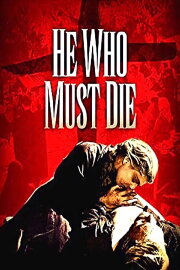
Greece, in the 1920's, is occupied by the Turks. The country is in turmoil with entire villages uprooted. The site of the movie is a Greek village that conducts a passion play each year. The leading citizens of the town, under the auspices of the Patriarch, choose those that will play the parts in the Passion. A stuttering shepherd is chosen to play Jesus. The town butcher (who wanted to be Jesus) is chosen as Judas. The town prostitute is chosen as Mary Magdalene. The rest o... (Full plot summary below)
Enjoy FREE movies and series with your Prime (USA) subscription or when you start a 30-day free trial!
| Movie Source | Available | Offers | Added | Views | Quality | Format | Rating | Link | Share |
|---|---|---|---|---|---|---|---|---|---|
 | UK only | 1 Month Free Trial | 17 Sep 2023 | 5659 | HD | Watch OnlineStream Instantly | 78% |  Report: Broken Link Report: Broken Link |   |
| USA only | 1 Month Free Trial | 05 Jun 2018 | 6456 | HD | Watch OnlineStream Instantly | 73% | Report: Broken Link | |
| IRELAND only | 1 Month Free Trial | 16 Jan 2015 | 4656 | HD | Watch OnlineStream Instantly | 78% | Report: Broken Link | |
 | UK only | 30 Day Free Trial | 02 Mar 2019 | 497 | HD | Watch OnlineStream Instantly | 83% | Report: Broken Link | |
![Its HD [He Who Must Die]](/images/logos/icons/itshd.png) | WORLDWIDE | ? | 22 Oct 2021 | 3181 | HD | Watch OnlineStream Instantly | 84% | Report: Broken Link | |
 | UK only | 30 Day Free Trial | 17 Feb 2020 | 207 | HD | Watch OnlineStream Instantly | 60% | Report: Broken Link | |
 | UK only | Free Credit | 01 Aug 2019 | 145 | HD | Watch OnlineStream Instantly | 39% | Report: Broken Link | |
 | WORLDWIDE | ? | 22 Apr 2017 | 184 | HD | Watch OnlineStream Instantly | 23% | Report: Broken Link | |
 | WORLDWIDE | ? | 21 Feb 2022 | 19 | SD / TV | Watch OnlineStream Instantly | 14% | Report: Broken Link | |
 | WORLDWIDE | ? | 02 Jun 2019 | 151 | HD | Watch OnlineStream Instantly | 17% | Report: Broken Link | |
 | WORLDWIDE | ? | 23 Aug 2023 | 38 | SD / TV | Watch OnlineStream Instantly | 9% | Report: Broken Link | |
Links compiled using automated software. Availability of offers subject to change / might be region specific / out of date.
| Movie Source | Available | Offers | Added | Views | Quality | Format | Rating | Link | Share |
|---|---|---|---|---|---|---|---|---|---|
| UK only | 30 Day Free Trial | 13 Jan 2024 | 1393 | SD / DVD | DVD RentalRent by Post | 84% |  Report: Broken Link Report: Broken Link | |
 | UK only | N/A | 13 Jan 2024 | 39 | SD / DVD | DVD RentalRent by Post | 25% | Report: Broken Link | |
 | USA only | 1 Month Free Trial | 13 Jan 2024 | 238 | SD / DVD | DVD RentalRent by Mail | 9% | Report: Broken Link | |
| USA only | 1 Month Free Trial | 13 Jan 2024 | 8524 | SD / DVD | DVD RentalRent by Mail | 90% | Report: Broken Link | |
| Movie Source | Available | Offers | Added | Views | Quality | Format | Rating | Link | Share |
|---|---|---|---|---|---|---|---|---|---|
| UK only | 30 Day Free Trial | 15 Nov 2019 | 246 | HD / BR | Blu Ray RentalRent by Post | 77% | Report: Broken Link | |
| UK only | N/A | 15 Nov 2019 | 90 | HD / BR | Blu Ray RentalRent by Post | 12% | Report: Broken Link | |
| USA only | 1 Month Free Trial | 13 Jan 2024 | 613 | HD / BR | Blu Ray RentalRent by Mail | 18% | Report: Broken Link | |
| USA only | 1 Month Free Trial | 15 Nov 2019 | 6053 | HD / BR | Blu Ray RentalRent by Mail | 99% | Report: Broken Link | |
Sorry, we can't find any suggestions at the moment.
Greece, in the 1920's, is occupied by the Turks. The country is in turmoil with entire villages uprooted. The site of the movie is a Greek village that conducts a passion play each year. The leading citizens of the town, under the auspices of the Patriarch, choose those that will play the parts in the Passion. A stuttering shepherd is chosen to play Jesus. The town butcher (who wanted to be Jesus) is chosen as Judas. The town prostitute is chosen as Mary Magdalene. The rest of the disciples are also chosen. As the movie unfolds, the Passion Play becomes a reality. A group of villagers, uprooted by the war and impoverished, arrive at the village led by their priest. The wealthier citizens of the town want nothing with these people and manipulate a massacre. In the context of the 1920's each of the characters plays out their biblical role in actuality.
Leave your thoughts about He Who Must Die.
| The SpectatorIsabel QuiglyThere are old lessons and modern ones in the story; old allegory and some as up-to-date as modern politics. The book had innumerable themes that the film version, cannot pursue and unravel too far; but it sticks pretty faithfully, in fact and in spirit. |
| Ozus' World Movie ReviewsDennis SchwartzPowerful Christian allegory based on Nikos Kazantzakis' brilliant novel The Greek Passion. |
| User ReviewDavey MI can't understand how I only heard of this movie because I was familiar with the novel on which it was based. It's a brilliant, beautifully crafted piece of work, a modern reimagining of the story of Christ as a revolutionary. I'm not totally sold on the way it eventually builds into a Marxist call for violent revolution, but man is it powerful, and, whether I ultimately agree with Dassin's take on Kazantzakis or not, I do think it's a valid interpretation of the Jesus story. Great writing, great direction, great black and white Cinemascope photography, great movie. |
| User ReviewMaria SVision d'un Christ communiste qui se revolte contre les notables et le clergé. |
| User ReviewGiorgos S(ellhnika:"O Xristos ksanastavrwnetai")Masterpiece! It shows very clearly how easily people are manipulated by authority and especially the Church and how Greeks are unable to unite and help each other. One of the movies that make you a better person... I must read the book... |
| User ReviewTaylor B"I just realized, if Christ returned today, he would be crucified again... and you would be the one driving in the nails." |
| User ReviewJacob FAn incredibly well observed retelling of the Christ story in a semi-modern setting, through a Greek village's reenactment of a Passion play. Provides a damming commentary on the religious institute and its role in society and celebrates humanism no matter what your beliefs, religious or not. |