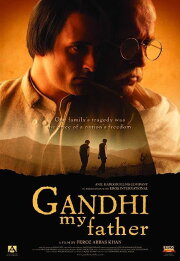
Mohandas was born in the Gujarati speaking family, had several brothers who jointly owned property in Rajkot. At the age of 13 Mohandas married Kasturba. On attaining maturity he re-located to England, became a Barrister, returned home, and together with Kasturba re-located to South Africa. They returned to India for a few years and this is where they became parents of four sons: Harilal, Manilal, Ramdas and Devdas. Subsequently, the family returned to South Africa, leaving H... (Full plot summary below)
Enjoy FREE movies and series with your Prime (USA) subscription or when you start a 30-day free trial!
| Movie Source | Available | Offers | Added | Views | Quality | Format | Rating | Link | Share |
|---|---|---|---|---|---|---|---|---|---|
 | UK only | 1 Month Free Trial | 30 Apr 2024 | 4006 | HD | Watch OnlineStream Instantly | 70% |  Report: Broken Link Report: Broken Link |   |
| USA only | 1 Month Free Trial | 16 Apr 2021 | 1435 | HD | Watch OnlineStream Instantly | 96% | Report: Broken Link | |
| IRELAND only | 1 Month Free Trial | 01 Apr 2019 | 5652 | HD | Watch OnlineStream Instantly | 95% | Report: Broken Link | |
 | UK only | 30 Day Free Trial | 27 May 2020 | 437 | HD | Watch OnlineStream Instantly | 83% | Report: Broken Link | |
![Its HD [Gandhi, My Father]](/images/logos/icons/itshd.png) | WORLDWIDE | ? | 15 Mar 2015 | 3269 | HD | Watch OnlineStream Instantly | 93% | Report: Broken Link | |
 | UK only | 30 Day Free Trial | 28 May 2021 | 835 | HD | Watch OnlineStream Instantly | 50% | Report: Broken Link | |
 | UK only | Free Credit | 15 Apr 2016 | 150 | HD | Watch OnlineStream Instantly | 50% | Report: Broken Link | |
 | WORLDWIDE | ? | 30 Dec 2023 | 97 | HD | Watch OnlineStream Instantly | 16% | Report: Broken Link | |
 | WORLDWIDE | ? | 20 May 2015 | 22 | SD / TV | Watch OnlineStream Instantly | 23% | Report: Broken Link | |
 | WORLDWIDE | ? | 26 Nov 2021 | 227 | HD | Watch OnlineStream Instantly | 10% | Report: Broken Link | |
 | WORLDWIDE | ? | 11 Jan 2026 | 28 | SD / TV | Watch OnlineStream Instantly | 12% | Report: Broken Link | |
Links compiled using automated software. Availability of offers subject to change / might be region specific / out of date.
| Movie Source | Available | Offers | Added | Views | Quality | Format | Rating | Link | Share |
|---|---|---|---|---|---|---|---|---|---|
| UK only | 30 Day Free Trial | 13 Sep 2019 | 3137 | SD / DVD | DVD RentalRent by Post | 88% |  Report: Broken Link Report: Broken Link | |
 | UK only | N/A | 13 Sep 2019 | 89 | SD / DVD | DVD RentalRent by Post | 60% | Report: Broken Link | |
 | USA only | 1 Month Free Trial | 13 Sep 2019 | 110 | SD / DVD | DVD RentalRent by Mail | 8% | Report: Broken Link | |
| USA only | 1 Month Free Trial | 13 Sep 2019 | 17701 | SD / DVD | DVD RentalRent by Mail | 79% | Report: Broken Link | |
| Movie Source | Available | Offers | Added | Views | Quality | Format | Rating | Link | Share |
|---|---|---|---|---|---|---|---|---|---|
| UK only | 30 Day Free Trial | 22 Nov 2017 | 296 | HD / BR | Blu Ray RentalRent by Post | 92% | Report: Broken Link | |
| UK only | N/A | 22 Nov 2017 | 29 | HD / BR | Blu Ray RentalRent by Post | 33% | Report: Broken Link | |
| USA only | 1 Month Free Trial | 13 Sep 2019 | 655 | HD / BR | Blu Ray RentalRent by Mail | 13% | Report: Broken Link | |
| USA only | 1 Month Free Trial | 22 Nov 2017 | 3611 | HD / BR | Blu Ray RentalRent by Mail | 92% | Report: Broken Link | |
Mohandas was born in the Gujarati speaking family, had several brothers who jointly owned property in Rajkot. At the age of 13 Mohandas married Kasturba. On attaining maturity he re-located to England, became a Barrister, returned home, and together with Kasturba re-located to South Africa. They returned to India for a few years and this is where they became parents of four sons: Harilal, Manilal, Ramdas and Devdas. Subsequently, the family returned to South Africa, leaving Harilal alone. As Harilal did not do well in his studies he got married to Gulab without his parents' blessings. Mohandas then invited Harilal to South Africa and on his Secretary's request also invited Gulab, who had recently given birth to a daughter, Rami. Harilal wanted to be a Barrister like his father but found his movements restricted as his father wanted him to actively participate against the Satanist and Racist British regime, leading to Harilal being arrested and imprisoned. Harilal's hopes of becoming a Barrister were dashed when Mohandas sent his nephew, Chaganlal, instead, and when Chaganlal proved a failure, sent Sorabjee to England in his place. Harilal then changed his name to Pranlal Mehta in a vain attempt to return to India. A frustrated Gulab, now a mother of 4, did return to India with her children. After actively protesting draconian British Laws, especially the Christian Act that only recognized marriages performed by a Christian Priest, by General Ian Smutts, Mohandas was imprisoned, and upon being released returned to India. He hoped that Harilal would follow in his footsteps, but Harilal re-located to Calcutta, found a job as a Cashier, embezzled and borrowed money to buy imported cloths, in vast contrast to Mohandas' campaign to burn foreign clothing, got himself in trouble and debt, prompting Gulab to return to leave him. Harilal did return to Gujarat after he heard of his son, Shanti's and Gulab's passing. He did get involved in the freedom struggle temporarily, but was lured by some businessmen, who used his and his dad's name to get people to invest, and then disappeared, forcing Mohandas to publicly disown his son, who was then arrested and imprisoned. Unstable, unemployed, unable to keep up with his father's lofty standards, Harilal considered becoming a Christian, but then with Zakaria's help became an Islamic and changed his name to Abdullah, prompting Kasturba to pay him a visit and talk him to becoming a Hindu again. Then when Mohandas announced the beginning of 'Do or Die' campaign in Bombay during 1942, he was placed under house arrest in the Agha Khan Palace with Hindus calling him a traitor and Muslims praying for his death. This is where a distraught, disheveled and bearded Harilal will meet his parents. Will his parents accept him as he is and welcome him back?
Leave your thoughts about Gandhi, My Father.
| Old School ReviewsJohn A. Nesbitpromising concept ends up devolving into the ordinary |
| VarietyDerek ElleyClassy production values and a textured lead performance by Darshan Jariwala are undercut by a lack of real drama in Gandhi My Father. |
| The Hollywood ReporterGautaman BhaskaranKhan's work, despite great performances, may not ride the popularity charts, and the film may have to content itself with attracting limited arthouse audiences. |
| Los Angeles TimesJohn AndersonExposes director Khan's stage roots -- he has no feel for the close-up, although his use of the frame itself, and negative space, is occasionally thrilling. |
| L.A. WeeklyDavid ChuteGandhi, My Father radiates sincerity. It’s a beautifully shot and staged period reconstruction, and is at times impressively acted, at least in the secondary roles. What it lacks is fresh insight. |
| BBC.comJaspreet PandoharJariwalla and Khanna's competent performances, and Khan's simplistic screenplay fail to grip and elevate this from an average to an exceptional piece of cinema. |
| Financial TimesNigel AndrewsA long-distance trek with refreshment breaks. |
| Total FilmNaman RamachandranDebut director Feroz Abbas Khan adapts his hit play Mahatma v/s Gandhi for the screen with mixed results. |
| Slant MagazineNick SchagerGandhi, My Father weakly opts for lionization at precisely the moment it should go in for the killshot. |
| Independent (UK)Anthony QuinnAn insight into the flawed nature of a great man. |