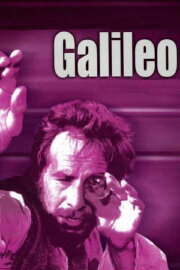
This biopic is about Galileo Galilei, the seventeenth century Italian who laid the foundations of modern science. Galileo made himself one of the world's first telescopes and discovered the moons of Jupiter. He supported Copernicus' theory that the Earth revolved around the Sun. This brought him in conflict with the Catholic Church. By threatening him with torture, the Church forced him to recant his views in front of a tribunal, and sentenced him to house arrest. However, Ga... (Full plot summary below)
Enjoy FREE movies and series with your Prime (USA) subscription or when you start a 30-day free trial!
| Movie Source | Available | Offers | Added | Views | Quality | Format | Rating | Link | Share |
|---|---|---|---|---|---|---|---|---|---|
 | UK only | 1 Month Free Trial | 28 Apr 2020 | 4578 | HD | Watch OnlineStream Instantly | 83% |  Report: Broken Link Report: Broken Link |   |
| USA only | 1 Month Free Trial | 30 Oct 2018 | 2672 | HD | Watch OnlineStream Instantly | 83% | Report: Broken Link | |
| IRELAND only | 1 Month Free Trial | 04 Apr 2016 | 1098 | HD | Watch OnlineStream Instantly | 90% | Report: Broken Link | |
 | UK only | 30 Day Free Trial | 16 Nov 2015 | 676 | HD | Watch OnlineStream Instantly | 81% | Report: Broken Link | |
![Its HD [Galileo]](/images/logos/icons/itshd.png) | WORLDWIDE | ? | 27 Nov 2019 | 3411 | HD | Watch OnlineStream Instantly | 93% | Report: Broken Link | |
 | UK only | 30 Day Free Trial | 26 Dec 2014 | 387 | HD | Watch OnlineStream Instantly | 47% | Report: Broken Link | |
 | UK only | Free Credit | 07 May 2013 | 164 | HD | Watch OnlineStream Instantly | 37% | Report: Broken Link | |
 | WORLDWIDE | ? | 02 Oct 2019 | 151 | HD | Watch OnlineStream Instantly | 21% | Report: Broken Link | |
 | WORLDWIDE | ? | 05 Jun 2020 | 18 | SD / TV | Watch OnlineStream Instantly | 13% | Report: Broken Link | |
 | WORLDWIDE | ? | 04 Aug 2024 | 293 | HD | Watch OnlineStream Instantly | 25% | Report: Broken Link | |
 | WORLDWIDE | ? | 03 Nov 2016 | 10 | SD / TV | Watch OnlineStream Instantly | 4% | Report: Broken Link | |
Links compiled using automated software. Availability of offers subject to change / might be region specific / out of date.
| Movie Source | Available | Offers | Added | Views | Quality | Format | Rating | Link | Share |
|---|---|---|---|---|---|---|---|---|---|
| UK only | 30 Day Free Trial | 12 Nov 2016 | 1632 | SD / DVD | DVD RentalRent by Post | 70% |  Report: Broken Link Report: Broken Link | |
 | UK only | N/A | 12 Nov 2016 | 79 | SD / DVD | DVD RentalRent by Post | 56% | Report: Broken Link | |
 | USA only | 1 Month Free Trial | 12 Nov 2016 | 147 | SD / DVD | DVD RentalRent by Mail | 15% | Report: Broken Link | |
| USA only | 1 Month Free Trial | 12 Nov 2016 | 3289 | SD / DVD | DVD RentalRent by Mail | 80% | Report: Broken Link | |
| Movie Source | Available | Offers | Added | Views | Quality | Format | Rating | Link | Share |
|---|---|---|---|---|---|---|---|---|---|
| UK only | 30 Day Free Trial | 02 Jul 2014 | 198 | HD / BR | Blu Ray RentalRent by Post | 82% | Report: Broken Link | |
| UK only | N/A | 02 Jul 2014 | 26 | HD / BR | Blu Ray RentalRent by Post | 49% | Report: Broken Link | |
| USA only | 1 Month Free Trial | 12 Nov 2016 | 808 | HD / BR | Blu Ray RentalRent by Mail | 19% | Report: Broken Link | |
| USA only | 1 Month Free Trial | 02 Jul 2014 | 3967 | HD / BR | Blu Ray RentalRent by Mail | 82% | Report: Broken Link | |
This biopic is about Galileo Galilei, the seventeenth century Italian who laid the foundations of modern science. Galileo made himself one of the world's first telescopes and discovered the moons of Jupiter. He supported Copernicus' theory that the Earth revolved around the Sun. This brought him in conflict with the Catholic Church. By threatening him with torture, the Church forced him to recant his views in front of a tribunal, and sentenced him to house arrest. However, Galileo's trials and theories inspired others like Sir Isaac Newton and Johannes Kepler to prove that the Earth was not the center of the universe. Some years ago, the Pope accepted that Earth does revolve around the Sun and issued a rare apology for what the Church had done to Galileo. The Catholic Church recanted.
Leave your thoughts about Galileo.
| User ReviewAdam OThis provocative and meditative collaboration is a hidden gem of historical drama. The dialogue is so masterfully written by Brecht and translated by Laughton that one could feasibly listen to the film without a single peek at the screen and still enjoy the entire drama. There is a highly interpretive and gestural ballad / ballet interlude that reaches deep and wide to the fringes of how impactful an earlier age of enlightenment might have been for all of us. The stylized interlude is likely to stir cringes from the average moviegoer, and might explain the lack of activity surrounding this work considering it's heavyweight authors and contributors. Topol must have been granted access to everything he needed to revive the legendary 1947 performance that Laughton is lauded for - perhaps it is the more obvious connection, the common director for both Laughton and Topol, Joseph Losey. Topol does a masterful job with the role, but I can imagine a more empathetic and cathartic experience from Laughton. I imagine Laughton brought the tragedy of Galileo's censure to a more emotional climax, as opposed to Topol's equally passionate, but decidedly cerebral and rational reaction to the harrowing conclusion of Galileo's work. |
| User ReviewHarry ETruely intelligent adaptation of Brecht's play. A must for philosophy students! |
| User ReviewJonathan SThe cast (especially the dynamic Topol as Galileo) is great for this filmed stageplay...not all the singing stuff works for me. |
| User ReviewAndrew BA marginally inspired yet straightforward setup that doesn't work all the time (they REALLY should have gotten rid of those singing boy narrators), but Topol's magnetism holds it together well enough. |