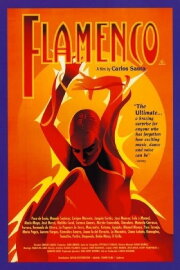
As a hall fills with performers, a narrator says that flamenco came from Andalucia, a mix of Greek psalms, Mozarabic dirges, Castillian ballads, Jewish laments, Gregorian chants, African rhythms, and Iranian and Romany melodies. The film presents thirteen rhythms of flamenco, each with song, guitar, and dance: the up-tempo bularías, a brooding farruca, an anguished martinete, and a satiric fandango de huelva. There are tangos, a taranta, alegrías, siguiriyas, soleás, a gua... (Full plot summary below)
Enjoy FREE movies and series with your Prime (USA) subscription or when you start a 30-day free trial!
| Movie Source | Available | Offers | Added | Views | Quality | Format | Rating | Link | Share |
|---|---|---|---|---|---|---|---|---|---|
 | UK only | 1 Month Free Trial | 11 Jan 2013 | 5609 | HD | Watch OnlineStream Instantly | 64% |  Report: Broken Link Report: Broken Link |   |
| USA only | 1 Month Free Trial | 10 Sep 2025 | 3385 | HD | Watch OnlineStream Instantly | 89% | Report: Broken Link | |
| IRELAND only | 1 Month Free Trial | 02 Apr 2013 | 2942 | HD | Watch OnlineStream Instantly | 88% | Report: Broken Link | |
 | UK only | 30 Day Free Trial | 08 Feb 2016 | 585 | HD | Watch OnlineStream Instantly | 91% | Report: Broken Link | |
![Its HD [Flamenco]](/images/logos/icons/itshd.png) | WORLDWIDE | ? | 18 Jan 2024 | 3416 | HD | Watch OnlineStream Instantly | 84% | Report: Broken Link | |
 | UK only | 30 Day Free Trial | 10 Dec 2024 | 402 | HD | Watch OnlineStream Instantly | 39% | Report: Broken Link | |
 | UK only | Free Credit | 31 Jul 2024 | 135 | HD | Watch OnlineStream Instantly | 47% | Report: Broken Link | |
 | WORLDWIDE | ? | 11 Jul 2018 | 35 | HD | Watch OnlineStream Instantly | 39% | Report: Broken Link | |
 | WORLDWIDE | ? | 24 Mar 2024 | 15 | SD / TV | Watch OnlineStream Instantly | 18% | Report: Broken Link | |
 | WORLDWIDE | ? | 28 Mar 2023 | 269 | HD | Watch OnlineStream Instantly | 17% | Report: Broken Link | |
 | WORLDWIDE | ? | 08 May 2020 | 6 | SD / TV | Watch OnlineStream Instantly | 9% | Report: Broken Link | |
Links compiled using automated software. Availability of offers subject to change / might be region specific / out of date.
| Movie Source | Available | Offers | Added | Views | Quality | Format | Rating | Link | Share |
|---|---|---|---|---|---|---|---|---|---|
| UK only | 30 Day Free Trial | 04 Jul 2019 | 480 | SD / DVD | DVD RentalRent by Post | 84% |  Report: Broken Link Report: Broken Link | |
 | UK only | N/A | 04 Jul 2019 | 59 | SD / DVD | DVD RentalRent by Post | 58% | Report: Broken Link | |
 | USA only | 1 Month Free Trial | 04 Jul 2019 | 192 | SD / DVD | DVD RentalRent by Mail | 20% | Report: Broken Link | |
| USA only | 1 Month Free Trial | 04 Jul 2019 | 10235 | SD / DVD | DVD RentalRent by Mail | 78% | Report: Broken Link | |
| Movie Source | Available | Offers | Added | Views | Quality | Format | Rating | Link | Share |
|---|---|---|---|---|---|---|---|---|---|
| UK only | 30 Day Free Trial | 21 Dec 2018 | 213 | HD / BR | Blu Ray RentalRent by Post | 87% | Report: Broken Link | |
| UK only | N/A | 21 Dec 2018 | 74 | HD / BR | Blu Ray RentalRent by Post | 36% | Report: Broken Link | |
| USA only | 1 Month Free Trial | 04 Jul 2019 | 440 | HD / BR | Blu Ray RentalRent by Mail | 14% | Report: Broken Link | |
| USA only | 1 Month Free Trial | 21 Dec 2018 | 4579 | HD / BR | Blu Ray RentalRent by Mail | 92% | Report: Broken Link | |
As a hall fills with performers, a narrator says that flamenco came from Andalucia, a mix of Greek psalms, Mozarabic dirges, Castillian ballads, Jewish laments, Gregorian chants, African rhythms, and Iranian and Romany melodies. The film presents thirteen rhythms of flamenco, each with song, guitar, and dance: the up-tempo bularías, a brooding farruca, an anguished martinete, and a satiric fandango de huelva. There are tangos, a taranta, alegrías, siguiriyas, soleás, a guajira of patrician women, a petenera about a sentence to death, villancicos, and a final rumba. Families present numbers, both festive and fierce. The camera and the other performers are the only audience.
Leave your thoughts about Flamenco.