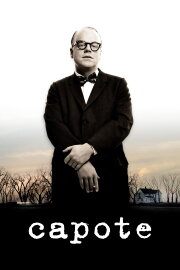
Famed writer Truman Capote, southern born and bred but now part of the New York City social circle, is growing weary of his current assignment of writing autobiographical type pieces for the New Yorker. After reading a newspaper article about the just occurred November 14, 1959 cold blooded murders of the Clutter family in their rural Kansas home, Truman feels compelled to write about that event as his next article. So he and his personal assistant Nelle Harper Lee, also a so... (Full plot summary below)
Enjoy FREE movies and series with your Prime (USA) subscription or when you start a 30-day free trial!
| Movie Source | Available | Offers | Added | Views | Quality | Format | Rating | Link | Share |
|---|---|---|---|---|---|---|---|---|---|
 | UK only | 1 Month Free Trial | 09 May 2021 | 2588 | HD | Watch OnlineStream Instantly | 62% |  Report: Broken Link Report: Broken Link |   |
| USA only | 1 Month Free Trial | 16 Dec 2023 | 2562 | HD | Watch OnlineStream Instantly | 84% | Report: Broken Link | |
| IRELAND only | 1 Month Free Trial | 27 Mar 2016 | 2052 | HD | Watch OnlineStream Instantly | 93% | Report: Broken Link | |
 | UK only | 30 Day Free Trial | 28 Aug 2015 | 517 | HD | Watch OnlineStream Instantly | 88% | Report: Broken Link | |
![Its HD [Capote]](/images/logos/icons/itshd.png) | WORLDWIDE | ? | 01 Nov 2015 | 3241 | HD | Watch OnlineStream Instantly | 84% | Report: Broken Link | |
 | UK only | 30 Day Free Trial | 30 Sep 2025 | 418 | HD | Watch OnlineStream Instantly | 47% | Report: Broken Link | |
 | UK only | Free Credit | 01 Sep 2018 | 168 | HD | Watch OnlineStream Instantly | 37% | Report: Broken Link | |
 | WORLDWIDE | ? | 20 Oct 2013 | 66 | HD | Watch OnlineStream Instantly | 16% | Report: Broken Link | |
 | WORLDWIDE | ? | 31 Jan 2014 | 21 | SD / TV | Watch OnlineStream Instantly | 22% | Report: Broken Link | |
 | WORLDWIDE | ? | 05 Feb 2020 | 301 | HD | Watch OnlineStream Instantly | 7% | Report: Broken Link | |
 | WORLDWIDE | ? | 21 Oct 2016 | 37 | SD / TV | Watch OnlineStream Instantly | 8% | Report: Broken Link | |
Links compiled using automated software. Availability of offers subject to change / might be region specific / out of date.
| Movie Source | Available | Offers | Added | Views | Quality | Format | Rating | Link | Share |
|---|---|---|---|---|---|---|---|---|---|
| UK only | 30 Day Free Trial | 17 Sep 2024 | 2595 | SD / DVD | DVD RentalRent by Post | 91% |  Report: Broken Link Report: Broken Link | |
 | UK only | N/A | 17 Sep 2024 | 57 | SD / DVD | DVD RentalRent by Post | 17% | Report: Broken Link | |
 | USA only | 1 Month Free Trial | 17 Sep 2024 | 224 | SD / DVD | DVD RentalRent by Mail | 5% | Report: Broken Link | |
| USA only | 1 Month Free Trial | 17 Sep 2024 | 14281 | SD / DVD | DVD RentalRent by Mail | 89% | Report: Broken Link | |
| Movie Source | Available | Offers | Added | Views | Quality | Format | Rating | Link | Share |
|---|---|---|---|---|---|---|---|---|---|
| UK only | 30 Day Free Trial | 27 Nov 2025 | 332 | HD / BR | Blu Ray RentalRent by Post | 66% | Report: Broken Link | |
| UK only | N/A | 27 Nov 2025 | 35 | HD / BR | Blu Ray RentalRent by Post | 17% | Report: Broken Link | |
| USA only | 1 Month Free Trial | 17 Sep 2024 | 590 | HD / BR | Blu Ray RentalRent by Mail | 10% | Report: Broken Link | |
| USA only | 1 Month Free Trial | 27 Nov 2025 | 10037 | HD / BR | Blu Ray RentalRent by Mail | 90% | Report: Broken Link | |
Famed writer Truman Capote, southern born and bred but now part of the New York City social circle, is growing weary of his current assignment of writing autobiographical type pieces for the New Yorker. After reading a newspaper article about the just occurred November 14, 1959 cold blooded murders of the Clutter family in their rural Kansas home, Truman feels compelled to write about that event as his next article. So he and his personal assistant Nelle Harper Lee, also a southern born New Yorker and an aspiring writer of her own, head to Kansas to research the story first-hand. Truman hopes to use his celebrity status to gain access to whomever he needs, such as to Laura Kinney, a friend of the Clutter daughter she who discovered the bodies, and to Alvin Dewey, the lead police investigator and also a Clutter family friend. If his celebrity doesn't work, Truman will grease the wheels by whatever means necessary. When the police eventually charge suspects, two young men named Dick Hickcock and Perry Smith, Truman uses those same tactics to gain access to them. Truman's fascination with the story makes him believe that he can revolutionize writing by expanding the germ of the article into what he calls a non-fiction novel. His personal involvement also changes as he grows emotionally attached to Perry, the seemingly sensitive and thus probable submissive in the criminal pairing, thus Truman becoming part of the story itself. Article or non-fiction novel, Truman knows that he has to take it to its natural conclusion, something which he cannot force. But also missing are the details of the November 14, 1959 event itself, something that neither Dick or Perry have divulged even in testimony.
Leave your thoughts about Capote.
| Dallas ObserverRobert WilonskyHow often does one see a masterpiece about a masterpiece? |
| Christian Science MonitorPeter RainerOn the personal betrayals that accompany Capote's ache for literary transcendence. The betrayals were necessary to create "In Cold Blood." This is why Capote is such an unsettlingly ambiguous experience. |
| USA TodayClaudia PuigIn Capote, Philip Seymour Hoffman's brilliant transformation into the mannered writer takes your breath away. |
| Wall Street JournalJoe MorgensternActor-turned-writer Dan Futterman's smart, subtle screenplay, which explores both Capote's determination to turn murder into literature and the deeply troubling questions he raised in the process. |
| The New YorkerDavid DenbySmall-scaled and limited, Capote is nevertheless the most intelligent, detailed, and absorbing film ever made about a writer's working method and character--in this case, a mixed quiver of strength, guile, malice, and mendacity. |
| Film ThreatEllen MarshallOne of the most beautifully stark, yet provocative and powerful films of 2005 has to be Capote. Phillip Seymour Hoffman, who gives his finest screen performance to date, literally becomes Truman Capote through effete mannerism, nasaly voice & self-absorbed tone. |
| EmpireKim NewmanAn outstanding film, showcasing a great performance, at once celebrating, analysing and criticising an important writer and his major book. You'll appreciate it more if you've read "In Cold Blood" recently and have seen enough footage of the real Truman Capote to know Hoffman is underplaying. |
| Baltimore SunMichael SragowJust when you might give up on young American film directors making art the way Bergman and Kurosawa did, along comes Bennett Miller's quiet, tumultuous Capote. |
| Portland OregonianShawn LevyThis is an awesome performance in an outstanding film, a film worthy, if you can imagine, of the book at its heart. |
| Washington PostStephen HunterThe genius of the film, besides Hoffman's stunning performance, is that it knows exactly how much is enough. It never overplays, lingers or punches up. |