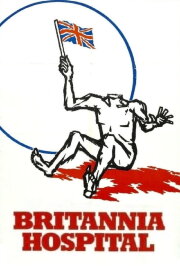
Mick Travis (Malcolm McDowell) is a reporter who is about to shoot a documentary on Britannia Hospital, an institution which mirrors the downsides of British Society. It's the day when the Queen Mother is to visit the hospital to inaugurate a new wing, where advanced (and sinister) scientific experiments led by Professor Millar (Graham Crowden) will take place. Everybody in the hospital, from the cooks who refuse to cook, to the painters who couldn't care less about getting t... (Full plot summary below)
FREE with your Prime (USA) subscription or when you start a 30-day free trial!
| Movie Source | Available | Offers | Added | Views | Quality | Format | Rating | Link | Share |
|---|---|---|---|---|---|---|---|---|---|
 | UK only | 1 Month Free Trial | 09 Jun 2024 | 3292 | HD | Watch OnlineStream Instantly | 67% |  Report: Broken Link Report: Broken Link |   |
| USA only | 1 Month Free Trial | 18 Nov 2025 | 5615 | HD | Watch OnlineStream Instantly | 99% | Report: Broken Link | |
| IRELAND only | 1 Month Free Trial | 18 Sep 2023 | 4839 | HD | Watch OnlineStream Instantly | 84% | Report: Broken Link | |
 | UK only | 30 Day Free Trial | 02 Apr 2026 | 770 | HD | Watch OnlineStream Instantly | 90% | Report: Broken Link | |
![Its HD [Britannia Hospital]](/images/logos/icons/itshd.png) | WORLDWIDE | ? | 03 Feb 2021 | 3442 | HD | Watch OnlineStream Instantly | 96% | Report: Broken Link | |
 | UK only | 30 Day Free Trial | 03 Nov 2020 | 417 | HD | Watch OnlineStream Instantly | 37% | Report: Broken Link | |
 | UK only | Free Credit | 10 Apr 2016 | 144 | HD | Watch OnlineStream Instantly | 49% | Report: Broken Link | |
 | WORLDWIDE | ? | 30 Aug 2017 | 92 | HD | Watch OnlineStream Instantly | 15% | Report: Broken Link | |
 | WORLDWIDE | ? | 01 Jul 2019 | 13 | SD / TV | Watch OnlineStream Instantly | 11% | Report: Broken Link | |
 | WORLDWIDE | ? | 09 Jan 2015 | 109 | HD | Watch OnlineStream Instantly | 22% | Report: Broken Link | |
 | WORLDWIDE | ? | 15 Jun 2023 | 2 | SD / TV | Watch OnlineStream Instantly | 9% | Report: Broken Link | |
Links compiled using automated software. Availability of offers subject to change / might be region specific / out of date.
| Movie Source | Available | Offers | Added | Views | Quality | Format | Rating | Link | Share |
|---|---|---|---|---|---|---|---|---|---|
| UK only | 30 Day Free Trial | 17 Oct 2020 | 1566 | SD / DVD | DVD RentalRent by Post | 78% |  Report: Broken Link Report: Broken Link | |
 | UK only | N/A | 17 Oct 2020 | 25 | SD / DVD | DVD RentalRent by Post | 23% | Report: Broken Link | |
 | USA only | 1 Month Free Trial | 17 Oct 2020 | 18 | SD / DVD | DVD RentalRent by Mail | 13% | Report: Broken Link | |
| USA only | 1 Month Free Trial | 17 Oct 2020 | 3314 | SD / DVD | DVD RentalRent by Mail | 88% | Report: Broken Link | |
| Movie Source | Available | Offers | Added | Views | Quality | Format | Rating | Link | Share |
|---|---|---|---|---|---|---|---|---|---|
| UK only | 30 Day Free Trial | 20 Aug 2015 | 183 | HD / BR | Blu Ray RentalRent by Post | 73% | Report: Broken Link | |
| UK only | N/A | 20 Aug 2015 | 55 | HD / BR | Blu Ray RentalRent by Post | 18% | Report: Broken Link | |
| USA only | 1 Month Free Trial | 17 Oct 2020 | 846 | HD / BR | Blu Ray RentalRent by Mail | 5% | Report: Broken Link | |
| USA only | 1 Month Free Trial | 20 Aug 2015 | 3713 | HD / BR | Blu Ray RentalRent by Mail | 86% | Report: Broken Link | |
Mick Travis (Malcolm McDowell) is a reporter who is about to shoot a documentary on Britannia Hospital, an institution which mirrors the downsides of British Society. It's the day when the Queen Mother is to visit the hospital to inaugurate a new wing, where advanced (and sinister) scientific experiments led by Professor Millar (Graham Crowden) will take place. Everybody in the hospital, from the cooks who refuse to cook, to the painters who couldn't care less about getting their work done, to a cannibalistic African dictator (à la Idi Amin Dada Oumee) whom demonstrators want expelled from the hospital and tried, will contribute to making Her Majesty Queen Elizabeth's visit (and Mick Travis's life) a true nightmare.
Leave your thoughts about Britannia Hospital.
| Mountain Xpress (Asheville, NC)Ken HankeThe bitterness of the satire has served to marginalize Anderson's final chapter. See it, but be aware that it's a chilly blast of unpleasantly cold air. |
| Ozus' World Movie ReviewsDennis SchwartzThis attempt at Swiftian satire wasn't too swift. |
| User ReviewPavandeep SWhat a film, the feeling I got of watching this film was of how long could it actually continue, I was stupefied. A zombie and a mob that was both leftist and revolutionary. It was out of this world, Lindsay Anderson continues to impress me. This film really was brilliant. A satire and a parody and an attack on society as it was developing in Britain. The scum of the Earth, angered and distasteful rise up against a government, an attack on the way the world was developing, people left behind and a satire on the different individuals of British society. It was honestly wicked, the camera, used a lot of long takes and povs and the story was really tight, like a boiling-pot at times. |
| User ReviewBrad WCriminally under-rated, this is every bit as good as both If and O Lucky Man (that are masterpieces in themselves). Nobody gets out of this film alive. A dark and comic masterpiece. |
| User ReviewDanny DAmazing! Lindsey Anderson completes his trilogy with this surreal and hilarious social commentary. McDowell is great as usual, the direction is innovative and the story is really intelligent. Highly recommended. |
| User ReviewEmeka WUnfairly scorned at the time of its realease Andersons final part of his Mick Travis films is a scathing attack on pretty much everything political . Mad Surgeons ,stoned tV makers,angry union bosses no one escapes Andersons venom here as all are as guilty as each other. A film which given todays political climate harks back to a day when the battlelines were more clearly drawn |
| User ReviewVincent BControversial follow-up to 'If' and 'O Lucky Man'. I've just seen this after years of wanting to, and it's not a let down. Amazing cast, amazing script. Best British film of the 80s? I can't think of anything better. |
| User ReviewKevin PArrr this film scared the living day lights out of me when i first watched it, again stars my uncle Maclcolm Macdowell and made me cry when he gets chopped up and stiched together |
| User ReviewVictor MAs the final chapter in the 'Mick Travis trilogy', which began with if.... and continued through O, Lucky Man!, Britannia Hospital may register as something of a disappointment. But taken on its own terms, this is a strong (if excessively sour) satire of Thatcher's Britain. Malcolm McDowell, playing Travis of course, is more of a supporting character here, with the lion's share of screen time going to Graham Crowden in a delightfully unhinged performance as Dr Millar (one of the characters he played in O, Lucky Man!), a genius/mad scientist who is hoping to unveil his newest 'creation' for the Queen, who's paying a visit to the titular hospital today. As luck would have it, the kitchen staff at Britannia Hospital have gone on strike, with other staff members joining them in solidarity. Meanwhile a mob of protestors have assembled outside to protest the fact that a brutal African dictator is being housed in Britannia Hospital's private ward, where he receives first-class treatment. And as mentioned McDowell himself is on hand as Mick Travis, the cynical exposé journalist attempting to break open a story on Dr Millar. It's all a bit of a mess, but this of course suits the material. If the film has one major flaw, it's the fact that Miroslav Ondricek wasn't on hand to photograph the film; his replacement, Mike Fash, is a competent cinematographer but doesn't shoot the film like a comedy. Consequently, a number of gags pass right by the viewer almost without being noticed. It is nevertheless a fascinating film, one that rewards repeat viewings, If you can get past the film's ultra-pessimistic tone. |
| User ReviewDaniel MIn the 1950s and 1960s Lindsay Anderson was hailed as a visionary, with If... receiving the Palme d'Or and widespread critical acclaim. In the 1970s, he was regarded as intelligent but indulgent, with O Lucky Man! dividing critical opinion upon its release. By the 1980s, he was branded obsolete, with Britannia Hospital receiving the worst notices and lowest box office of his career. In hindsight that is a crying shame, since the film is both a return to form from O Lucky Man! and one of the most underrated films of the early-1980s. Britannia Hospital is the third and final instalment of the Mick Travis trilogy, coming nearly nine years after O Lucky Man!. Having been the centrepiece of the last two films, Travis (played by Malcolm McDowell) takes only a peripheral role here â" he has risen from schoolboy revolutionary to coffee salesman and filmstar, only to wind up as a muckraking reporter with two stoned technicians. We can see through the trilogy a shift in semi-autobiographical emphasis from Anderson (Ifâ¦.) to McDowell (O Lucky Man!) and finally the nation as a whole. The film's biggest improvement on O Lucky Man! is the quality and integrity of its narrative. O Lucky Man! had so much to do, and so many stories to tell, that it ended up spreading itself too thin to achieve a knockout blow: it resembled pouring a pint of stout onto a very wide saucer. By confining itself to the events of a single day, in a single location, Britannia Hospital is more readily focussed. Even though it looks at many different groups of people, it succeeds as a microcosm of Britain in the same way that Ifâ¦. did, and manages to be more universal even when it drifts into outright horror or fantasy. Britannia Hospital is also a very unusual and interesting mix of genres. It is on one level a farce, albeit one with a great deal more sophistication and ambition than the Carry On series or the work of Blake Edwards. On another level, it is a political drama, in which the organised and politicised working classes take on both the middle-class managers and the upper class establishment embodied by the private patients and 'HRH'. On a further level, it is a full-blooded horror movie which draws on the traditions of Hammer and grand guignol. Leonard Rossiter's snarling and repressed manager is in stark contrast to Graham Crowden's Rotwang-like mad scientist, in a performance reminiscent of Vincent Price in Theatre of Blood. Britannia Hospital is primarily a lament or requiem of modern Britain. By comparing the state of the nation to that of a hospital constantly facing a crisis, Anderson is lambasting both the old guard and the post-war governments which attempted to brush them aside. Where O Lucky Man! skirted around the notion of champagne socialists and the corruption of politicians and lawmakers, Britannia Hospital launches a vitriolic attack on all sides from all fronts, showing how much the post-war dream has been eroded by self-interest and misjudgement on the part of everyone. In light of Anderson's life-long association with the British Left, you would expect such a thesis to treat the treat union movement with a certain amount of sympathy. But Anderson is merciless, almost to the point of bitterness, in pointing out the duplicity of the union movement with regard to the aims of the people it claims to defend. The film begins with an absurdist vignette of an old man with hypothermia. The ambulance drivers barter their way past the picket line, only for the manto be left on a stretcher in the corridor because both the nurses and porters have clocked off for the night. As Rossiter's name appears he breaths his last; through little more than pedantry and selfishness, the health service is prevented from doing the one thing it was set up to do. Britannia Hospital finds the public and the private co-existing uneasily in the new welfare state. The plight of ordinary patients, for whom the NHS is a matter of life or death, is contrasted with the attitudes of the VIP patients in the private ward, who demand to be treated like royalty. Their number includes a child-eating dictator (a further nod to O Lucky Man!) who has taken up residence in his own private ward. When the catering staff go on strike, matron is forced to offer the private patients oranges for breakfast; her efforts are met with anger, disgust and racial epithets, with one general remarking: âI didn't spend forty years in India to end up with a lot of wogs!â?. The Britain depicted in Britannia Hospital is a country which is deeply fractured, being torn apart by violence, injustice, inequality and the threat of revolution. But again, Anderson doesn't just fall into the trap of making propaganda, turning out his own private Battleship Potemkin. He characterises Britain as a nation about to turn its back not merely on socialism and the achievements of the welfare state, but on idealism and intelligence as a whole in favour of the simplicity of brute force and tribal warfare. The riot scenes are kinetic and frightening, but they also have a heart-breaking quality, summed up by an image of a protester offering a riot policeman a flower, only to get her head smashed in with his baton. The film also has very little time for the media, with both sets of film crews coming in for a lot of stick. Mick's technicians (one of whom is played by Mark Hamill) are portrayed as sensationalist and lazy: while Mick is crawling around the hospital sticking his neck out to get the footage, they get stoned and laugh themselves stupid watching documentaries about battery hens. The BBC fare no better, coming over as sycophants who fabricate events around Dr. Millar to inflate his ego and make him feel more like a God. Despite Anderson's depression about this state of affairs, the film manages to tackle these pertinent and vital political issues without ever slipping into self-pity. Anderson's sense of righteous anger at what is unfolding is matched by fear on his part for the future of the country his loves, and by a feeling of pathos on the part of the characters. The humour is satirically vainglorious â" for instance on the soundtrack, where Alan Price plays 'Rule Britannia' very slowly for maximum irony. There is a comparison between Britannia Hospital and the work of Pink Floyd around the same period, namely The Wall, the subsequent film helmed by Alan Parker, and The Final Cut which was accompanied by a 20-minute short. Britannia Hospital itself shares certain features with The Fletcher Memorial Home: it is a bastion for a bygone age based upon privilege and order, which has since been eroded and rendered all-but-obsolete. Running through all these projects is a theme of missed chances and regret, which will echo through the plight of future generations. Britannia Hospital is also an attack on positivism, showing the march of scientific progress continuing at the expense of mankind. One of the core themes of modernist art is Man feeling lost in a world which is constantly evolving, and which He at best struggles and at worst fails to control. In this case we have Dr. Millar, up to his old tricks again, as the maverick private pioneer being sponsored by (but not controlled by) the state. Where O Lucky Man! felt in places like The Island of Dr. Moreau, the horror elements of Britannia Hospital are a retuning of Frankenstein. It takes a story about humans trying to live forever, leaves in Mary Shelleyâ(TM)s warnings about the dangers of progress, and adds disturbing allegories for social engineering. What begins with Travis finding foetuses in jars or freezers full of limbs culminates in a terrifying sequence where his head is grafted onto Millar's monster â" it comes to life, only to attack its creator and disintegrate. The gore in these scenes is worthy of anything in Sweeney Todd or Lucio Fulci, coming virtually out of nowhere and being terrifying gruesome. But by far the highlight of Britannia Hospital is its final scene. With a cross-section of society gathered, from royalty to revolutionaries, Millar gives a passionate speech about humanity's need to reinvent itself and the inherent injustices of the status quo. He concludes by revealing 'Genesis', a giant brain which begins to recite from Hamlet before repeating the line 'How like a God'. It's a wonderfully judged paean complimented by creepy special effects and Crowden as his absolute best. There are flaws with Britannia Hospital. Some of the broader, more farcical comedy doesn't work, such as the clichà (C)d sequence of Travis crawling out of the mass of people. And its sexual politics have not dated all that well: the random sex scene with the nurse feels jarring and unnecessary. But as both a plea for intelligence in a time of crisis and a savage social satire, it still holds up both on its own and as a fine conclusion to the trilogy. It's a twisted tale of compassion and caustic humour, and remains a hidden gem of British cinema. |